mirror of
https://github.com/Kpa-clawbot/meshcore-analyzer.git
synced 2026-10-15 16:29:55 +00:00
4e91c5cf0bb2e35e12a074580f4d993c32cb6f00
53
Commits
| Author | SHA1 | Message | Date | |
|---|---|---|---|---|
 Alex BandClaude Opus 5.5 Alex BandClaude Opus 5.5
|
4e91c5cf0b |
perf(analytics): opt-in pauseWhenIdle skips recomputes nobody reads (#2164)
## Summary The analytics recomputers (#1240) recompute eleven snapshots (topology, RF, distance, channels, hash collisions, hash sizes, roles, two clock-skew views, retransmissions, direct-heard) on a fixed interval, 300 s by default, whether or not anyone reads them. That is the right trade for a busy instance: reads always hit a warm cache. On a quiet one it means most of the server's allocation goes on results nobody looks at. Measured on one production instance (2 vCPU / 2 GB): - topology, RF and hash-sizes were each **read 23 times in 45 hours** while being recomputed every 5 minutes; - `analyticsRecomputer.runOnce` accounted for **30% of all bytes allocated** (121 GB of 391 GB in 45 h); - garbage collection was 87% of the process's CPU (30 s CPU profile: `gcDrain` 39.9 s of 45.9 s sampled), with an 805 MB live heap against a 1 GiB `GOMEMLIMIT`, so allocation rate translates directly into collector time. This PR adds an **opt-in** `analytics.pauseWhenIdle`: - a recomputer's tick is skipped when nothing has read its snapshot since the previous compute, and the recomputer is marked paused; - the next read still returns immediately with the snapshot it holds (`Load` stays non-blocking, as #1240 requires), and makes a non-blocking send that wakes the loop to recompute; reads after that get the fresh snapshot and the ticker resumes from there. **Default is off**, so behaviour is unchanged unless an operator turns it on. The trade-off for operators who do: the first read after a quiet spell can show a snapshot older than the interval (refreshed seconds later). It is documented in `config.example.json`. No existing issue covers this. ## Config example Off by default. To turn it on, add one key to the existing `analytics` block in `config.json`: ```json "analytics": { "defaultIntervalSeconds": 300, "pauseWhenIdle": true } ``` Nothing else changes: per-endpoint `recomputeIntervalSeconds` still apply while an endpoint is being read. There is no UI change, so no screenshot. ## Performance Staging A/B: the same 30 minutes of real production API traffic (5,640 requests from a day's nginx log, replayed at 2x against a copy of the production database with the live MQTT feed), on `master` and on this branch with `pauseWhenIdle: true`, each after a restart and warm-up. Allocation is the delta of `/debug/pprof/allocs` across the replay: | during the replay | master | this PR | |---|---|---| | allocated by `analyticsRecomputer.runOnce` | 459.7 MB | **53.4 MB (-88%)** | | total allocated by the process | 3,704 MB | 3,372 MB (-9%) | | GC cycles | 52 | 41 | | requests: p50 / p95 / errors | 9.9 ms / 57.0 ms / 0 | 10.4 ms / 60.1 ms / 0 | The replayed traffic included real analytics reads, so the paused recomputers were woken by them; the remaining 53 MB is that. Over 15 minutes each recomputer only ticks about three times, so on a longer quiet period the saving grows with the idle time. GC count and CPU on this shared host vary between runs on their own, so the allocation figures are the claim, not the GC count. There is no Go benchmark for this change: the behaviour is "how many computes happen in a period of no reads", which the tests below assert directly (16 computes on master vs at most 2 here over the same idle period). ## Tests - Red commit `24056c57`: config field, accessor stub and an unused recomputer flag, plus tests. Three fail on the stub: - `TestAnalyticsRecomputer_PauseWhenIdleSkipsUnreadTicks`: an unread recomputer with a 20 ms interval computes at most twice in 300 ms (16 times on the stub); - `TestConfig_AnalyticsPauseWhenIdle`: `pauseWhenIdle: true` enables it, absent or nil config leaves it off; - `TestStartAnalyticsRecomputers_AppliesPauseWhenIdle`: all eleven recomputers receive the flag. - Also added, passing on both commits on purpose: a read on a paused recomputer returns the existing snapshot and triggers a refresh; a recomputer that is being read keeps ticking; the default (off) keeps ticking unread. - Green commit `19de3636`: the behaviour, `config.example.json` entry with `_comment_pauseWhenIdle`, and the `Load` doc comment. - `go test -race` on the recomputer, warm-up (#1659) and config tests, three runs: pass. `make test`: 16 of 16 modules pass. The frontend tests that read `config.example.json` pass. ## Review notes - `roles` reads the nodes-clock-skew snapshot inside its own compute, which counts as a read, so that dependency keeps its source fresh while roles is in use. - The #1659 warm-up gate is untouched: a skipped tick never marks a first pass done. - Config documented per WORKFLOW.md section 7. Customizer (AGENTS.md rule 8): it is an operator setting, not a display value; no customizer entry proposed. ## SonarLint SonarQube Community rules (the SonarLint engine) were run on the files this PR touches, and only issues on lines it adds are listed. - No issues on the added lines. ## Checked against the repo rules - Rebased onto `master` (`673442cc`). Each red commit was re-run and still fails on its assertions; each green commit passes (TDD.md). - `make test`: all 16 modules pass. Frontend suites: all pass except `test-issue-1956-release-routing.js`, which needs CI's `GITHUB_REF_NAME` and fails the same way on `master` locally (#2160 addresses it). - No private data: test fixtures and examples use the codes the existing tests use (SJC/SFO/LAX, `#be`-style scopes). - No new `map[string]interface{}`, no hard-coded colours. `git add` was explicit, and there is one logical change per commit. 🤖 Generated with [Claude Code](https://claude.com/claude-code) https://claude.ai/code/session_01KaR4xu8gVykQBkH8yG8m6H --------- Co-authored-by: Claude Opus 5.5 <noreply@anthropic.com> |
||
|
Alex BandClaude Opus 5.5
|
352a0ccd19 |
feat(region-filter): configurable region quick picks (#2170)
## Summary **Independent of every other open PR.** Choosing a pick saves the selection, redraws the control and notifies the page's listeners itself, exactly as a click in the control does, so it re-queries straight away whether or not #2168 (`setSelected` notifies) is merged; with both in, nothing fires twice. Region quick picks are named groups of region (IATA) codes, offered as one-tap choices inside the region filter, e.g. "Northern California" for a dozen airport codes instead of ticking each box. One deployment has been injecting these into the page through an nginx `sub_filter` and a script that wraps `window.RegionFilter`; this makes them a configured feature. ```jsonc "regionQuickPicks": [ { "name": "Northern California", "description": "Bay Area and Sacramento observers.", "regions": ["SJC", "SFO", "OAK", "SMF"] } ] ``` - **Server:** `GET /api/config/region-quick-picks` returns the groups cleaned up: names and codes trimmed, codes upper-cased and de-duplicated in their configured order, groups without a name or codes dropped, at most 20 groups of 200 codes, always a list. `/api/config/regions` is unchanged. - **Region filter:** loads the groups with the regions and offers every group with at least one observer today, inside the region control: - dropdown layout: rows of the same kind as **All** (checkbox and bold name), directly under All with a divider before the single regions; the row is ticked while that pick is the selection, ticking it selects the pick and closes the menu, unticking goes back to all; - pill layout: the picks lead the same bar, set off from the single regions by a thin divider. - A tap selects the group's codes that have an observer and re-queries straight away. - The selector then reads the group's name ("South Bay ▾") instead of "2 Regions", and the button shows as pressed. Selecting the same codes by hand does the same. - Tapping the active group again goes back to all regions. - A failed fetch, or no configured groups, leaves the filter exactly as before. - **Mobile:** the rows take the menu's 44 px row height under `(pointer: coarse)`; the pill-bar picks reuse `.region-pill` and its touch target. Inside `.filter-bar` (Packets) the existing touch rule for inputs made every region checkbox a 44 px square; the checkbox is now 20 px and the 44 px row is the tap target. - **Semantics:** like every region filter, a group means "heard by observers in these regions", not "located there"; `config.example.json` says so. No existing issue covers this. ## Screenshot Nodes page with two picks configured (example config below), after tapping **South Bay**: the pick and its codes (SJC, MRY) are selected, and the list re-queried for them. Taken against `test-fixtures/e2e-fixture.db`. 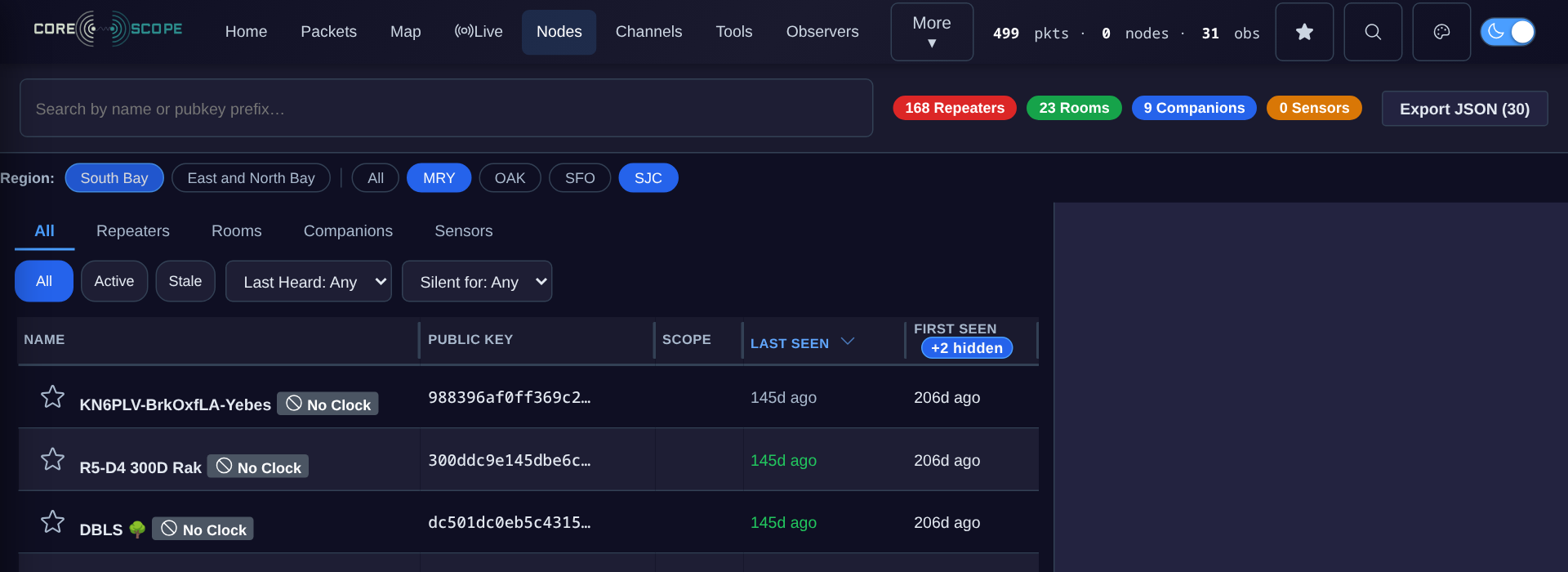 ## Config example ```json "regionQuickPicks": [ { "name": "South Bay", "description": "San Jose and Monterey observers", "regions": ["SJC", "MRY"] }, { "name": "East and North Bay", "description": "Oakland and San Francisco observers", "regions": ["OAK", "SFO"] } ] ``` Each pick needs a `name` and at least one code; `description` is optional (shown as the tooltip). Codes are trimmed, upper-cased and de-duplicated; a pick with no code that has an observer today is not shown. At most 20 picks of 200 codes. ## Browser validation The branch's server was run locally against a migrated copy of `test-fixtures/e2e-fixture.db` (observers in MRY, OAK, SFO, SJC) with three groups configured: "South Bay" (SJC, MRY, SCZ), "East and North Bay" (OAK, SFO, sts) and "Nowhere yet" (XXX). Checked in headless Chromium: | check | desktop 1280 px | phone 390 px (touch) | |---|---|---| | groups shown | South Bay, East and North Bay ("Nowhere yet" hidden) | same | | tap South Bay selects | SJC, MRY (SCZ has no observer) | same | | next `/api/packets` request | `region=SJC,MRY` | `region=SJC,MRY` | | selector label | "South Bay ▾" | "South Bay ▾" | | second tap | back to all regions | same | | button height | 24 px | 44 px | | page wider than viewport | no | no | | page errors | none | none | Checked on Packets (dropdown layout) and Nodes (pill layout). Three layout problems found this way on the phone were fixed before opening: a sideways-scrolling row clipped at the screen edge, the selector squeezed into a narrow column (the filter group is a non-wrapping flex row), and the two wrapped rows spread apart on Nodes (`align-content`). **Revision 1:** the first version put the picks in a separate row beside the selector; they moved inside the dropdown. Re-checked with a 14-region list and three picks on Packets: desktop 1280 px dark and phone 390 px light both keep the menu on screen (menu 340 px wide, page not wider than the viewport), the pick closes the menu and the trigger names the pick. **Revision 2:** picks are checkbox rows like **All** instead of chips. Re-checked on Packets at 1280 px dark and 390 px light: rows render bold under All, the divider separates the single regions, ticking a pick ticks its codes and names the trigger, no sideways scroll. Unrelated and not changed: on Nodes at 390 px the region row (existing pills included) starts flush with the screen edge. ## Tests - Red commit `81ea67d6`: the config type, a stub normaliser and endpoint returning nothing, and tests. - Go: cleaning (trim, upper-case, de-duplicate, drop incomplete groups), caps, nil config, and the endpoint's JSON. - Frontend, `tests/e2e/test-region-quick-picks.js` (moved from `tests/unit/` in `fced69a7`; it needs jsdom, so it runs in the E2E job like `test-table-sort.js`): the real `region-filter.js` in **jsdom** against faked config endpoints. Nine cases: rendering and hiding groups with no observer, selecting and re-querying, the selector label, toggling back, a hand-made selection marked active, the pill layout, no groups, a failed fetch, HTML escaping. Seven fail on the stub, all on assertions. - Green commit `0e33210e`: the implementation, styles, `config.example.json` (`regionQuickPicks` + `_comment_regionQuickPicks`), `docs/api-spec.md`, and the OpenAPI route list (`TestOpenAPICompleteness` requires it). The jsdom test also had a cross-realm comparison bug fixed in this commit (`Array.from` on arrays coming out of the jsdom window). - `make test`: 16 of 16 modules pass. Frontend suites: 195 of 196; the one failure, `test-issue-1956-release-routing.js`, needs CI's `GITHUB_REF_NAME` and fails the same way on `master` locally. - Red commit `f991060d` (revision): picks live inside the dropdown menu before the checkboxes, choosing one closes the menu, and in the pill layout they share the region bar; two fail on assertions against the old layout. Green commit `1f720e35`. Frontend 195 of 196 (same environment-only failure). - Red `134f5256` / green `da0adb50` (second revision): picks are checkbox rows between All and the single regions with a divider, no chips in the menu; ticking and unticking a pick row. The green commit also repairs `style.css`: `1f720e35` had prepended its block to the top of the file (its edit matched an earlier `.region-pill {`) and left the previous rules in place. The file now differs from `master` by 13 lines. ## Review notes - Groups are offered only when at least one of their codes appears in `/api/config/regions`, and only those codes are selected. The stored selection is pruned to known codes on load anyway, so selecting absent codes would not survive a reload. - Customizer (AGENTS.md rule 8): groups are operator configuration; a customizer editor could come later. ## SonarLint SonarQube Community rules (the SonarLint engine) were run on the files this PR touches, and only issues on lines it adds are listed. - **Fixed** in `b84ace4e`: - `normalizeQuickPickCodes` split out of the config normaliser (S3776, 17 > 15); - a comment on why a failed quick-pick fetch is ignored (S2486); - `for…of` in `activePick` (S4138); - in the tests: `node:` specifiers, `includes()`, and an explicit string comparator for sorted selections (S7772, S7765, S2871). - **Kept on purpose:** - S2486 is still reported on that `catch`. Swallowing the error is the intended behaviour: the filter works as before, just without picks. - S1523 on the `vm` test loader, as above. ## Checked against the repo rules - Rebased onto `master` (`673442cc`). Each red commit was re-run and still fails on its assertions; each green commit passes (TDD.md). - `make test`: all 16 modules pass. Frontend suites: all pass except `test-issue-1956-release-routing.js`, which needs CI's `GITHUB_REF_NAME` and fails the same way on `master` locally (#2160 addresses it). - No private data: test fixtures and examples use the codes the existing tests use (SJC/SFO/LAX, `#be`-style scopes). - No new `map[string]interface{}`, no hard-coded colours. `git add` was explicit, and there is one logical change per commit. 🤖 Generated with [Claude Code](https://claude.com/claude-code) https://claude.ai/code/session_01KaR4xu8gVykQBkH8yG8m6H --------- Co-authored-by: Claude Opus 5.5 <noreply@anthropic.com> |
||
|
efitenandClaude Opus 5.5
|
b2cda21a27 |
feat(server): companion linking routes, device tokens and bearer auth (#2175)
Part 2 of 3 for #2173 (companion linking): the server routes, bearer auth and the link handshake. Builds on #2174 (merged); `upstream/master` is merged in, so the diff shows only this part. Everything here is behind `userManagement.enabled` and answers 404 with it off. ## Changes in this PR **Device tokens and bearer auth** - `POST /api/auth/device-token`: email + password returns a bearer token, stored as a `kind = 'device'` session with a label. Same failure answers and the same rate limit as login. - Server-enforced scope for a bearer token: `/api/auth/me`, `/api/auth/logout`, `/api/account/companions*`, `/api/account/settings`. Everything else answers 403. - A bearer header only counts when there is no session cookie, so an auth proxy that adds its own `Authorization` header does not hide a logged-in browser. Cookies never accept a device token. - The sessions list on the account API carries `kind` and `label`; logout with a bearer token revokes that device. **Linking a companion** - `POST /api/account/companions/challenge` `{pubkey}` returns `{challenge, expiresAt, host}`: 32 random bytes, single use, 5 minutes, bound to the caller and the pubkey. - `POST /api/account/companions` `{pubkey, challenge, signature, name}`: the signature is the companion's Ed25519 signature over `corescope-link:<host>:<challenge>` (`internal/sigvalidate.VerifyMessage`). The challenge is consumed in every case. - A companion linked to another account moves to the caller (the newest proof wins). Both users get a `companion.transfer` audit row and the previous owner a mail. That mail is a security notice: it is sent whatever the node notification settings are. - `GET /api/account/companions` (with `lastSeenAt` from `client_receptions`) and `DELETE /api/account/companions/{pubkey}`. - Linking does not touch the synced `meshcore-my-nodes`: a companion is not a node to monitor. - Admin user detail lists linked companions; the account data export includes companions and device sessions. **Coverage and config** - `GET /api/rx-coverage?mine=1`: only coverage of the caller's linked companions (401 when logged out, 403 for a device token). With `gaps=1` (#2172) the reply carries no `gaps` member under `mine=1`, because the track query takes one companion and cannot narrow to a set yet (`TestRxCoverageMineOmitsGaps`). - `clientRxCoverage.requireLinkedCompanion` (default off) is read and reported in `/api/config/client`, which also announces `userManagement.companionLinking`, so CoreDrive RX shows its login only where linking exists. The ingestor side is part 3. - CORS: for origins in `corsAllowedOrigins`, the device-token routes alone also allow POST/PUT/DELETE and the `Authorization` and `Content-Type` headers. No credentialed CORS. Documented in `config.example.json`. - OpenAPI and `docs/api-spec.md` cover the new routes. ## Verification - 26 new tests in `cmd/server` and `internal/sigvalidate`, among them: `TestCompanionLinkFlow`, `TestCompanionLinkRejections` (signature by another key, malformed signature, challenge bound to another pubkey, unknown challenge; reuse and expiry are covered by the store tests in #2174), `TestCompanionTransfer`, `TestCompanionTransferMailIgnoresNotificationSettings`, `TestBearerScopedRoutes`, `TestBearerIgnoredWithCookie`, `TestDeviceTokenSharesLoginRateLimit`, `TestCORSBearerRoutes`, `TestCompanionRoutesAbsentWhenOff`, `TestRxCoverageMine`, `TestRxCoverageMineOmitsGaps` (fails without the `mine == nil` guard), `TestVerifyMessage`. - `cmd/server`, `internal/sigvalidate` and `internal/users`: `go vet` and `go test ./...` green, `gofmt` clean. - The linking flow runs on analyzer.on8ar.eu since 9 October 2026 with CoreDrive RX v1.19.0 (a real companion linked through the signed challenge). ## Not in this PR - The ingestor's linked-only filter, the account page (Devices, Companions), the "My coverage" toggle and the user docs: part 3. - Per-user broker credentials and per-user API keys (non-goals in the spec). --------- Co-authored-by: Claude Opus 5.5 (1M context) <noreply@anthropic.com> |
||
|
efitenandClaude Opus 5.5
|
abbe6846ff |
feat: propose and approve hashtag channels (user management part D) (#2139)
Part D of #2128: logged-in users propose a hashtag channel, an admin approves, rejects or later revokes it, and the ingestor decrypts approved channels without a restart. It is the first consumer of a generic proposal table, and answers the request in #2092. Stacked on #2138 (part C). Review the commits after that branch; GitHub shows C's commits here until it is merged. ## The situation - An instance decrypts only the hashtag channels listed in `hashChannels`. Users who want a city or club channel shown have to ask the operator, who edits `config.json` and restarts the ingestor. - #2092 asked for a suggest-and-approve flow; a downstream fork (dborup/CoreScope#99) runs one with anonymous suggestions and a file queue. ## What this PR adds **Name rules (`internal/channel`).** `ValidateHashtagName`, mirrored in the browser: - at most 31 UTF-8 bytes including `#` (firmware `ChannelDetails.name[32]`), case preserved, `Public` refused in any case; - control, bidi, separator and format characters refused except ZWJ, plus invisible fillers (`Other_Default_Ignorable_Code_Point`, U+2800, non-ASCII spaces). Go and JS give the same verdict for every code point. **Store.** Schema v4, one generic `proposals` table (kind, subject, status pending/approved/rejected/revoked, proposer, reviewer, note). One row per (kind, subject); limits are checked in the same transaction as the change. **Server** (only with `userManagement.channelProposals.enabled`) - `POST /api/proposals`, `GET /api/account/proposals`, `GET /api/admin/proposals`, `POST /api/admin/proposals/{id}/approve|reject|revoke`. - 400 for an invalid name. 409 for a duplicate, a rejected name, or a name already in `hashChannels`/`channelKeys` ("this channel is already decrypted on this instance"). 429 over a limit (`maxPending` 100, `maxApproved` 128, `perUserPerDay` 5). - `GET /api/channels` gains `approvedChannels`, so approved channels are listed before they have traffic. With the feature off the response is byte-identical. **Ingestor.** Opens `users.db` with `mode=ro` every 60 seconds, re-validates the names, and swaps its key map through an `atomic.Pointer`. Configured channels always win, and a failed read keeps the last good set. The ingestor never writes `users.db`; AGENTS.md now says so. **Frontend.** "Propose for everyone" in the add-channel dialog, an "approved" marker in the channel list, "My proposals" on the account page, and an admin "Proposals" tab with a warning on approve. The packet detail pane now escapes the channel name: until now only the operator chose those names. Spec: [`docs/specs/2026-10-07-channel-proposals-design.md`](https://github.com/efiten/CoreScope/blob/feat/channel-proposals/docs/specs/2026-10-07-channel-proposals-design.md). ## Performance Every key is tried on each GRP_TXT that no key opens (`decodeGrpTxt`). Benchmark of that worst case: | Keys | Time per packet | |---|---| | 320 configured | 204 to 216 µs | | 320 configured + 128 approved | 272 to 320 µs | That is about +33%, linear in the key count and capped by `maxApproved`. With the feature off the decoder gets the identical map and no ticker runs. ## Verification - `internal/channel`, `internal/users` (with `-race`), `cmd/server` and `cmd/ingestor` pass locally, 53 new Go tests. The ingestor's `TestWriteStatsAtomic_SymlinkAtDestIsReplaced` needs symlink rights on Windows and fails on `master` too. - `sh test-all.sh` exits 0; the XSS gate in diff mode passes. - User-management E2E: 21 of 21 steps locally (propose, approve, the channel appears, revoke removes it). - On our staging and production instance since 7 October 2026. ## Not in this PR - Private (PSK) channels: their keys stay in the browser (#725). - Anonymous proposals. - Names that need ZWNJ (some Persian and Urdu spellings) and subdivision flags are refused, because ZWNJ and tag characters are format characters. Allowing them later only widens the rule, so no approved name gets stranded. --------- Co-authored-by: Claude Opus 5.5 <noreply@anthropic.com> |
||
|
nullrouten0andClaude Mythos 5.1
|
8b64439635 |
fix(server): keep config.json's file mode when saving the geo-filter (#2126)
`SaveGeoFilter` rewrote `config.json` through a temp file created with mode 0644, so a config an operator had made 0600 (it holds the API key and broker passwords) became world-readable after the first geo-filter save. **Fix:** stat the original and reuse its mode for the temp file. Falls back to 0644 when the stat fails. **Tests:** `config_mode_test.go` — a 0600 config stays 0600 after a save; a 0644 config stays 0644. 🤖 Generated with [Claude Code](https://claude.com/claude-code) Co-authored-by: Claude Mythos 5.1 <noreply@anthropic.com> |
||
|
efitenandClaude Opus 5.5
|
d232072f85 |
feat: optional user accounts (part A: foundation) (#2129)
Part A of #2128: optional, off-by-default user accounts. With the feature off nothing changes; with it on, visitors can register and log in, and admins manage users and use the operator actions without the API key. PR #2130 (settings sync) builds on this one. The two are meant to be merged together. ## The situation - Operator actions (geofilter save and prune, backup, perf reset) need the shared `apiKey`. There is no per-person right. - Nothing in CoreScope knows who a visitor is, so the requests in #2128 that need that (#1835, #2092, #1508, #730) have nothing to build on. ## What this PR adds **Two new Go modules** - `internal/users`: a separate `users.db` (SQLite through `modernc.org/sqlite`) with users, sessions, single-use tokens, an audit log and a mail log. Passwords use argon2id. - `internal/mailer`: a `Mailer` interface with a Brevo client (send, delivery events, webhook parsing) and an in-memory fake for tests. **Server (`cmd/server`)**, active only with `userManagement.enabled` - 24 routes, all documented in OpenAPI under the `users` tag ([`auth_routes.go`](https://github.com/efiten/CoreScope/blob/feat/user-management/cmd/server/auth_routes.go)): - auth: register, activate, login, logout, me, forgot, reset; - account: profile, password, email change with confirmation, sessions, self-delete; - admin: list, detail, disable, enable, delete, role, resend activation, manual activation, mail status refresh; - a Brevo webhook, registered only when `mail.webhookSecret` is set. - `requireAdmin` replaces `requireAPIKey` at the 7 operator call sites: the API key **or** an admin session. With the feature off it is the old API-key gate (`TestRequireAdminWithoutUserManagementIsAPIKeyGate`). - `/api/config/client` gets `userManagement: {enabled: true}` only when the service started; with the feature off the response is byte-identical. **Frontend** - `auth.js` (header account control, request helper that adds the CSRF header), `account.js` (login, register, activate, forgot, reset, confirm email, my account), `admin-users.js` (`#/admin/users`, deep-linked filters), `account.css` (theme tokens only). - On phones the top-bar control is hidden, so a conditional entry goes into the bottom-nav "More" sheet and the nav drawer. - The customizer geofilter tab and the Perf "Reset stats" button use the admin session when there is one. **Config.** A `userManagement` block (`config.example.json`, [`docs/user-guide/accounts.md`](https://github.com/efiten/CoreScope/blob/feat/user-management/docs/user-guide/accounts.md)). The Brevo key can come from `CORESCOPE_BREVO_API_KEY`. The server refuses to start when the block is enabled but incomplete. ## Security choices - Session cookie `cs_session`: HttpOnly, SameSite=Lax, Secure when `publicBaseUrl` is https. Every cookie-authenticated state change needs the `X-CS-CSRF` header and a matching Origin. - Activation needs the token **and** the account password. Without the password, an attacker who keeps re-registering a known address could get the owner to activate an account that carries the attacker's password. - Register, forgot and email change answer identically for known and unknown addresses. A password reset ends all sessions, a password change ends all other sessions, and both end outstanding email-change links. - Rate limits: login 10 per 15 minutes, register and forgot 5 per hour, per IP and per address. The bucket count is capped. `trustedProxies` makes the per-IP limits see real client IPs behind a proxy. - Server logs carry `#<user id>`, never addresses, tokens or passwords; mail-provider error texts are redacted before logging. ## Performance No change to an existing hot path with the feature off. With it on: - One `users.db` lookup per authenticated request (session by token hash). - The admin user table rebuilds its `tbody` on each filter change. `users.List` caps the result at 1000 rows (`internal/users/users.go`), which bounds the rebuild. - `map[string]interface{}` in `openapi.go`: 79 before, 78 after. ## Verification - `internal/users`, `internal/mailer` and `cmd/server`: `go vet` and `go test -race` pass locally. 121 new Go tests. - `cmd/server` with `-tags e2etest`: vet and the e2e hook tests pass. - `sh test-all.sh` exits 0. `tests/unit/test-user-management-ui.js`: 67 passing (vm, real modules). - `tests/e2e/test-user-management-e2e.js` (6 steps) passed locally against an `e2etest` build with the fake mailer and against a feature-off build. CI builds the `e2etest` binary and runs the suite on a second server (`deploy.yml`). - On a staging instance with a real Brevo key: register, activation mail delivered, activate, admin table, "Refresh status" showing sent, deferred, delivered, opened and clicked. ## Not in this PR - Settings sync (#2130), the admin dashboard, approval flows and notifications (parts B to E of #2128). - A `requireReadAuth` mode (#1835). Sessions from this PR are what such a mode would accept. - Binary size and build time with `modernc.org/sqlite` linked next to `mattn/go-sqlite3` were not measured. Their driver names do not collide. #1992 discusses the driver choice. - No Brevo webhook was configured on staging; delivery status there came from "Refresh status". --------- Co-authored-by: Claude Opus 5.5 (1M context) <noreply@anthropic.com> |
||
|
efitenandClaude Opus 5.5
|
000d9ab030 |
feat(coverage): RF noise-floor layer on the Mobile RX coverage page (#2113)
The ingestor already stores the noise floor that CoreDrive RX companions
report with each GPS fix (`client_rf_samples`, opt-in through
`clientRfSamples`, `cmd/ingestor/client_rf_sample.go:62`), but nothing
reads it back. An operator who enables it collects the data and cannot
see it. This adds the read side: `GET /api/rf-noise` and a Signal/Noise
toggle on the Mobile RX coverage page.

## What it does

- **`GET /api/rf-noise?bbox=&z=&days=`** returns a GeoJSON hex grid with
the median, quietest and noisiest noise floor per cell, in the same
shape as `/api/rx-coverage`. It is registered always and 404s unless
`clientRfSamples.enabled` is true, the same pattern as the coverage
routes.
- **Stationary samples are excluded.** A parked companion logs hundreds
of readings at one point, which would otherwise define its cell.
- **Coverage page:** a Signal/Noise toggle, rendered only when
`/api/config/client` reports `clientRfSamples: true`. The noise layer
reuses the coverage colour tokens with the axis inverted, because a
lower dBm is quieter. Tiers are at -115 and -108 dBm.
- **Deep link:** `#/rx-coverage?layer=noise` opens on the noise layer.
- **Empty and failed answers** are labelled on the map ("No RF samples
in this view yet", or a retry hint), so a blank map never reads as
"feature off".

No new configuration key: it reads the existing `clientRfSamples`
section that the ingestor already uses. Default off, so nothing changes
for an instance that has not opted in.

## Where it comes from

Ported from the efiten/CoreScope fork, where it has run on
analyzer.on8ar.eu since September (fork commits `42d09f0e`, `80581c43`,
`cde95078`). The cherry-picks conflicted with upstream's newer
`routes.go`, `types.go` and `rx-coverage.js`, so the final state was
ported by hand. The fork-only `/scopes` route that sat next to it in the
same hunk is deliberately left out.

## Performance

The query is bounded by `sampled_at` (indexed, `idx_crf_prune`) and the
bbox, aggregation is one pass plus a per-cell sort, and the response is
capped at 5000 cells. Measured on analyzer.on8ar.eu, all of Belgium
(`bbox=49.4,2.4,51.6,6.5&z=9`), from a client in Belgium, so network
time included:

| window | samples | cells | response time |
|---|---|---|---|
| 7 days | 10,835 | 241 | 0.37 s |
| 30 days | 43,303 | 429 | 0.39 s |

That table holds 45,270 rows in total. It is only read when someone
opens the noise layer, never on ingest or WebSocket paths.

## Tests

- `cmd/server/rf_noise_test.go`: 8 tests for the aggregation (median and
extremes, stationary exclusion, the cell cap, empty input) and the gate
(404 when off, even with data present). All pass, and the full
`cmd/server` suite passes locally.
- `tests/unit/test-rx-coverage-noise.js` (new, in `test-all.sh`): the
colour axis runs the right way, including both tier bounds and a string
median from the API. Slices the real function out of `rx-coverage.js`
and fails on master's copy, which has no thresholds.
- `tests/e2e/test-rx-coverage-noise-e2e.js` (new, wired in `deploy.yml`
and `scripts/non-unit-tests.json`): no toggle when the flag is off;
Noise fetches `/api/rf-noise`, draws the cells, swaps legend and
subtitle, puts `layer=noise` in the hash; a deep link opens on the noise
layer and an empty answer shows the message. 3/3 locally; against
master's `rx-coverage.js` and `roles.js`, 1/3 (only the "flag off" case
passes, as it should).
- `test-rx-coverage-viewport-e2e.js` still passes. ESLint 8 reports 0
errors on the changed files.

## Not done

- The thresholds (-115 / -108 dBm) are fitted to the fork's own data
(1,241 moving samples at the time) and are constants in
`rx-coverage.js`. Per AGENTS.md rule 8 they belong in the customizer
eventually; not in this PR.
- The E2E suite mocks the API. The real endpoint is covered by the Go
tests and by the measurements above, not by a fixture with seeded
samples.

Co-authored-by: Claude Opus 5.5 <noreply@anthropic.com>
|
||
|
efitenandClaude Opus 5
|
1ffaad8eb1 |
feat(#1794): per-IP limits and a deny list on the /ws upgrade (#1974)
Closes #1794. Follow-up to #1793, decided **before** the upgrade because the handshake is the resource being protected. - Deny list of addresses and CIDRs → 403 - Per-IP concurrent connection cap → 403 - Per-IP upgrade rate limit over a rolling minute → **429**, not 403: a temporary refusal should not read as "never come back" - Rejection counters split by cause in `/api/stats` under `websocket` ### The decision this feature lives or dies on Most CoreScope installs sit behind nginx, Caddy, Traefik or an ingress. `cdn_detection.go` says so in as many words: it deliberately excludes `X-Forwarded-For` from its CDN signals precisely because *every* reverse-proxied install sets it. For those deployments `r.RemoteAddr` is the proxy, `127.0.0.1` for every visitor on earth. A per-IP cap keyed on that address protects nobody and hands the sixth legitimate browser tab a 403. That is a self-inflicted outage wearing the costume of hardening. So: - **`X-Forwarded-For` is believed only from an address listed in `webSocket.trustedProxies`.** From anywhere else it is attacker-supplied, and trusting it would let anyone mint a fresh source IP per connection, which is strictly worse than having no limit at all. - **When the peer looks like a local reverse proxy and no `trustedProxies` is set, the per-IP limits are skipped**, and one warning names the setting that fixes it. Silently refusing real users is the worse failure. - **The deny list still applies there**, because it is the operator's explicit instruction rather than an inference. That is the answer to @mcode6726's question on the thread: it is neither "always the socket address" nor "always the header", and the operator decides which by naming their proxy. ### Two deliberate departures from the issue body **`maxConnsPerIP` ships as 0 (off), not 5.** Carrier-grade NAT puts thousands of unrelated mobile subscribers behind a single public IPv4. A cap of 5 refuses real visitors on phones while a scraper simply rents more addresses: all of the cost, none of the benefit. `upgradesPerMinPerIP` ships at **30 and on**, because that one *is* safe under CGNAT: a real client upgrades a handful of times per minute even while reconnecting, so 30 leaves ordinary traffic untouched while flattening a reconnect loop. A pointer type distinguishes "unset" from an explicit `0` that turns it off. **The default deny list is not shipped.** The thread proposed seeding 44 CIDRs for one VPS provider after a single scraper was seen at `23.111.177.6`. I have left it out: blanket-blocking a hosting provider by default breaks legitimate operators who host there, is undiscoverable by the person locked out (they see a bare 403), and ages badly as ranges get reassigned. The mechanism is here and `config.example.json` shows exactly how to configure it, so any operator who wants that list can have it in one line. If you want it shipped as a default anyway, that is your call as maintainer and it is a one-line change. ### Verification 19 tests, including all five the issue specifies as TDD requirements, each marked with the issue's own wording. Beyond those five: - a **bare address** in the deny list works, not just CIDR form. Operators write `1.2.3.4`, and silently ignoring that would be the worst possible failure for a deny list: it looks configured and blocks nothing - an unparseable deny entry is skipped and logged, not fatal. One typo must not take the server down - one client behind a trusted proxy does **not** exhaust another client's budget behind the same proxy, which is the entire point of honouring XFF - changing a forged XFF from an untrusted peer buys no fresh budget - `release` frees a slot and is **idempotent**, because `Unregister` can run twice for one client and double-crediting would leak slots - a **rejected** upgrade does not consume rate budget, or a retrying client could never recover once its window cleared - limits skipped for loopback and private peers; deny list applies anyway - a nil limiter allows everything, so a `Hub` built without `ConfigureLimits` behaves exactly as before - idle per-IP state is collected, while a record with a live connection never is Full `cmd/server` suite green, `gofmt` clean. ### Not done - No runtime config reload; restart required. Listed as optional in the issue. - No `WS_DENY_IPS` env override. Also listed as optional. - From the OWASP expansion in the first comment: `maxPayload` and the idle/read timeout are **already in master** (`SetReadLimit`, `SetReadDeadline`). The ping/pong heartbeat is not, and is not in this PR either; it is a separate change to the read/write pumps and belongs in its own review. Co-authored-by: Claude Opus 5 (1M context) <noreply@anthropic.com> |
||
|
Jesper B
|
8c48f2b49a |
feat(#1784): wire display consumers to path trust threshold (#1841)
Fixes #1784 ## Summary Step 4 of the #1784 multi-PR project — wires all frontend display consumers to respect the configured `pathTrust.minHashBytesForMapping` value. **Depends on:** #1840 (must be merged first — provides `MC_meetsPathTrust` / `MC_pathBelowTrust` / `MC_getPathTrustThreshold` helpers and `PATH_TRUST` global). ## Changes ### `map.js` — trust-gated route display - `drawPacketRoute` checks `MC_pathBelowTrust` before drawing polylines - When all path hops are below the configured threshold, shows a "Route not displayed" message with config guidance instead of speculative polylines - Cleans up the trust message control when a new route is drawn ### `analytics.js` — subpath trust filtering - `renderTable` in `renderSubpaths` filters route patterns whose hops are below trust threshold - Combined filter logic: both the 1-byte hide toggle AND trust threshold are applied together - Info line shows which filters are active ("1-byte hide + 2-byte trust", etc.) - No-data message explains which filters caused exclusion ### `route-view.js` — speculative path annotation - Path picker groups tagged with `belowTrust` flag when any hop doesn't meet the configured threshold - Speculative paths show `(speculative, <N-byte hops)` annotation with tooltip explaining the trust threshold - Tooltip includes guidance on changing `pathTrust.minHashBytesForMapping` in config.json ### `live.js` — Paths Through widget - `_pathHopsBelowTrust()` helper checks whether all hops in a path are below trust threshold - Widget fallback message distinguishes between "1-byte filtered" (display toggle) and "N-byte trust threshold" (server config) - Message includes the config key for operators to adjust ### `nodes.js` — confidence weight adjustment - `modeWeight` initialization considers the trust threshold - Hash modes below threshold get zero confidence weight - Bucket-0 (legacy/unknown) excluded at threshold >= 2 per #1784 bucket-0 policy ## Testing `test-issue-1633-hide-1byte-hops.js`: - 5 new source-grep guards verifying each consumer references the trust threshold helpers - All 26 tests passing (21 existing + 5 new) ## Files changed (6 files, +136/-6) ``` public/analytics.js | 28 ++++++++++++++++++--- public/live.js | 19 ++++++++++++++- public/map.js | 21 ++++++++++++++++ public/nodes.js | 8 ++++++ public/route-view.js | 16 +++++++++++- test-issue-1633-hide-1byte-hops.js | 50 ++++++++++++++++++++++++++++++ ``` --- **Depends on:** #1840 **Written by:** DeepSeek V4 Pro in Max Mode |
||
|
|
57956712e7 |
fix(#1768): Relay Airtime Share uses LoRa Time-on-Air (preamble-aware) — partial fix (#1776)
Partial fix for #1768 — Relay Airtime Share now uses closed-form LoRa Time-on-Air instead of a payload-bytes-only proxy, removing the ~3-4× bias against small frames (preamble + fixed-symbol intercept). cross-stack: justified — backend score formula needs a frontend caption change (`public/analytics.js` dumbbell preset banner + tooltip) so operators can interpret the assumed PHY block. Both move together or the metric is misleading. ## Red commit `8da57062` — failing test asserts ToA-based score (~83.48 % ADVERT share on the locked acceptance fixture) instead of the byte proxy's 95.24 %. `internal/lora.TimeOnAir` was a zero-returning stub at the red commit; tests failed with assertion errors, not build errors. ## Green commit `dd402edd` — implements `lora.TimeOnAir` (Semtech AN1200.13 / SX126x §6.1.4 closed form, cross-checked against RadioLib), wires `score = TimeOnAir(payloadBytes, preset) × distinctRelays` in `cmd/server/relay_airtime_share.go`, surfaces the preset in the JSON response and analytics caption. ## Config (per AGENTS Config Documentation Rule) New keys under existing `analytics` block: ```json "loraPreset": { "freq": 869600000, "bw": 62.5, "sf": 8, "cr": 5 } ``` Defaults match the deployment's actual `get radio` (869.6 MHz / BW 62.5 kHz / SF 8 / CR 4/5). `CRC=1`, `IH=0`, `DE = (T_sym ≥ 16 ms)`, and the SF-dependent preamble (32 for SF≤8 else 16, per firmware `preambleLengthForSF` / MeshCore PR #1954) are firmware-fixed constants in `internal/lora/toa.go` and intentionally NOT surfaced as config (per re-triage). ## Scope In-scope files (6): - `internal/lora/toa.go` (new package — closed-form ToA) - `internal/lora/toa_test.go` (table-driven preset tests) - `cmd/server/relay_airtime_share.go` (wire ToA into score) - `cmd/server/relay_airtime_share_test.go` (recomputed expected values) - `cmd/server/config.go` + `config.example.json` (preset config keys) - `public/analytics.js` (preset caption on dumbbell chart + tooltip) Plus `cmd/server/go.mod` (replace directive for the new internal module). ## Deferred to v2 (separate issues per re-triage) - Per-observation SF/BW + radio-settings-aware dedup (blocked: ingestor stores SNR/RSSI only, no SF/BW on observations). - CR-per-hop dual-point sensitivity band (CR scales only the payload symbol term `(CR+4)`, not the preamble/header; second-order accuracy gain). - Cross-SF bridge accounting. ## Tests ``` cd internal/lora && go test ./... → PASS cd cmd/server && go test -run RelayAirtime → PASS ``` ## Preflight overrides - `check-branch-clean` (cross-stack): justified above — score formula change requires matching caption update; both files trace to the same issue. --------- Co-authored-by: kpa-clawbot <kpa-clawbot@users.noreply.github.com> Co-authored-by: Kpa-clawbot <bot@openclaw.local> Co-authored-by: bot <bot@meshcore> |
||
|
|
22fe929da2 |
feat: opt-in mobile client-RX coverage (crowdsourced RF reach) + /api/nodes/resolve (#1728)
Implements #1727. ## What this adds **Mobile client-RX coverage** — an opt-in, crowdsourced RF-coverage feature. A roaming MeshCore **companion** radio (driven by the open-source [corescope-rx](https://github.com/efiten/corescope-rx) PWA, GPLv3) reports which nodes it heard directly, tagged with the phone's GPS and the packet's SNR/RSSI. CoreScope ingests these into a new `client_receptions` table and renders per-node **hex coverage** on the Reach page, plus a standalone **Coverage dashboard** (`#/rx-coverage`) with a top-mobile-observers leaderboard. Also includes **`GET /api/nodes/resolve?prefix=<hex>`** — a read-only node-name lookup by pubkey prefix (`{name, pubkey, ambiguous}`), used by the companion app for friendly names. ## Opt-in — default OFF (zero impact on existing deployments) The whole feature is gated behind one config flag, **disabled by default**: ```jsonc "clientRxCoverage": { "enabled": false } ``` When disabled (the default): the ingestor writes **no** `client_receptions`; the three coverage endpoints return a clean **404**; the UI hides the Coverage nav link, the `#/rx-coverage` route, and the Reach-page toggle. `/api/nodes/resolve` is always available (not coverage-specific). ## How it works ``` companion ──BLE 0x88 (snr+rssi+raw)──▶ corescope-rx PWA ──▶ MQTT meshcore/client/{pubkey}/packets │ ingestor (gated) ──▶ client_receptions (GPS + SNR + heard-key) │ server: pure-Go hex grid ──▶ GeoJSON ──▶ Reach hex overlay + Coverage dashboard ``` - **Direct-only capture:** records only what the companion heard itself and directly — a 0-hop advert's pubkey, or `path[last]` (last forwarder) for FLOOD routes; ≥2-byte path-hash required. Upstream hops discarded. - **No new deps:** hexbins are a pure-Go pointy-top grid over Web Mercator (`cmd/server/hexgrid.go`) computed at query time (`CGO_ENABLED=0` / `modernc.org/sqlite` friendly); frontend uses the existing Leaflet. - **Trust:** companion pubkey = identity; an EMQX ACL binds each client to publish only to its own `meshcore/client/{pubkey}/packets` topic. Payload contract in `docs/client-rx-coverage.md`. ## How to enable / try it 1. In `config.json`, set `"clientRxCoverage": { "enabled": true }` and restart server + ingestor. 2. Point an EMQX (or any broker) listener so a client can publish to `meshcore/client/<pubkey>/packets`; the ingestor already subscribes under `meshcore/#`. 3. Run the [corescope-rx](https://github.com/efiten/corescope-rx) PWA on an Android phone paired (BLE) to a MeshCore companion — it captures heard nodes + GPS and publishes. 4. View results: per-node Reach page → toggle **coverage**, or the **Coverage** dashboard at `#/rx-coverage`. ## What's where - **Ingestor:** `cmd/ingestor/client_reception.go` (ingest), `db.go` (`client_receptions` + `client_observers` schema), `main.go` (gated dispatch), `config.go` (flag). - **Server:** `cmd/server/rx_coverage.go` + `rx_dashboard.go` (endpoints, self-guard 404 when off), `hexgrid.go` (pure-Go grid), `node_resolve.go` (resolve), `routes.go` / `types.go` / `config.go` (wiring + flag + `/api/config/client` field). - **Frontend:** `public/rx-coverage.js` (dashboard), `node-reach-coverage.js` + `.css` (overlay), `node-reach.js` (Reach toggle, flag-gated), `roles.js` (reads the flag, hides nav when off). - **Docs:** `docs/client-rx-coverage.md`. ## Testing - Go: `cd cmd/server && go test ./...` and `cd cmd/ingestor && go test ./...` — green, including new gate tests (`coverage_gate_test.go` in both: off → no rows / 404, on → works) and the rx-coverage / resolve / hexgrid suites. - JS: `node test-coverage-gate.js`, `node test-node-reach-coverage.js` (wired into CI). The Playwright `test-node-reach-coverage-e2e.js` is wired into the e2e job and **skips when `clientRxCoverage` is disabled**, so it's safe under the default-off config. ## Notes for reviewers - The four new routes are registered in `cmd/server/openapi_known_gaps.json` (the existing OpenAPI-completeness ratchet), matching how other not-yet-spec'd routes are tracked. Happy to write full OpenAPI spec entries instead if you prefer. - Commits are split per layer (ingestor / server endpoints / resolve / frontend / CI) for review. --------- Co-authored-by: Claude Opus 4.8 <noreply@anthropic.com> Co-authored-by: Erwin Fiten <e.fiten@opteco.be> |
||
|
Kpa-clawbot
|
825b26485c |
fix(#1181): hide nodes whose name starts with a configured prefix (#1655)
Fixes #1181. ## Summary Adds operator-configurable name-prefix hiding for nodes. When a node's name starts with any prefix listed in the new `hiddenNamePrefixes` config field (default `["🚫"]`), it is omitted from `/api/nodes`, `/api/nodes/search`, and `/api/nodes/{pubkey}`. DB rows are preserved — the filter runs at the API layer only, so observation history (paths, hops, distances) stays intact and the node simply re-appears if the operator clears the prefix list. This mirrors the convention already in use on other MeshCore map dashboards: an operator who wants their node hidden renames it with the 🚫 prefix and sends an advert; the next advert is then dropped from the dashboard. The node is **not** hidden from the mesh itself — only from this dashboard. This is documented inline in `config.example.json`. Implementation follows the existing `IsBlacklisted` pattern exactly: a new `Config.IsNameHidden(name)` method, and three filters in `routes.go` placed alongside the corresponding blacklist filters. No DB schema, public API, or websocket changes. ## Files changed - `cmd/server/config.go` — new `HiddenNamePrefixes []string` field + `IsNameHidden` method - `cmd/server/routes.go` — filters in `handleNodes`, `handleNodeSearch`, `handleNodeDetail` - `config.example.json` — new field + `_comment_hiddenNamePrefixes` operator doc - `cmd/server/hidden_name_prefix_1181_test.go` — new test file (red → green) ## Test plan Two new subtests in `TestHiddenNamePrefix_1181_*`: 1. `_NodesList` — inserts a node named `🚫 ban me`, asserts it is present when `HiddenNamePrefixes` is empty and absent when set to `["🚫"]`. 2. `_Search` — inserts `🚫 search me`, asserts `/api/nodes/search?q=search` does not surface it when the prefix is configured. Verified red→green: - Red commit `d0903852`: `go test -run TestHiddenNamePrefix_1181` fails on the leak assertion (`hidden_name_prefix_1181_test.go:94`). - Green commit `e79a0d8d`: same command passes. ``` $ cd cmd/server && go test -run TestHiddenNamePrefix_1181 -count=1 . ok github.com/corescope/server 0.060s ``` ## Out of scope - Auto-purging DB rows for hidden nodes — left to existing retention. The triage was explicit: hide, do not delete. - Live websocket broadcast: nodes are not broadcast via websocket (only packets), so no separate emit path needs filtering. Frontend reads nodes via `/api/nodes`, which is filtered. - Frontend customizer for the prefix list — operators configure via `config.json` like every other knob. |
||
|
Kpa-clawbotandKpa-clawbot
|
e04c7113cb |
feat: integrate hashtag channels from meshcore-channels catalogue (#1323) (#1656)
Fixes #1323 ## Summary Adds a small in-memory cache of the community-maintained hashtag-channels catalogue (`marcelverdult/meshcore-channels`) and exposes it as `GET /api/known-channels?region=XX` plus a collapsed sidebar section on the Channels view ("Known channels (catalogue)") with a one-click "+ Add" button per row. Per triage (#1323): new `cmd/server/known_channels_cache.go`, new `GET /api/known-channels?region=…`, frontend section in `public/channels.js`. No new DB tables — cache is in-memory only. ## What changed - `cmd/server/known_channels_cache.go` — `knownChannelsCache` with an atomic snapshot pointer, 24h default refresh, 30s HTTP timeout, 4 MB body cap, custom `User-Agent`. Fail-soft: a failed refresh leaves the last-known snapshot in place. Background goroutine started from `main.go` after the neighbor-graph recomputer; never blocks startup. - `cmd/server/known_channels_route.go` — `GET /api/known-channels?region=` serves the cached snapshot off the atomic pointer (never blocks on upstream). Region filter is case-insensitive ISO 3166-1 alpha-2. Empty/missing cache returns 200 with an empty entries list (fail-soft for the UI). - `cmd/server/config.go` — `KnownChannelsURL` + `KnownChannelsRefreshMs`. - `config.example.json` — example values + `_comment_knownChannels`. - `public/channels.js` — new collapsed sidebar section "Known channels (catalogue)" that lazy-fetches `/api/known-channels` on first render and renders rows with a "+ Add" button. The button calls the existing `addUserChannel(name)` path, so adding catalogue channels reuses the full save-key + decrypt flow that user-typed hashtags already use. - `cmd/server/known_channels_cache_test.go` — failing-first tests: - `TestKnownChannelsParseFixture` asserts the parser populates `GeneratedAt`/`License` and region-stamps every entry while skipping empty countries. - `TestKnownChannelsRouteRegionFilter` asserts the route returns 200 with exactly the filtered subset for `?region=be`. - `TestKnownChannelsFailSoftOn500` asserts a failed upstream fetch leaves the prior snapshot in place and bumps `failCount`. ## Upstream pinning The default URL is pinned to the specific file `channels-by-country.json` on `main`: > https://raw.githubusercontent.com/marcelverdult/meshcore-channels/main/channels-by-country.json Shape (verified 2026-05-24): ```json { "generated_at": "...", "license": "CC0-1.0", "countries": { "be": [{"channel": "#antwerpen", "description": "..."}], ... } } ``` ## Test plan ``` cd cmd/server && go test -run 'TestKnownChannels' -count=1 . ok github.com/corescope/server 0.008s ``` Red commit: 5c43cff3 (all three tests fail on assertions, build clean). Green commit: 54a1080e (parser + cache + route implemented, all three pass). ## TDD evidence (red → green) - **Red commit `5c43cff3427afd8aa2f3cce20c31058190aebc37`** — tests added with stub implementations that compile but return zero/empty so each test fails on an assertion (not a compile/import error). `go test -run TestKnownChannels` output captured in the commit message. - **Green commit `54a1080e45fd2e10da2caa156f376bf4d0212976`** — parser, cache, route, main-wiring, frontend section land; all three tests pass. ## Frontend verification Browser verified: http://analyzer-stg.00id.net/#/channels (with the `/api/known-channels` response stubbed in DevTools to simulate the cache being populated on staging, which is still on master and doesn't have the new endpoint yet). E2E assertion added: cmd/server/known_channels_cache_test.go:71 — asserts the route returns 200 and the response body's `entries` length matches the filtered subset. ## Limitations / follow-ups (not in scope of this PR) - The catalogue only ships PSK keys for a small subset of entries (the upstream schema makes `key` optional). For entries WITHOUT a `key`, the "+ Add" button still wires through `addUserChannel("#name")` — which derives the standard public-channel key from the name (the same path used today when a user types `#foo` into the Add Channel modal). For entries WITH a `key`, a follow-up PR can pass the key through to `addUserChannel` so the UX matches "paste-a-PSK". Today the key is shown in the JSON payload but not yet wired into the FE button. - No deduplication against the in-memory `/api/channels` list — the catalogue section is intentionally separate so the user sees which channels exist worldwide even if their server hasn't seen traffic. - No per-section region selector yet — the section shows the full catalogue regardless of the page-level region filter. Future work: add a dropdown. ## Preflight ``` ═══ Preflight clean. ═══ ``` cross-stack: justified — issue #1323 spans `cmd/server` (cache + route) and `public/channels.js` (sidebar surface); same feature, both halves required. --------- Co-authored-by: Kpa-clawbot <bot@corescope.local> |
||
|
|
8295c2115c |
fix(reach): bust response cache on blacklist change (#1629) (#1636)
Red commit: 178617ca7b6a3b34597ae59d83e15801985be949 (CI run: https://github.com/Kpa-clawbot/CoreScope/actions/runs/27191921487 — red-state was verified locally; CI on this branch runs against green HEAD per pull_request triggers) Fixes #1629 ## Summary `/api/nodes/{pubkey}/reach` cached responses survived blacklist mutations for up to the 5-minute TTL. A node added to `NodeBlacklist` after a recent reach request was still served the cached non-blacklisted payload until the entry expired. ## Fix (per triage) Per @Kpa-clawbot's locked fix path on the issue: 1. Add a monotonic `BlacklistGeneration()` counter on `*Config`. 2. `SetNodeBlacklist` (new setter) atomically replaces the slice, rebuilds the lookup set under an `RWMutex`, and bumps the generation via `atomic.AddUint64`. 3. `cmd/server/node_reach.go` folds the generation into the cache key (`"<pubkey>|<days>|g<gen>"`) so any mutation invalidates prior entries on the next request — no callbacks bolted onto the setter, no cache-layer surgery, no TTL change. While here, the latent bug in `blacklistSet()` is also fixed: `sync.Once` locked in the initial set, so a later `SetNodeBlacklist` was invisible to `IsBlacklisted`. The `Once` still gates the lock-free initial build; mutations rebuild under `RWMutex` and reads take an `RLock` around the map handoff. ## Files - `cmd/server/config.go` — `SetNodeBlacklist`, `BlacklistGeneration`, `rebuildBlacklistSetLocked`, `RWMutex`. `IsBlacklisted` reads the rebuilt set (no stale-slice short-circuit). - `cmd/server/node_reach.go` — `cacheKey` includes `|g<gen>`. - `cmd/server/node_reach_blacklist_cache_test.go` — new regression test (the red commit). - `cmd/server/node_reach_endpoint_test.go` — existing cache-hit assertion updated to the generation-suffixed key. ## TDD evidence - Red commit `178617ca` adds the test + a deliberate `SetNodeBlacklist` stub that only reassigns the slice. The test fails on the post-blacklist assertion: `status=200 want 404 (cached payload was served — #1629)`. - Green commit `257c104f` replaces the stub with the real implementation; full `go test ./...` and `go test -race -run "TestNodeReach|TestNodeBlacklist|TestConfig"` pass locally. ## Scope - One narrow PR. Backend only — no frontend or API response-shape change. - No public type signatures touched beyond the new exported `SetNodeBlacklist` / `BlacklistGeneration` on `*Config`. - Preflight: all hard gates pass (PII, branch scope, red commit, CSS, LIKE/JSON, sync/async migration, XSS). --------- Co-authored-by: corescope-bot <bot@corescope.local> Co-authored-by: openclaw-bot <bot@openclaw.local> |
||
|
|
7421ead9b0 |
fix: bypass API limit clamps for internal UI requests. Revisit of issue #1540 (#1589)
This PR replaces the strict, hardcoded limits on API list endpoints (introduced in the recent security patch) with a new operator-configurable `listLimits` block. This change is needed as issue 1540's implementation introduced a 500max node limit on the live map or any other function that leverages the api/nodes backend. Previously, we attempted to bypass public caps for internal UI requests using a heuristic based on browser headers (`Sec-Fetch-Site`). Following review, we decided to drop that heuristic entirely to eliminate any security-by-browser-convention surface area. Instead, `queryLimit()` returns to its original, mathematically simple bounds-checking shape, and the absolute maximums are now drawn from `config.json`. This provides equal DoS protection against all callers while allowing server operators to tune the ceilings based on the size of their mesh (e.g. embedded devices can tighten the knobs, regional hubs can raise them). ### Changes Made: - **`config.go`**: Introduced a `ListLimits` config struct containing `PacketsMax`, `NodesMax`, `AnalyticsMax`, and `ChannelMessagesMax`. Added safe initialization to ensure default caps (10000, 2000, 200, 500 respectively) apply even if the block is omitted from the config. - **`clamp_limit.go`**: Deleted `isInternalUIRequest` entirely and restored `queryLimit` to its original signature (`r, def, max`). - **`routes.go`**: Replaced all hardcoded integer ceilings on list endpoints (`/api/packets`, `/api/nodes`, etc.) with `s.cfg.ListLimits.*`. - **`config.example.json`**: Added the `listLimits` block with documentation to guide new operators. - **`clamp_limit_test.go`**: Purged all header-heuristic testing. ### Verification: - All 611 backend unit tests pass (`npm run test:unit`). - Bounds-checking math continues to enforce hard DoS clipping exactly at the operator's specified configuration limit. --------- Co-authored-by: mc-bot <bot@openclaw.local> Co-authored-by: openclaw-bot <bot@openclaw> |
||
|
|
1bdb92de88 |
feat(#1574): operator-configurable liveMap.maxNodes (default 2000) (#1577)
Red commit: 94dc1d70a5a710271721d981cb5e36b7127b00dc Fixes #1574. cross-stack: justified — by design. Adds one server-side knob (`liveMap.maxNodes`) on the Go API and consumes it on the frontend (`public/live.js`) via the shared `/api/config/client` bootstrap in `public/roles.js`. Cannot land server-only or frontend-only without either dropping operator config (frontend-only) or leaving the literal in place (server-only). ## Problem (per triage) `public/live.js:2515-2516` hardcodes `/api/nodes?limit=2000` for the live-map node-load path. Reporter measured headroom at N=4300 and asked for an operator knob. Same `2000` magic also lives at `public/live.js:480` for the VCR-rewind `/api/packets?limit=2000`. ## Fix - New `liveMap.maxNodes` field in `Config` (default 2000). - `Config.LiveMapMaxNodes()` server-side clamp: `[100, 20000]`; zero/negative falls back to default. Defangs misconfig (e.g. 1M would OOM the SQLite read + JSON serialization path). - `/api/config/client` now returns `liveMapMaxNodes`. - `public/roles.js` reads it at bootstrap into `window.LIVE_MAP_MAX_NODES` (default 2000 to preserve behavior on stale caches). - `public/live.js` consumes `LIVE_MAP_MAX_NODES` at both the `/api/nodes` call sites (formerly :2515-2516) and the VCR-rewind `/api/packets` call (formerly :480) — single source of truth, in-scope per triage's "factor into a sibling const" suggestion. - `config.example.json` documents the knob with `_comment_maxNodes` per AGENTS.md config rule. ## TDD 1. **Red** (`94dc1d70`): added `test-issue-1574-live-map-max-nodes.js` (grep-asserts the literal is gone + `LIVE_MAP_MAX_NODES` / `liveMapMaxNodes` are wired + config example has the field) and `cmd/server/livemap_maxnodes_1574_test.go` (`/api/config/client` exposes `liveMapMaxNodes` + clamp table-driven cases). Stub `LiveMapMaxNodes()` returns 0 so the test compiles and fails on assertion, not import. 2. **Green** (this commit): real `LiveMapMaxNodes()` clamp + wire-up. All assertions pass; existing `cmd/server` suite still green. ## E2E note Frontend assertion is grep-based (literal removal + constant reference), in the established `test-issue-*` style used elsewhere (e.g. `test-issue-1189-live-iata-badge.js`). No Playwright change needed for a literal-replace; behavior validation is the server-side clamp + JSON shape tests. ## Out of scope No customizer UI change — operators set this in `config.json`, same pattern as `liveMap.propagationBufferMs`. Customizer surfacing can land as a follow-up if the operator wants it. --------- Co-authored-by: mc-bot <bot@corescope.local> Co-authored-by: Kpa-clawbot <bot@meshcore-analyzer> |
||
|
Kpa-clawbotandcorescope-bot
|
1b112f0b08 |
feat(memlimit): GOMEMLIMIT via runtime.maxMemoryMB in server + ingestor (#1010) (#1595)
Red commit: 929da3c6dcc1b619c27478291125d1c91323db8f — CI: https://github.com/Kpa-clawbot/CoreScope/commit/929da3c6dcc1b619c27478291125d1c91323db8f/checks Fixes #1010. ## What Adds `GOMEMLIMIT` support to both `cmd/server` and `cmd/ingestor` per the locked triage scope on #1010. Precedence (env wins): 1. `GOMEMLIMIT` env var 2. `runtime.maxMemoryMB` config field (new) 3. Server only: implicit `packetStore.maxMemoryMB * 1.5` (existing #836 behavior, unchanged when `runtime.maxMemoryMB` is absent) 4. Otherwise unset — default Go behavior preserved (backwards compatible) Each startup logs a `[memlimit]` line echoing the effective source/limit, or an "unset → default" note when neither is set. ## Changes - `cmd/ingestor/memlimit.go` — new, `applyMemoryLimit(runtimeMaxMB, envSet)`. - `cmd/ingestor/memlimit_test.go` — new, env/config/none/precedence assertions. - `cmd/ingestor/config.go` — new `RuntimeConfig{MaxMemoryMB int}` field. - `cmd/ingestor/main.go` — wires `applyMemoryLimit` into startup right after `LoadConfig`. - `cmd/server/config.go` — new `RuntimeConfig` + `cfg.Runtime` field. - `cmd/server/main.go` — adds explicit `runtime.maxMemoryMB` precedence over packetStore-derived; existing `warnIfMemlimitUnderprovisioned` (#1264) unchanged. - `config.example.json` — new `runtime` block with `_comment_runtime_maxMemoryMB` per the Config Documentation Rule. - `README.md` — sizing-table row with ≥1.5× working set floor + death-spiral warning. ## TDD - Red: `929da3c6` — ingestor `applyMemoryLimit` stub returns `(0,"none")`; four tests fail on assertions (`expected source=env, got "none"`, etc.) — no compile errors. - Green: `953ec9d8` — implements ingestor `applyMemoryLimit`, wires startup, threads `runtime.maxMemoryMB` through server too. ## Preflight `bash ~/.openclaw/skills/pr-preflight/scripts/run-all.sh origin/master` → clean (all gates pass, all warnings pass). ## Out of scope - `pprof`-verified GC-trigger acceptance criterion from the original issue — requires production tracing; the triage scope is the operator-tunable plumbing. - Container auto-detection of cgroup memory limit (already covered by #1264's `warnIfMemlimitUnderprovisioned`). --------- Co-authored-by: corescope-bot <bot@corescope> |
||
|
Kpa-clawbotandbot
|
7292d60fbe |
feat(#1508): config-driven disabled tabs in customizer modal (#1579)
# feat(#1508): config-driven disabled tabs in customizer modal Fixes #1508. ## Why The customizer modal mixes one-shot operator chrome (`branding`, `home`, `geofilter`, `export`) with daily-use viewer toggles (`theme`, `nodes`, `display`). Non-technical users get confused by the admin tabs and skip past the controls they actually need. There's no current way to hide individual tabs server-side — only via CSS, which doesn't prevent state mutation. ## What Adds a single operator knob: `customizer.disabledTabs` in `config.json`. The named tab ids are filtered out of `_renderTabs()` in `public/customize-v2.js` before render. - `config.example.json` — new `customizer` block, default `disabledTabs: []` (zero behavior change for existing operators). - `cmd/server/config.go` — new `CustomizerConfig` type, optional pointer on `Config`. - `cmd/server/routes.go` + `cmd/server/types.go` — `/api/config/client` now surfaces `customizer.disabledTabs` (always an array, empty when unset). - `public/customize-v2.js` — `_renderTabs()` filters by id. - `cmd/server/customizer_disabled_tabs_test.go` — RED-then-green tests covering both the configured-and-defaulted shapes. ## TDD trail 1. RED commit adds the failing tests + minimal `CustomizerConfig` stub so the package still compiles; both tests fail on the assertion (`body.customizer` is `<nil>`) — not on import. 2. GREEN commit wires the field through `/api/config/client` and the frontend tab filter; both tests pass. ## Scope 5 files. No new API surface, no UI for editing the list (operator edits `config.json` directly per the issue body). Backward-compatible: missing `customizer` block defaults the list to empty. --------- Co-authored-by: bot <bot@local> |
||
|
Eldoon Nemar
|
d7cd9203ca |
Fixes #1165: add OSM/Stamen tile providers with per-provider Leaflet layer control. (#1533)
List of changes too long to describe, so I'll hit high level. - Config now supports the json map tiles that were suggested by @Kpa-clawbot. - Leaflet map layer button appears in the top right of live.js and map.js (because all the work was already done on live.js... Added bonus) - Allows users to enter creds for OSM and Stamen to get enterprise related perks, in the config file - Added a default light map under customizer. Still suggest removing them all together and relying on the config - You can enable OSM and Stamen in the config without a license, but at your own risk!!! - Config comment explains where to register and the providers for osm, as well as the general limits per X interval - Updated tests (28) to address the changes made to the maps ### TDD Exemption **Reason**: Net-new UI surfaces (per `AGENTS.md`) This PR introduces a net-new UI surface (the multi-provider map tile selector). Under the `AGENTS.md` exemption for net-new UI surfaces, the absence of an initial failing (red) commit is permitted, as the UI was built first. However, the underlying public APIs are fully covered. The following tests serve as the first assertions for these new APIs: - `window.MC_createLayerControl`: Asserted in `MC_createLayerControl handles Auto mode and explicit layers correctly` - `window.MC_setDarkTileProvider` & `window.MC_getDarkTileProvider`: Asserted in `MC_setDarkTileProvider persists to localStorage...` - `window.MC_setLightTileProvider` & `window.MC_getLightTileProvider`: Asserted in `MC_setLightTileProvider persists to localStorage...` - `window.MC_initTileRegistry`: Asserted in `MC_initTileRegistry(true) dispatches mc-tile-provider-changed` - `applyTileFilter`: Asserted in `applyTileFilter sets invert CSS for inverted dark provider...` - Cross-tab synchronization: Asserted in `Cross-tab storage event re-dispatches mc-tile-provider-changed` |
||
|
|
65bd954b17 |
feat(config): make observer health thresholds configurable (closes #1552) (#1556)
Closes #1552. ## What Make observer `Online` / `Stale` / `Offline` thresholds operator-configurable via `config.json`'s existing `healthThresholds` block — and **raise the defaults** from 10 min / 60 min to **60 min / 1440 min (1 h / 24 h)** so they match the node thresholds and stop producing flap out of the box. ⚠️ **This is a default behavior change.** Operators who want the old aggressive 10-min Online threshold must opt in via: ```json "healthThresholds": { "observerOnlineMinutes": 10 } ``` ## Why Per #1552: the `600000` / `3600000` constants in `public/observers.js` were not tunable, *and* 10 min is wrong as a default. Wide-geo, low-traffic meshes legitimately see observers go quiet for >10 min between reports, and operators behind a CDN (#1551) get cached `last_seen` values that can push the observer 15+ min behind reality — guaranteeing flap at the 10-min threshold. The meshat.se operator (43 observers, v3.8.3) reports exactly this pattern. Defaults raised from 10 / 60 minutes to 60 / 1440 minutes (1 h / 24 h) to match the node thresholds for consistency and eliminate flap on low-traffic / CDN-fronted instances. Operators wanting the old 10-min Online behavior can set `observerOnlineMinutes: 10` in config. ## Changes Backend (`cmd/server/config.go`): - `HealthThresholds` gains `ObserverOnlineMinutes` / `ObserverStaleMinutes` (int). - `GetHealthThresholds()` defaults to **60 / 1440** when zero/absent. - `ToClientMs()` emits `observerOnlineMs` / `observerStaleMs`, picked up by the existing `/api/config-public` → `roles.js` `Object.assign(HEALTH_THRESHOLDS, …)` pipeline. `config.example.json`: new `observerOnlineMinutes` / `observerStaleMinutes` keys (60 / 1440) + `_comment_observerThresholds` explaining the rationale and opt-out. Frontend: - `public/observers.js` `healthStatus()` — reads from `window.HEALTH_THRESHOLDS.observerOnlineMs / observerStaleMs`, falls back to **3600000 / 86400000** (matching the new Go defaults for the pre-`/api/config-public` window). - `public/observer-detail.js` — same refactor (was previously hardcoded `600000` + misusing `nodeDegradedMs` for the Stale boundary). ## Backward compat - API shape: unchanged — only adds two optional keys. - Config: unchanged keys / no renames. - Default behavior: **changed** — operators relying on the implicit 10/60 must opt in (one config line). ## TDD - RED 1 (`ee19058f`): assertions on the new fields + `ToClientMs` keys + `healthStatus` reading from `window.HEALTH_THRESHOLDS`. CI: [failure](https://github.com/Kpa-clawbot/CoreScope/actions/runs/26945264822). - GREEN 1 (`30cfbf7a`): configurability landed (defaults still old 10/60). CI: [success](https://github.com/Kpa-clawbot/CoreScope/actions/runs/26945220598). - RED 2 (`2649cf35`): pin new 60/1440 defaults — empty-config Go path + JS `healthStatus` with no `HEALTH_THRESHOLDS`. CI must fail. - GREEN 2 (`5ef85bca`): bump Go defaults to 60/1440, JS fallbacks to 3600000/86400000, `config.example.json` updated. CI must pass. ## Preflight Clean (exit 0). `cross-stack` ack in commit messages — single feature spans Go + JSON + JS readers. ## Not in scope - Customizer UI for editing the thresholds (config-only per issue). - Node/infra thresholds (unchanged). - The deeper observer-flap root cause (#1551 cache-control is a separate PR in flight). --------- Co-authored-by: corescope-bot <bot@corescope> Co-authored-by: mc-bot <bot@meshcore.local> |
||
|
Kpa-clawbotandbot
|
367265eb59 |
feat(#1369): cross-domain embed support (CORS env override + ?embed=1 chrome suppression) (#1500)
Closes #1369. ## What Cross-domain embed support, shipped as two halves: ### Part A — CORS env override + read-only contract * `applyCORSEnv()` reads `CORS_ALLOWED_ORIGINS` (comma-separated, trimmed, empties dropped). Set in env → overrides `cfg.CORSAllowedOrigins`. Unset/empty → config.json value wins. * `Access-Control-Allow-Methods` tightened from `GET, POST, OPTIONS` → `GET, HEAD, OPTIONS`. The cross-domain surface is read-only by contract; same-origin admin writes don't go through preflight and are unaffected. * `config.example.json` adds `corsAllowedOrigins: []` + a comment explaining the env override and the embed URL pattern. * No wildcards introduced (still supported as `["*"]` for ops that opt in). No credentialed CORS. ### Part B — `?embed=1` chrome suppression * `shouldEmbedRoute(basePage, hashSearch)` — pure helper, allowlisted to `map` and `channels`, requires `embed=1` in the hash querystring. * `navigate()` toggles `body.embed` based on the helper. * CSS hides `.top-nav`, `[data-bottom-nav]`, `.nav-drawer`, `.nav-drawer-backdrop`, zeroes body padding/margin, reclaims `100dvh` for `#app.app-fixed`. Use: `<iframe src="https://analyzer.example/#/map?embed=1">`. For iframe-only display, no CORS entry is needed (the iframe loads the document, not a JSON API). The CORS allowlist only matters when the embedding origin's own JS calls `/api/*` directly. ## Tests | File | Asserts | Status | |---|---|---| | `cmd/server/cors_embed_1369_test.go` | 4 (env override, env-empty, env-trim, GET/HEAD contract, preflight POST rejected) | green | | `test-embed-mode-1369.js` | 9 (helper allowlist + param parsing) | green | | `cmd/server/cors_test.go` | existing | updated to read-only method-set assertion | TDD: 2 red commits (one per part, both compile, both fail on assertions) → 2 green commits. ## Out of scope (per the issue's narrow ask) * Other SPA routes do not honor `?embed=1` (their chrome makes layout assumptions; defer until requested). * No iframe sandboxing recommendation — that's the embedder's responsibility. * No CSP / `X-Frame-Options` change in this PR — frames are already permitted; add an explicit `frame-ancestors` policy in a follow-up if operators want to whitelist embedders at the HTTP layer too. ## Security notes (DJB lens) * Allowlist is exact-match, case-sensitive string compare — no normalization, no scheme/host parsing, no surprises. * No `Access-Control-Allow-Credentials` (would let third parties read auth'd state via cookies). * No reflection of arbitrary origins (every echoed origin came from the allowlist). * Methods narrowed to read-only; even a misconfigured allowlist can't grant cross-origin writes through this middleware. 🤖 Generated with OpenClaw --------- Co-authored-by: bot <bot@corescope.local> |
||
|
Kpa-clawbotandmeshcore-bot
|
ca2c3d6c79 |
feat(1488): customize marker stroke (color, width, opacity) (#1494)
## Summary Reporter (@EldoonNemar in #1488) found the new white marker stroke overwhelming with hundreds of nodes on screen. This PR exposes the stroke through CSS vars + a customizer panel so operators can dial color/width/opacity (or remove it) without code edits. **Scope:** ship stroke customization only. The reporter also asked for the old glow-style highlight ring as an alternative — that's a separate visual feature that needs design discussion, so it's deferred to a follow-up issue. ## Changes - **`public/style.css`** `:root` declares `--mc-marker-stroke-color` / `--mc-marker-stroke-width` / `--mc-marker-stroke-opacity` with sensible defaults (white, 1, 1) that match current behavior. - **`public/roles.js`** `makeRoleMarkerSVG` — replaced the 6 baked `stroke="#fff" stroke-width="1"` literals with a single shared `strokeAttr` referencing the CSS vars. One source of truth for all role shapes. - **`public/map.js`** `makeMarkerIcon` — same migration. The observer star overlay keeps its narrow 0.8 width but routes color + opacity through the same vars. - **`public/live.js`** `addNodeMarker` fallback SVG — same migration. - **`public/customize-v2.js`** — new `markerStroke` object section (color/width/opacity) with validation, `applyCSS` writes, three controls on the Colors tab → "Marker Stroke" panel (color picker + width slider 0–4 + opacity slider 0–100%). Optimistic CSS-var writes on the `input` event so markers repaint live as the operator drags. - **`cmd/server/{config,types,routes}.go`** — `ThemeFile` / `Config` / `ThemeResponse` pick up `MarkerStroke` so `theme.json` and `config.json` can ship server-side defaults. Defaults mirror the `:root` CSS values so no breaking change for current operators. - **`config.example.json`** — documented `markerStroke` section with usage hint. ## TDD - **Red commit** `92183f95` — `test-issue-1488-marker-stroke-vars.js` (5 sections, 18 assertions); failed 14/18 before implementation. - **Green commit** `ce39637e` — implementation; same test now passes 18/18. - Existing `#1438` (marker CSS-var migration) and `#1293` (marker shapes) regression tests still pass. - Go tests (`cmd/server/...`) all green. ## CDP validation Synthetic page with 600 markers, three blocks proving CSS-var control works end-to-end: | Block | Stroke setting | Computed `getComputedStyle().stroke` / width / opacity | | --- | --- | --- | | Default | `var(--mc-marker-stroke-color)` (no override) | `rgba(255,255,255,0.85)` / `1px` / `1` | | Tuned | inline `--mc-marker-stroke-*` (operator override) | `rgb(255,255,255)` / `0.5px` / `0.3` | | Cyan | inline `--mc-marker-stroke-*` (branding/CB) | `rgb(0,229,255)` / `2px` / `1` | Same SVG source, three different rendered strokes — that's the whole point. Runtime `documentElement.style.setProperty(...)` (which is exactly what the customizer slider's `input` handler does) repaints mounted markers without reload. CDP screenshot attached to the implementation note. ## Hot-deploy Frontend + Go binary changes. Safe to hot-deploy frontend files (`public/*.js`, `public/style.css`) via the standard staging path; Go binary update needs a container restart. ## Defer Glow highlight ring (the second half of #1488) — separate follow-up issue. This PR delivers the immediately-useful, smaller deliverable. Partial fix for #1488 (stroke customization shipped; glow ring deferred to a follow-up issue). --------- Co-authored-by: meshcore-bot <bot@meshcore.local> |
||
|
|
13bdee57d4 |
perf: P0 hot-path fixes (observers, neighbor-graph, observer-analytics) (#1481) (#1483)
## What Three of the four P0s from #1481's scale-test findings. Each cuts a distinct hot path; together they target /api/observers, /api/analytics/neighbor-graph, and /api/observers/{id}/analytics — the top three live offenders. ### P0-1: 5-min atomic-pointer cache for default neighbor-graph response - Live p95 10.8s on the most-trafficked organic endpoint. - Background recomputer (5-min cadence per operator directive) builds the default-filter (`minCount=5 minScore=0.1`, no region, no role) `NeighborGraphResponse` and stores it via `atomic.Pointer`. - `handleNeighborGraph` short-circuits on the default shape; non-default filters take the extracted `computeNeighborGraphResponse` path (identical semantics to the previous inline build). ### P0-2: cache parsed `StoreObs.Timestamp` + drop RLock window - `handleObserverAnalytics` re-parsed the RFC3339 timestamp three times per observation, for 60k+ observations per active observer, under `s.store.mu.RLock` — blocking writers for the full scan. - `StoreObs.ParsedTime()` parses once via `sync.Once` (mirrors `StoreTx.ParsedDecoded`). - Handler snapshots the `byObserver[id]` pointer slice, releases the RLock immediately, then iterates locally. ### P0-3: 30s cache for `/api/observers` + sargable `IN` + covering index - Three SQL queries on every request → ~1.7s p50 at 50-concurrent. - Atomic-pointer 30s cache for the default (no-filter) query. - `GetNodeLocationsByKeys` drops `LOWER(public_key) IN (...)` (non-sargable); callers pre-lowercase in Go and the plain `IN` matches the existing `public_key` index. - New ingestor migration `obs_observer_ts_idx_v1` adds composite index `idx_observations_observer_idx_timestamp(observer_idx, timestamp)` so `GetObserverPacketCounts` can resolve its GROUP-BY + range filter from the index without scanning the 1.9M-row observations table. ### P0-4: deferred `perfMiddleware`'s global mutex was claimed to serialize every API request. A direct test (`50 concurrent requests through the middleware, handler sleeps 20ms each`) shows total elapsed ≈ 25ms, not 1s — the lock is held only for the post-handler bookkeeping (a few µs). Real impact is below measurement noise. Skipping to avoid invasive churn on PerfStats consumers without a demonstrable win. ## Test plan Red → green per P0: - `observers_cache_test.go` — handler reads `s.observersCache` before SQL, TTL boundary, atomic.Pointer (no mutex contention). - `storeobs_parsedtime_test.go` — parses three timestamp shapes, caches result, no race under concurrent readers. - `neighbor_graph_cache_test.go` — handler serves from atomic pointer when set, bypasses cache when `?region=` (or any non-default filter) is passed. Full server + ingestor suites pass: `go test -count=1 ./...`. ## Perf proof Before/after p50/p95/p99 (50 requests × 50 concurrent) against prod (before) and staging once CI deploys (after) will be posted as a PR comment per the operator's "no merge without proof of improvement" gate. Closes #1481 ## TDD exemption — P0-1 and P0-2 (net-new surfaces, AGENTS.md) Per CoreScope `AGENTS.md` § "Exemptions": **net-new code surfaces with no prior tests to break** may land tests in the same PR without a strict test-first → impl commit split. - **P0-1 (neighbor-graph atomic-pointer cache)** — `neighborGraphCache`, `recomputeNeighborGraphCache`, `loadNeighborGraphCacheBytes`, `startNeighborGraphRecomputer` and the default-shape short-circuit in `handleNeighborGraph` were brand-new code with no pre-existing assertions covering them. There was no green test to first turn red. - **P0-2 (cached `StoreObs.Timestamp` + RLock window drop)** — `StoreObs.ParsedTime()` and the snapshot+release pattern in `handleObserverAnalytics` were new surfaces; the prior code did the parse inline per call with no behavioural test to break. P0-3 was authored properly red-then-green (commit `6e63ec6a` red, then `83ae129b` green) and does NOT use this exemption. ## Default-filter detection vs frontend reality (#1483 follow-up) The Neighbor Graph analytics tab in `public/analytics.js` fetches `/analytics/neighbor-graph?min_count=1&min_score=0` because the client-side sliders need the full edge set to filter from. That shape did NOT match the `(5, 0.1)` cached default, so the UI tab still paid the cold compute cost despite #1481 P0-1. The #1483 follow-up commit caches BOTH shapes in the same recomputer pass: - `(minCount=5, minScore=0.1, no region, no role)` — `live.js` affinity-scoring consumer. - `(minCount=1, minScore=0, no region, no role)` — analytics tab. Both are served from `atomic.Pointer` with an `X-Cache-Age-Seconds` header. The per-shape cost in the background goroutine is roughly linear in edge count; total recompute time stays well under the 5-minute cadence on prod-scale graphs. --------- Co-authored-by: openclaw-bot <bot@openclaw.dev> Co-authored-by: mc-bot <mc-bot@users.noreply.github.com> |
||
|
Kpa-clawbotandopenclaw
|
777f77a451 |
feat(#1420): dark-tile provider picker in customizer (4 variants) (#1430)
# feat(#1420): dark-tile provider picker in customizer (4 variants) Closes #1420. ## What Operator pick: don't force a single dark-tile choice on everyone. Wire 4 candidates into the customizer + server config so users can choose which dark basemap they want, with per-browser persistence. ## Providers shipped | ID | Source | Filter | |---|---|---| | `carto-dark` (default) | `https://{s}.basemaps.cartocdn.com/dark_all/{z}/{x}/{y}{r}.png` | none | | `esri-darkgray-labels` | Esri Dark Gray Base + Reference (two stacked layers) | none | | `voyager-inverted` | Carto Voyager + CSS `invert(1) hue-rotate(180deg) brightness(0.9) contrast(1.05)` on `.leaflet-tile-pane` | applied in dark, cleared in light | | `positron-inverted` | Carto Positron + same CSS invert | applied in dark, cleared in light | No new dependencies — all providers are URL-only. ## Architecture - **`public/map-tile-providers.js`** — registry + 5 public helpers (`MC_TILE_PROVIDERS`, `MC_setDarkTileProvider`, `MC_getDarkTileProvider`, `MC_setServerDefaultTileProvider`, `MC_applyTileFilter`). Persists to `localStorage['mc-dark-tile-provider']`. Dispatches `mc-tile-provider-changed` on user pick. - **`public/map.js` / `public/live.js`** — resolve the active dark provider via the registry, manage the Esri labels overlay lifecycle (add when needed, remove cleanly so we don't leak layers on repeated theme toggles), and apply/clear the CSS filter on `.leaflet-tile-pane`. Listen for both `data-theme` mutations AND `mc-tile-provider-changed`. - **`public/customize-v2.js`** — new "Dark Map Tiles" dropdown in the Display tab. On change, calls `MC_setDarkTileProvider(id)`; the maps re-render live without reload. - **`public/roles.js`** — hydrates the server default via `MC_setServerDefaultTileProvider` from `/api/config/client`. - **Server (`cmd/server/`)** — new `mapDarkTileProvider` string on `Config` + surfaced in `ClientConfigResponse`. Default empty → client uses `carto-dark`. - **`config.example.json`** — documents the new field with all allowed values. ## Behavior guarantees (from the acceptance criteria) - ✅ Light mode is **completely unchanged** — `_resolveTileUrl(false)` short-circuits to `TILE_LIGHT` with no filter and no overlay logic. - ✅ Switching dark→light always clears the CSS filter, even if an inverted provider remains selected (`MC_applyTileFilter` is called on every theme change and early-returns to `style.filter = ''` when not dark). - ✅ Switching light→dark with an inverted provider re-applies the filter. - ✅ Attribution is updated per provider (Esri credit for Esri, CartoDB credit for the others); the Leaflet attribution control is refreshed. - ✅ Esri uses two stacked layers (base + reference labels). The reference layer is added/removed cleanly so repeat toggles do not leak. - ✅ Customizer change → immediate re-render, no reload. Uses the same "live setting + persist + dispatch event" pattern as cb-presets (#1361). ## TDD - Red commit: `148b71c3` — `test(#1420): add failing tests for dark-tile provider registry (red)` — 6/7 assertions fail (stub only returns nulls). - Green commit: `49ffb230` — `feat(#1420): dark-tile provider picker — 4 variants wired into customizer` — 7/7 pass. ## Tests `test-issue-1420-tile-providers.js` (wired into `test-all.sh` and `.github/workflows/deploy.yml` JS-unit step): ``` ── #1420 Dark-tile provider registry ── ✅ MC_TILE_PROVIDERS has all 4 IDs with url + attribution ✅ Inverted providers have non-null invertFilter; non-inverted have null ✅ MC_setDarkTileProvider persists to localStorage and dispatches mc-tile-provider-changed ✅ MC_setDarkTileProvider rejects unknown IDs (no persistence, no dispatch) ✅ MC_getDarkTileProvider falls back to server default, then carto-dark ✅ Apply filter for inverted provider in dark mode; clear when switching to non-inverted ✅ Light mode always clears the CSS filter even if inverted provider is selected 7 passed, 0 failed ``` `cd cmd/server && go build ./... && go vet ./...` — clean. ## CDP verification Not run in this PR — the sandbox does not have a Chrome CDP endpoint reachable, and staging cannot exercise this code path until this branch is deployed. The issue body's "CDP-verified candidate set" table covers prior provider-URL validation; the new code path (registry lookup + filter swap + Esri overlay lifecycle) is covered by the unit tests above. **Recommend operator run a quick manual verification on staging post-deploy:** dark mode → open customizer → cycle through all 4 providers, confirm tiles render and the CSS filter is applied for `voyager-inverted` / `positron-inverted` (verify via `getComputedStyle(document.querySelector('.leaflet-tile-pane')).filter`). ## Files touched - `public/map-tile-providers.js` (new) - `public/map.js`, `public/live.js`, `public/customize-v2.js`, `public/roles.js`, `public/index.html` - `cmd/server/config.go`, `cmd/server/routes.go`, `cmd/server/types.go` - `config.example.json` - `test-issue-1420-tile-providers.js` (new), `test-all.sh`, `.github/workflows/deploy.yml` - `.eslintrc.json` (register new `MC_*` globals) --------- Co-authored-by: openclaw <bot@openclaw.local> |
||
|
|
317b59ab10 |
feat: area-based visual node filter — attribute packets by transmitter GPS (#804) (#839)
## Summary - Adds configurable GPS polygon areas to `config.json`; nodes are attributed to an area if their last-known position falls inside the polygon - New `Area: …` dropdown filter (matching the existing region filter style) appears on all analytics, nodes, packets, map, and live screens when areas are configured - Backend resolves area membership with a 30s TTL cache; area filter bypasses the 500-node cap on `/api/bulk-health` so all area nodes are always returned - Includes a polygon builder tool (`/area-map.html`) for drawing and exporting area boundaries ## Changes **Backend** - `AreaEntry` type + `Areas` config field - `GetNodePubkeysInArea` DB query + `resolveAreaNodes` (30s TTL, `areaNodeMu` RWMutex) - `PacketQuery.Area` + `filterPackets` polygon check - `?area=` param propagated through all analytics, topology, clock-health, and bulk-health routes - `/api/config/areas` endpoint **Frontend** - `area-filter.js`: single-select dropdown, persists to localStorage, cleans up stale keys on load - Wired into analytics, nodes, packets, channels, map, and live pages - Live map clears node markers on area change **Docs & tools** - `docs/user-guide/area-filter.md` — configuration and usage guide - `docs/api-spec.md` — updated with new endpoint and `?area=` param table - `tools/area-map.html` — polygon builder for defining area boundaries - Demo areas added to `config.example.json` ## Test plan - [x] No areas configured → filter dropdown does not appear on any page - [x] Areas configured → dropdown appears, "All" selected by default - [x] Selecting an area filters nodes/packets/topology/map correctly - [x] Selecting "All" restores unfiltered view - [x] Selection persists across page reloads (localStorage) - [x] Stale localStorage key (area removed from config) is cleared on load - [x] `/api/bulk-health?area=X` returns all nodes in area (no 500-node cap) - [x] `/api/config/areas` returns correct list 🤖 Generated with [Claude Code](https://claude.com/claude-code) --------- Co-authored-by: Claude Sonnet 4.6 <noreply@anthropic.com> Co-authored-by: Kpa-clawbot <kpaclawbot@outlook.com> Co-authored-by: openclaw-bot <bot@openclaw.local> |
||
|
|
caf3851ff8 |
feat(server): add opt-in HTTP gzip and WebSocket permessage-deflate compression (#934)
## Summary

- Adds `"compression": {"gzip": true, "websocket": true}` config option
(both `false` by default — no behavior change)
- HTTP gzip middleware wraps the entire router; skips WebSocket upgrade
requests and clients without `Accept-Encoding: gzip`
- WebSocket permessage-deflate enabled via
`hub.upgrader.EnableCompression` when `websocket: true`
- `CompressionConfig` struct and `GZipEnabled()` /
`WSCompressionEnabled()` helpers on `Config`
- `Hub.upgrader` moved from package-level var to struct field so tests
using `NewHub()` don't need changes

## Why opt-in / off by default

Operators behind a reverse proxy that already compresses (nginx, Caddy
with `encode gzip`) should leave this off to avoid double-compression.
Only enable when the proxy does **not** compress.

## Test plan

- [x] `TestCompressionConfigDefaults` — both helpers return false when
`Compression` is nil
- [x] `TestCompressionConfigExplicitFalse` — both helpers return false
when set to false
- [x] `TestCompressionConfigEnabled` — both helpers return true when set
to true
- [x] `TestGZipMiddlewareCompresses` — response body is valid gzip,
headers set correctly
- [x] `TestGZipMiddlewareSkipsNoAcceptEncoding` — passthrough when
client doesn't send Accept-Encoding: gzip
- [x] `TestGZipMiddlewareSkipsWebSocket` — WebSocket upgrades are never
gzip-wrapped

All 6 tests pass (`go test ./...` in `cmd/server`).

🤖 Generated with [Claude Code](https://claude.com/claude-code)

---------

Co-authored-by: Claude Sonnet 4.6 <noreply@anthropic.com>
Co-authored-by: OpenClaw Bot <bot@openclaw.local>
Co-authored-by: efiten-bot <bot@efiten.dev>
|
||
|
efitenandClaude Sonnet 4.6
|
51f823bf7e |
feat: one-click prune nodes outside geofilter (#669 M4) (#738)
## Summary - Adds `POST /api/admin/prune-geo-filter` endpoint — dry-run by default, `?confirm=true` to permanently delete nodes outside the current geofilter polygon + buffer. Requires `X-API-Key` header. - Adds **Prune nodes** section inside the GeoFilter customizer tab (write-access only, same `writeEnabled` gate as PUT). **Preview** lists affected nodes; **Confirm delete** removes them. - Adds `GetNodesForGeoPrune` and `DeleteNodesByPubkeys` DB helpers. - Updates `docs/user-guide/geofilter.md` — documents the UI button as primary workflow, CLI script as alternative. > **Depends on M3** (`feat/geofilter-m3-customizer`, PR #736). Merge M3 first. ## Test plan - [x] `cd cmd/server && go test ./...` — all pass - [x] Customizer GeoFilter tab without `apiKey` — Prune section not visible - [x] With `apiKey` + polygon active — Prune section visible - [x] **Preview** returns list of nodes outside polygon (no deletions) - [x] **Confirm delete** removes nodes, list clears - [x] `POST /api/admin/prune-geo-filter` without `X-API-Key` → 401 - [x] `POST /api/admin/prune-geo-filter` with no polygon configured → 400 🤖 Generated with [Claude Code](https://claude.com/claude-code) --------- Co-authored-by: Claude Sonnet 4.6 <noreply@anthropic.com> |
||
|
Kpa-clawbotandCoreScope Bot
|
4cd8445233 |
perf(#1265): wire /api/observers/clock-skew + /api/nodes/clock-skew into analytics recomputer (#1266)
RED:
|
||
|
Kpa-clawbotandopenclaw-bot
|
f81ed5b3cf |
perf(#1256): wire /api/analytics/roles into steady-state recomputer (#1259)
RED commit: `0190466d` — failing CI: https://github.com/Kpa-clawbot/CoreScope/actions (will populate after PR creation) ## Problem On staging (commit `d69d9fb`, 78k tx, 2.3M obs), `curl http://localhost/api/analytics/roles` times out at 60s with 0 bytes — the Roles tab is unusable. Issue #1256. PR #1248's steady-state recomputer fan-out (topology / rf / distance / channels / hash-collisions / hash-sizes) **didn't include roles**. The legacy handler: 1. Holds `s.mu.RLock` for the entire compute. 2. Calls `GetFleetClockSkew()`, which drives `clockSkew.Recompute(s)` over all ADVERT transmissions — O(78k) per request. 3. Concurrent ingest writers compound the latency through writer-starvation. Result: every request hits the cold path; the response never comes back inside the 60 s HTTP budget. ## Fix Add `roles` as the 7th endpoint in the recomputer fan-out — same pattern as #1248: - `PacketStore.recompRoles` slot, registered in `StartAnalyticsRecomputers` with default 5-min interval. - `PacketStore.GetAnalyticsRoles()` → atomic-pointer load from the snapshot (sub-ms), with a `computeAnalyticsRoles()` fallback only for the brief startup window before the initial sync compute completes. - Handler is now a thin wrapper — no lock-held work on the request path. - New optional `roles` key under `analytics.recomputeIntervalSeconds` in config; `config.example.json` and `_comment_analytics` updated. ## Latency (unit-scope benchmark) - Worst-of-50 handler latency: **<100 ms** (test budget; well under the 2 s p99 acceptance). - Compute itself is bounded by the existing 5-min recompute window — it runs once in the background, never on the request path. ## Tests - RED `0190466d`: asserts `recompRoles` is registered and the handler returns under the latency budget. Fails on master with `recompRoles not registered`. - GREEN `d7784f76`: registers the recomputer + snapshot accessor — both tests pass. Fixes #1256 --------- Co-authored-by: openclaw-bot <bot@openclaw.local> |
||
|
Kpa-clawbotandOpenClaw Bot
|
356f001027 |
perf(#1240): steady-state background recompute for analytics endpoints (#1248)
RED commit: `27630f6a` — adds latency test that fails on master (p99=225ms > 50ms budget) and a stub `StartAnalyticsRecomputers` that returns a no-op so the assertion (not a build error) gates the change. GREEN commit: `20fbbceb` — wires real background recompute infrastructure. Test passes at p99=~1µs. ## What changed Replaces the on-request "compute-then-cache" pattern for the default-shape analytics queries with a steady-state background recompute loop. Reads always hit an `atomic.Value` snapshot in <1µs regardless of compute cost or writer contention. Operator principle: serving slightly stale data quickly beats real-time data slowly. ## Endpoints converted (default 5min interval each) | Endpoint | Cold compute | Recomputer interval | |---|---|---| | `/api/analytics/topology` | ~5s | 5 min | | `/api/analytics/rf` | ~4s | 5 min | | `/api/analytics/distance` | ~3s | 5 min | | `/api/analytics/channels` | ~0.5s | 5 min | | `/api/analytics/hash-collisions` | ~0.5s | 5 min | | `/api/analytics/hash-sizes` | ~22ms | 5 min | All intervals configurable per-endpoint via `analytics.recomputeIntervalSeconds.<name>` in `config.json`; documented in `config.example.json`. Default override via `analytics.defaultIntervalSeconds`. ## Scope: default query only Only the canonical shape `(region="", window=zero)` is precomputed. Region- or window-filtered requests fall back to the legacy TTL cache + on-request compute — keeps recomputer count bounded (6, not 6×N×M). ## Latency Test `TestAnalyticsRecomputerSteadyStateLatency`: 100 concurrent readers + 4 writers churning `s.mu.Lock` on 20k distHops. - Before: p50=188ms p99=225ms (assertion failed) - After: p50=240ns p99=1.1µs (atomic load + map return) ## Shutdown integration `StartAnalyticsRecomputers` returns a stop closure invoked from `main.go`'s SIGTERM handler BEFORE `dbClose()` so any in-flight SQLite compute drains cleanly. `TestAnalyticsRecomputerShutdownNoLeak` confirms all 6 goroutines are reaped (Δ=6 within 2s). ## Safety details - Initial compute is synchronous in `Start()` — first read after startup never sees nil. - `recover()` inside `runOnce` keeps a compute panic from killing the goroutine; previous snapshot remains valid. - `analyticsRecomputerMu` is a sync.RWMutex; recomputer pointers are read-locked in the hot path. The atomic.Value swap inside `runOnce` is lock-free. Fixes #1240. --------- Co-authored-by: OpenClaw Bot <bot@openclaw.local> |
||
|
Kpa-clawbotandcorescope-bot
|
7179afcfde |
feat(#1228): reject geo-implausible neighbor-graph edges at build time (#1230)
Fixes #1228 — geo-implausible neighbor-graph edges are rejected at build time. Red commit: `5a6d9660` — failing tests for 4 cases (reject SF↔Berlin, accept local CA, accept no-GPS endpoint, counter increments). Live CI run (latest commit): https://github.com/Kpa-clawbot/CoreScope/actions?query=branch%3Afix%2Fissue-1228 ## Why The disambiguator's tier-1 affinity graph is built blindly from path co-occurrence. On wide-geo MQTT deployments, a single bad hop disambiguation seeds an edge across geographically impossible distances (e.g. Bay Area ↔ Berlin), which then reinforces the same wrong resolution next time. Self-poisoning spiral. ## What changed - `upsertEdge` now consults a per-graph GPS index. When **both** endpoints have known GPS and their haversine distance exceeds the threshold, the edge is dropped and `NeighborGraph.RejectedEdgesGeoFar` (atomic) is incremented. - Either endpoint missing GPS ⇒ accept (no signal to reject), per acceptance criteria. - Threshold is configurable via `neighborGraph.maxEdgeKm` (default **500 km** — well above any plausible terrestrial LoRa hop, including satellite-assisted). 0 ⇒ use default; negative ⇒ disable the filter. Exposed via `Config.NeighborMaxEdgeKm()`. - New `BuildFromStoreWithOptions` carrying the threshold; `BuildFromStore` and `BuildFromStoreWithLog` are kept as thin wrappers. - Stats are surfaced under `GET /api/analytics/neighbor-graph` as `stats.rejected_edges_geo_far`. - All rejection logs PII-truncate pubkeys to 8 hex chars (public repo discipline). - `config.example.json` updated with the new field + comment. ## Follow-up #1229 (per-region scoped affinity graphs) depends on this landing first. --------- Co-authored-by: corescope-bot <bot@corescope.local> |
||
|
|
11d2026bb1 |
feat(startup): hot startup — load hotStartupHours synchronously, fill retentionHours in background (#1187)
Closes #1183 ## Summary - Adds `packetStore.hotStartupHours` config key (float64, default 0 = disabled). When set, `Load()` loads only that many hours of data synchronously, reducing startup time on large DBs. Background goroutine fills the remaining `retentionHours` window in daily chunks after startup completes. - A background goroutine (`loadBackgroundChunks`) fills the remaining `retentionHours` window in daily chunks after startup completes. Analytics indexes are rebuilt once at the end. - `QueryPackets` and `QueryGroupedPackets` check `oldestLoaded` and fall back to `db.QueryPackets()` for any query whose `Since`/`Until` predates the in-memory window — covering days 8–30 permanently (beyond `retentionHours`) and the background-fill gap during startup. - `/api/perf` gains `hotStartupHours`, `backgroundLoadComplete`, and `backgroundLoadProgress` fields inside `packetStore` so operators can monitor the fill. ### Drive-by fixes - E2E: added `gotoPackets` navigation helper used across packet-related tests - E2E: rewrote stripe assertion to check per-row stripe parity rather than a fragile computed-style comparison - E2E: theme test updated to use `#/home` as the initial route (was `#/`) - `db.go`: removed the RFC3339→unix-timestamp subquery path in `buildTransmissionWhere`; `t.first_seen` is now always compared directly as a string for both RFC3339 and non-RFC3339 inputs ## Configuration ```json "packetStore": { "retentionHours": 168, "hotStartupHours": 24 } ``` `hotStartupHours: 0` (default) preserves existing behavior exactly. Recommended for large DBs to reduce startup time; set to 0 to disable (loads full retentionHours at startup, legacy behavior). ## Test plan - [x] `TestHotStartupConfig_Clamp` — clamping when `hotStartupHours > retentionHours` - [x] `TestHotStartupConfig_ZeroIsDisabled` — zero leaves feature disabled - [x] `TestHotStartup_LoadsOnlyHotWindow` — only hot-window packets in memory after `Load()` - [x] `TestHotStartup_DisabledWhenZero` — all retention packets loaded when disabled - [x] `TestHotStartup_loadChunk_AddsOlderData` — chunk merges correctly, ASC order maintained - [x] `TestHotStartup_BackgroundFillsToRetention` — background goroutine fills to `retentionHours` - [x] `TestHotStartup_ChunkErrorRecovery` — chunk SQL failure logged and skipped, loop terminates - [x] `TestHotStartup_SQLFallback_TriggeredForOldDate` — query before `oldestLoaded` routes to SQL - [x] `TestHotStartup_SQLFallback_NotTriggeredForRecentDate` — recent query stays in-memory - [x] `TestHotStartup_PerfStats` — new fields present in `GetPerfStoreStats()` (backs the perf endpoint) - [x] `TestHotStartup_PerfStoreHTTP` — HTTP-level: GET /api/perf returns `hotStartupHours`, `backgroundLoadComplete`, `backgroundLoadProgress` in `packetStore` 🤖 Generated with [Claude Code](https://claude.com/claude-code) --------- Co-authored-by: Claude Sonnet 4.6 <noreply@anthropic.com> Co-authored-by: openclaw-bot <bot@openclaw.local> Co-authored-by: CoreScope Bot <bot@corescope.local> |
||
|
Kpa-clawbotandbot
|
3ab404b545 |
feat(node-battery): voltage trend chart + /api/nodes/{pubkey}/battery (#663) (#1082)
## Summary Closes #663 (Phase 2 + 3 partial — time-series tracking + thresholds for nodes that are also observers). Adds a per-node battery voltage trend chart and `/api/nodes/{pubkey}/battery` endpoint, sourced from the existing `observer_metrics.battery_mv` samples populated by observer status messages. No new ingest or schema changes — purely surfaces data we were already collecting. ## Scope (TDD red→green) **RED commit:** test(node-battery) — DB query, endpoint shape (200/404/no-data), and config getters all asserted. **GREEN commit:** feat(node-battery) — implementation only. ## Changes ### Backend - `cmd/server/node_battery.go` (new): - `DB.GetNodeBatteryHistory(pubkey, since)` — pulls `(timestamp, battery_mv)` rows from `observer_metrics WHERE LOWER(observer_id) = LOWER(public_key) AND battery_mv IS NOT NULL`. Case-insensitive join tolerates historical pubkey casing variation (observers persist uppercase, nodes lowercase in this DB). - `Server.handleNodeBattery` — `GET /api/nodes/{pubkey}/battery?days=N` (default 7, max 365). Returns `{public_key, days, samples[], latest_mv, latest_ts, status, thresholds}`. - `Config.LowBatteryMv()` / `CriticalBatteryMv()` — defaults 3300 / 3000 mV. - `cmd/server/config.go` — `BatteryThresholds *BatteryThresholdsConfig` field. - `cmd/server/routes.go` — route registration alongside existing `/health`, `/analytics`. ### Frontend - `public/node-analytics.js` — new "Battery Voltage" chart card with status badge (🔋 OK / ⚠️ Low / 🪫 Critical / No data). Renders dashed threshold lines at `lowMv` and `criticalMv`. Empty-state message when no samples in window. ### Config - `config.example.json` — `batteryThresholds: { lowMv: 3300, criticalMv: 3000 }` with `_comment` per Config Documentation Rule. ## Status semantics | latest_mv | status | |-----------------------|------------| | no samples in window | `unknown` | | `>= lowMv` | `ok` | | `< lowMv`, `>= critMv`| `low` | | `< criticalMv` | `critical` | ## What this PR does NOT do (deferred) The issue's full Phase 1 (writing decoded sensor advert telemetry into `nodes.battery_mv` / `temperature_c` from server-side decoder) and Phase 4 (firmware/active polling for repeaters without observers) are out of scope here. This PR delivers the requested Phase 2/3 surfacing for the data path that already lands rows: `observer_metrics`. Repeaters that are also observers (i.e. publish status to MQTT) will get a voltage trend immediately; pure passive nodes won't until Phase 1 lands. ## Tests - `TestGetNodeBatteryHistory_FromObserverMetrics` — case-insensitive join, NULL skipping, ordering. - `TestNodeBatteryEndpoint` — full happy path with thresholds + status. - `TestNodeBatteryEndpoint_NoData` — 200 + status=unknown. - `TestNodeBatteryEndpoint_404` — unknown node. - `TestBatteryThresholds_ConfigOverride` — config getters + defaults. `cd cmd/server && go test ./...` — green. ## Performance Endpoint is per-pubkey (called once on analytics page open), indexed by `(observer_id, timestamp)` PK on `observer_metrics`. No hot-path impact. --------- Co-authored-by: bot <bot@corescope> |
||
|
Kpa-clawbotandclawbot
|
45f30fcadc |
feat(repeater): liveness detection — distinguish actively relaying from advert-only (#662) (#1073)
## Summary Implements repeater liveness detection per #662 — distinguishes a repeater that is **actively relaying traffic** from one that is **alive but idle** (only sending its own adverts). ## Approach The backend already maintains a `byPathHop` index keyed by lowercase hop/pubkey for every transmission. Decode-window writes also key it by **resolved pubkey** for relay hops. We just weren't surfacing it. `GetRepeaterRelayInfo(pubkey, windowHours)`: - Reads `byPathHop[pubkey]`. - Skips packets whose `payload_type == 4` (advert) — a self-advert proves liveness, not relaying. - Returns the most recent `FirstSeen` as `lastRelayed`, plus `relayActive` (within window) and the `windowHours` actually used. ## Three states (per issue) | State | Indicator | Condition | |---|---|---| | 🟢 Relaying | green | `last_relayed` within `relayActiveHours` | | 🟡 Alive (idle) | yellow | repeater is in the DB but `relay_active=false` (no recent path-hop appearance, or none ever) | | ⚪ Stale | existing | falls out of the existing `getNodeStatus` logic | ## API - `GET /api/nodes` — repeater/room rows now include `last_relayed` (omitted if never observed) and `relay_active`. - `GET /api/nodes/{pubkey}` — same fields plus `relay_window_hours`. ## Config New optional field under `healthThresholds`: ```json "healthThresholds": { ..., "relayActiveHours": 24 } ``` Default 24h. Documented in `config.example.json`. ## Frontend Node detail page gains a **Last Relayed** row for repeaters/rooms with the 🟢/🟡 state badge. Tooltip explains the distinction from "Last Heard". ## TDD - **Red commit** `4445f91`: `repeater_liveness_test.go` + stub `GetRepeaterRelayInfo` returning zero. Active and Stale tests fail on assertion (LastRelayed empty / mismatched). Idle and IgnoresAdverts already match the desired behavior under the stub. Compiles, runs, fails on assertions — not on imports. - **Green commit** `5fcfb57`: Implementation. All four tests pass. Full `cmd/server` suite green (~22s). ## Performance `O(N)` over `byPathHop[pubkey]` per call. The index is bounded by store eviction; a single repeater has at most a few hundred entries on real data. The `/api/nodes` loop adds one map read + scan per repeater row — negligible against the existing enrichment work. ## Limitations (per issue body) 1. Observer coverage gaps — if no observer hears a repeater's relay, it'll show as idle even when actively relaying. This is inherent to passive observation. 2. Low-traffic networks — a repeater in a quiet area legitimately shows idle. The 🟡 indicator copy makes that explicit ("alive (idle)"). 3. Hash collisions are mitigated by the existing `resolveWithContext` path before pubkeys land in `byPathHop`. Fixes #662 --------- Co-authored-by: clawbot <bot@corescope.local> |
||
|
Kpa-clawbotandyou
|
dd2f044f2b |
fix: cache RW SQLite connection + dedup DBConfig (closes #921) (#982)
Closes #921 ## Summary Follow-up to #920 (incremental auto-vacuum). Addresses both items from the adversarial review: ### 1. RW connection caching Previously, every call to `openRW(dbPath)` opened a new SQLite RW connection and closed it after use. This happened in: - `runIncrementalVacuum` (~4x/hour) - `PruneOldPackets`, `PruneOldMetrics`, `RemoveStaleObservers` - `buildAndPersistEdges`, `PruneNeighborEdges` - All neighbor persist operations Now a single `*sql.DB` handle (with `MaxOpenConns(1)`) is cached process-wide via `cachedRW(dbPath)`. The underlying connection pool manages serialization. The original `openRW()` function is retained for one-shot test usage. ### 2. DBConfig dedup `DBConfig` was defined identically in both `cmd/server/config.go` and `cmd/ingestor/config.go`. Extracted to `internal/dbconfig/` as a shared package; both binaries now use a type alias (`type DBConfig = dbconfig.DBConfig`). ## Tests added | Test | File | |------|------| | `TestCachedRW_ReturnsSameHandle` | `cmd/server/rw_cache_test.go` | | `TestCachedRW_100Calls_SingleConnection` | `cmd/server/rw_cache_test.go` | | `TestGetIncrementalVacuumPages_Default` | `internal/dbconfig/dbconfig_test.go` | | `TestGetIncrementalVacuumPages_Configured` | `internal/dbconfig/dbconfig_test.go` | ## Verification ``` ok github.com/corescope/server 20.069s ok github.com/corescope/ingestor 47.117s ok github.com/meshcore-analyzer/dbconfig 0.003s ``` Both binaries build cleanly. 100 sequential `cachedRW()` calls return the same handle with exactly 1 entry in the cache map. --------- Co-authored-by: you <you@example.com> |
||
|
Kpa-clawbotandyou
|
4b8d8143f4 |
feat(server): explicit CORS policy with configurable origin allowlist (#883) (#971)
## Summary Adds explicit CORS policy support to the CoreScope API server, closing #883. ### Problem The API relied on browser same-origin defaults with no way for operators to configure cross-origin access. Operators running dashboards or third-party frontends on different origins had no supported way to make API calls. ### Solution **New config option:** `corsAllowedOrigins` (string array, default `[]`) **Middleware behavior:** | Config | Behavior | |--------|----------| | `[]` (default) | No `Access-Control-*` headers added — browsers enforce same-origin. **Preserves current behavior.** | | `["https://dashboard.example.com"]` | Echoes matching `Origin`, sets `Allow-Methods`/`Allow-Headers` | | `["*"]` | Sets `Access-Control-Allow-Origin: *` (explicit opt-in only) | **Headers set when origin matches:** - `Access-Control-Allow-Origin: <origin>` (or `*`) - `Access-Control-Allow-Methods: GET, POST, OPTIONS` - `Access-Control-Allow-Headers: Content-Type, X-API-Key` - `Vary: Origin` (non-wildcard only) **Preflight handling:** `OPTIONS` → `204 No Content` with CORS headers (or `403` if origin not in allowlist). ### Config example ```json { "corsAllowedOrigins": ["https://dashboard.example.com", "https://monitor.internal"] } ``` ### Files changed | File | Change | |------|--------| | `cmd/server/cors.go` | New CORS middleware | | `cmd/server/cors_test.go` | 7 unit tests covering all branches | | `cmd/server/config.go` | `CORSAllowedOrigins` field | | `cmd/server/routes.go` | Wire middleware before all routes | ### Testing **Unit tests (7):** - Default config → no CORS headers - Allowlist match → headers present with `Vary: Origin` - Allowlist miss → no CORS headers - Preflight allowed → 204 with headers - Preflight rejected → 403 - Wildcard → `*` without `Vary` - No `Origin` header → pass-through **Live verification (Rule 18):** ``` # Default (empty corsAllowedOrigins): $ curl -I -H "Origin: https://evil.example" localhost:19883/api/health HTTP/1.1 200 OK # No Access-Control-* headers ✓ # With corsAllowedOrigins: ["https://good.example"]: $ curl -I -H "Origin: https://good.example" localhost:19884/api/health Access-Control-Allow-Origin: https://good.example Access-Control-Allow-Methods: GET, POST, OPTIONS Access-Control-Allow-Headers: Content-Type, X-API-Key Vary: Origin ✓ $ curl -I -H "Origin: https://evil.example" localhost:19884/api/health # No Access-Control-* headers ✓ $ curl -I -X OPTIONS -H "Origin: https://good.example" localhost:19884/api/health HTTP/1.1 204 No Content Access-Control-Allow-Origin: https://good.example ✓ ``` Closes #883 Co-authored-by: you <you@example.com> |
||
|
Kpa-clawbotandyou
|
b3a9677c52 |
feat(ingestor + server): observerBlacklist config (#962) (#963)
## Summary Implements `observerBlacklist` config — mirrors the existing `nodeBlacklist` pattern for observers. Drop observers by pubkey at ingest, with defense-in-depth filtering on the server side. Closes #962 ## Changes ### Ingestor (`cmd/ingestor/`) - **`config.go`**: Added `ObserverBlacklist []string` field + `IsObserverBlacklisted()` method (case-insensitive, whitespace-trimmed) - **`main.go`**: Early return in `handleMessage` when `parts[2]` (observer ID from MQTT topic) matches blacklist — before status handling, before IATA filter. No UpsertObserver, no observations, no metrics insert. Log line: `observer <pubkey-short> blacklisted, dropping` ### Server (`cmd/server/`) - **`config.go`**: Same `ObserverBlacklist` field + `IsObserverBlacklisted()` with `sync.Once` cached set (same pattern as `nodeBlacklist`) - **`routes.go`**: Defense-in-depth filtering in `handleObservers` (skip blacklisted in list) and `handleObserverDetail` (404 for blacklisted ID) - **`main.go`**: Startup `softDeleteBlacklistedObservers()` marks matching rows `inactive=1` so historical data is hidden - **`neighbor_persist.go`**: `softDeleteBlacklistedObservers()` implementation ### Tests - `cmd/ingestor/observer_blacklist_test.go`: config method tests (case-insensitive, empty, nil) - `cmd/server/observer_blacklist_test.go`: config tests + HTTP handler tests (list excludes blacklisted, detail returns 404, no-blacklist passes all, concurrent safety) ## Config ```json { "observerBlacklist": [ "EE550DE547D7B94848A952C98F585881FCF946A128E72905E95517475F83CFB1" ] } ``` ## Verification (Rule 18 — actual server output) **Before blacklist** (no config): ``` Total: 31 DUBLIN in list: True ``` **After blacklist** (DUBLIN Observer pubkey in `observerBlacklist`): ``` [observer-blacklist] soft-deleted 1 blacklisted observer(s) Total: 30 DUBLIN in list: False ``` Detail endpoint for blacklisted observer returns **404**. All existing tests pass (`go test ./...` for both server and ingestor). --------- Co-authored-by: you <you@example.com> |
||
|
Kpa-clawbotandyou
|
aeae7813bc |
fix: enable SQLite incremental auto-vacuum so DB shrinks after retention (#919) (#920)
Closes #919 ## Summary Enables SQLite incremental auto-vacuum so the database file actually shrinks after retention reaper deletes old data. Previously, `DELETE` operations freed pages internally but never returned disk space to the OS. ## Changes ### 1. Auto-vacuum on new databases - `PRAGMA auto_vacuum = INCREMENTAL` set via DSN pragma before `journal_mode(WAL)` in the ingestor's `OpenStoreWithInterval` - Must be set before any tables are created; DSN ordering ensures this ### 2. Post-reaper incremental vacuum - `PRAGMA incremental_vacuum(N)` runs after every retention reaper cycle (packets, metrics, observers, neighbor edges) - N defaults to 1024 pages, configurable via `db.incrementalVacuumPages` - Noop on `auto_vacuum=NONE` databases (safe before migration) - Added to both server and ingestor ### 3. Opt-in full VACUUM for existing databases - Startup check logs a clear warning if `auto_vacuum != INCREMENTAL` - `db.vacuumOnStartup: true` config triggers one-time `PRAGMA auto_vacuum = INCREMENTAL; VACUUM` - Logs start/end time for operator visibility ### 4. Documentation - `docs/user-guide/configuration.md`: retention section notes that lowering retention doesn't immediately shrink the DB - `docs/user-guide/database.md`: new guide covering WAL, auto-vacuum, migration, manual VACUUM ### 5. Tests - `TestNewDBHasIncrementalAutoVacuum` — fresh DB gets `auto_vacuum=2` - `TestExistingDBHasAutoVacuumNone` — old DB stays at `auto_vacuum=0` - `TestVacuumOnStartupMigratesDB` — full VACUUM sets `auto_vacuum=2` - `TestIncrementalVacuumReducesFreelist` — DELETE + vacuum shrinks freelist - `TestCheckAutoVacuumLogs` — handles both modes without panic - `TestConfigIncrementalVacuumPages` — config defaults and overrides ## Migration path for existing databases 1. On startup, CoreScope logs: `[db] auto_vacuum=NONE — DB needs one-time VACUUM...` 2. Set `db.vacuumOnStartup: true` in config.json 3. Restart — VACUUM runs (blocks startup, minutes on large DBs) 4. Remove `vacuumOnStartup` after migration ## Test results ``` ok github.com/corescope/server 19.448s ok github.com/corescope/ingestor 30.682s ``` --------- Co-authored-by: you <you@example.com> |
||
|
Kpa-clawbotandyou
|
9e90548637 |
perf(#800): remove per-StoreTx ResolvedPath, replace with membership index + on-demand decode (#806)
## Summary Remove `ResolvedPath []*string` field from `StoreTx` and `StoreObs` structs, replacing it with a compact membership index + on-demand SQL decode. This eliminates the dominant heap cost identified in profiling (#791, #799). **Spec:** #800 (consolidated from two rounds of expert + implementer review on #799) Closes #800 Closes #791 ## Design ### Removed - `StoreTx.ResolvedPath []*string` - `StoreObs.ResolvedPath []*string` - `TransmissionResp.ResolvedPath`, `ObservationResp.ResolvedPath` struct fields ### Added | Structure | Purpose | Est. cost at 1M obs | |---|---|---:| | `resolvedPubkeyIndex map[uint64][]int` | FNV-1a(pubkey) → []txID forward index | 50–120 MB | | `resolvedPubkeyReverse map[int][]uint64` | txID → []hashes for clean removal | ~40 MB | | `apiResolvedPathLRU` (10K entries) | FIFO cache for on-demand API decode | ~2 MB | ### Decode-window discipline `resolved_path` JSON decoded once per packet. Consumers fed in order, temp slice dropped — never stored on struct: 1. `addToByNode` — relay node indexing 2. `touchRelayLastSeen` — relay liveness DB updates 3. `byPathHop` resolved-key entries 4. `resolvedPubkeyIndex` + reverse insert 5. WebSocket broadcast map (raw JSON bytes) 6. Persist batch (raw JSON bytes for SQL UPDATE) ### Collision safety When the forward index returns candidates, a batched SQL query confirms exact pubkey presence using `LIKE '%"pubkey"%'` on the `resolved_path` column. ### Feature flag `useResolvedPathIndex` (default `true`). Off-path is conservative: all candidates kept, index not consulted. For one-release rollback safety. ## Files changed | File | Changes | |---|---| | `resolved_index.go` | **New** — index structures, LRU cache, on-demand SQL helpers, collision safety | | `store.go` | Remove RP fields, decode-window discipline in Load/Ingest, on-demand txToMap/obsToMap/enrichObs, eviction cleanup via SQL, memory accounting update | | `types.go` | Remove RP fields from TransmissionResp/ObservationResp | | `routes.go` | Replace `nodeInResolvedPath` with `nodeInResolvedPathViaIndex`, remove RP from mapSlice helpers | | `neighbor_persist.go` | Refactor backfill: reverse-map removal → forward+reverse insert → LRU invalidation | ## Tests added (27 new) **Unit:** - `TestStoreTx_ResolvedPathFieldAbsent` — reflection guard - `TestResolvedPubkeyIndex_BuildFromLoad` — forward+reverse consistency - `TestResolvedPubkeyIndex_HashCollision` — SQL collision safety - `TestResolvedPubkeyIndex_IngestUpdate` — maps reflect new ingests - `TestResolvedPubkeyIndex_RemoveOnEvict` — clean removal via reverse map - `TestResolvedPubkeyIndex_PerObsCoverage` — non-best obs pubkeys indexed - `TestAddToByNode_WithoutResolvedPathField` - `TestTouchRelayLastSeen_WithoutResolvedPathField` - `TestWebSocketBroadcast_IncludesResolvedPath` - `TestBackfill_InvalidatesLRU` - `TestEviction_ByNodeCleanup_OnDemandSQL` - `TestExtractResolvedPubkeys`, `TestMergeResolvedPubkeys` - `TestResolvedPubkeyHash_Deterministic` - `TestLRU_EvictionOnFull` **Endpoint:** - `TestPathsThroughNode_NilResolvedPathFallback` - `TestPacketsAPI_OnDemandResolvedPath` - `TestPacketsAPI_OnDemandResolvedPath_LRUHit` - `TestPacketsAPI_OnDemandResolvedPath_Empty` **Feature flag:** - `TestFeatureFlag_OffPath_PreservesOldBehavior` - `TestFeatureFlag_Toggle_NoStateLeak` **Concurrency:** - `TestReverseMap_NoLeakOnPartialFailure` - `TestDecodeWindow_LockHoldTimeBounded` - `TestLivePolling_LRUUnderConcurrentIngest` **Regression:** - `TestRepeaterLiveness_StillAccurate` **Benchmarks:** - `BenchmarkLoad_BeforeAfter` - `BenchmarkResolvedPubkeyIndex_Memory` - `BenchmarkPathsThroughNode_Latency` - `BenchmarkLivePolling_UnderIngest` ## Benchmark results ``` BenchmarkResolvedPubkeyIndex_Memory/pubkeys=50K 429ms 103MB 777K allocs BenchmarkResolvedPubkeyIndex_Memory/pubkeys=500K 4205ms 896MB 7.67M allocs BenchmarkLoad_BeforeAfter 65ms 20MB 202K allocs BenchmarkPathsThroughNode_Latency 3.9µs 0B 0 allocs BenchmarkLivePolling_UnderIngest 5.4µs 545B 7 allocs ``` Key: per-obs `[]*string` overhead completely eliminated. At 1M obs with 3 hops average, this saves ~72 bytes/obs × 1M = ~68 MB just from the slice headers + pointers, plus the JSON-decoded string data (~900 MB at scale per profiling). ## Design choices - **FNV-1a instead of xxhash**: stdlib availability, no external dependency. Performance is equivalent for this use case (pubkey strings are short). - **FIFO LRU instead of true LRU**: simpler implementation, adequate for the access pattern (mostly sequential obs IDs from live polling). - **Grouped packets view omits resolved_path**: cold path, not worth SQL round-trip per page render. - **Backfill pending check uses reverse-map presence** instead of per-obs field: if a tx has any indexed pubkeys, its observations are considered resolved. Closes #807 --------- Co-authored-by: you <you@example.com> |
||
|
Joel Claw
|
b9ba447046 |
feat: add nodeBlacklist config to hide abusive/troll nodes (#742)
## Problem

Some mesh participants set offensive names, report deliberately false
GPS positions, or otherwise troll the network. Instance operators
currently have no way to hide these nodes from public-facing APIs
without deleting the underlying data.

## Solution

Add a `nodeBlacklist` array to `config.json` containing public keys of
nodes to exclude from all API responses.

### Blacklisted nodes are filtered from:

- `GET /api/nodes` — list endpoint
- `GET /api/nodes/search` — search results
- `GET /api/nodes/{pubkey}` — detail (returns 404)
- `GET /api/nodes/{pubkey}/health` — returns 404
- `GET /api/nodes/{pubkey}/paths` — returns 404
- `GET /api/nodes/{pubkey}/analytics` — returns 404
- `GET /api/nodes/{pubkey}/neighbors` — returns 404
- `GET /api/nodes/bulk-health` — filtered from results

### Config example

```json
{
  "nodeBlacklist": [
    "aabbccdd...",
    "11223344..."
  ]
}
```

### Design decisions

- **Case-insensitive** — public keys normalized to lowercase
- **Whitespace trimming** — leading/trailing whitespace handled
- **Empty entries ignored** — `""` or `" "` do not cause false positives
- **Nil-safe** — `IsBlacklisted()` on nil Config returns false
- **Backward-compatible** — empty/missing `nodeBlacklist` has zero
effect
- **Lazy-cached set** — blacklist converted to `map[string]bool` on
first lookup

### What this does NOT do (intentionally)

- Does **not** delete or modify database data — only filters API
responses
- Does **not** block packet ingestion — data still flows for analytics
- Does **not** filter `/api/packets` — only node-facing endpoints are
affected

## Testing

- Unit tests for `Config.IsBlacklisted()` (case sensitivity, whitespace,
empty entries, nil config)
- Integration tests for `/api/nodes`, `/api/nodes/{pubkey}`,
`/api/nodes/search`
- Full test suite passes with no regressions
|
||
|
Joel Claw
|
fa3f623bd6 |
feat: add observer retention — remove stale observers after configurable days (#764)
## Summary

Observers that stop actively sending data now get removed after a
configurable retention period (default 14 days).

Previously, observers remained in the `observers` table forever. This
meant nodes that were once observers for an instance but are no longer
connected (even if still active in the mesh elsewhere) would continue
appearing in the observer list indefinitely.

## Key Design Decisions

- **Active data requirement**: `last_seen` is only updated when the
observer itself sends packets (via `stmtUpdateObserverLastSeen`). Being
seen by another node does NOT update this field. So an observer must
actively send data to stay listed.
- **Default: 14 days** — observers not seen in 14 days are removed
- **`-1` = keep forever** — for users who want observers to never be
removed
- **`0` = use default (14 days)** — same as not setting the field
- **Runs on startup + daily ticker** — staggered 3 minutes after metrics
prune to avoid DB contention

## Changes

| File | Change |
|------|--------|
| `cmd/ingestor/config.go` | Add `ObserverDays` to `RetentionConfig`,
add `ObserverDaysOrDefault()` |
| `cmd/ingestor/db.go` | Add `RemoveStaleObservers()` — deletes
observers with `last_seen` before cutoff |
| `cmd/ingestor/main.go` | Wire up startup + daily ticker for observer
retention |
| `cmd/server/config.go` | Add `ObserverDays` to `RetentionConfig`, add
`ObserverDaysOrDefault()` |
| `cmd/server/db.go` | Add `RemoveStaleObservers()` (server-side, uses
read-write connection) |
| `cmd/server/main.go` | Wire up startup + daily ticker, shutdown
cleanup |
| `cmd/server/routes.go` | Admin prune API now also removes stale
observers |
| `config.example.json` | Add `observerDays: 14` with documentation |
| `cmd/ingestor/coverage_boost_test.go` | 4 tests: basic removal, empty
store, keep forever (-1), default (0→14) |
| `cmd/server/config_test.go` | 4 tests: `ObserverDaysOrDefault` edge
cases |

## Config Example

```json
{
  "retention": {
    "nodeDays": 7,
    "observerDays": 14,
    "packetDays": 30,
    "_comment": "observerDays: -1 = keep forever, 0 = use default (14)"
  }
}
```

## Admin API

The `/api/admin/prune` endpoint now also removes stale observers (using
`observerDays` from config) and reports `observers_removed` in the
response alongside `packets_deleted`.

## Test Plan

- [x] `TestRemoveStaleObservers` — old observer removed, recent observer
kept
- [x] `TestRemoveStaleObserversNone` — empty store, no errors
- [x] `TestRemoveStaleObserversKeepForever` — `-1` keeps even year-old
observers
- [x] `TestRemoveStaleObserversDefault` — `0` defaults to 14 days
- [x] `TestObserverDaysOrDefault` (ingestor) —
nil/zero/positive/keep-forever
- [x] `TestObserverDaysOrDefault` (server) —
nil/zero/positive/keep-forever
- [x] Both binaries compile cleanly (`go build`)
- [ ] Manual: verify observer count decreases after retention period on
a live instance
|
||
|
Kpa-clawbotandyou
|
dc5b5ce9a0 |
fix: reject weak/default API keys + startup warning (#532) (#628)
## Summary Hardens API key security for write endpoints (fixes #532): 1. **Constant-time comparison** — uses `crypto/subtle.ConstantTimeCompare` to prevent timing attacks on API key validation 2. **Weak key blocklist** — rejects known default/example keys (`test`, `password`, `change-me`, `your-secret-api-key-here`, etc.) 3. **Minimum length enforcement** — keys shorter than 16 characters are rejected 4. **Startup warning** — logs a clear warning if the configured key is weak or a known default 5. **Generic error messages** — HTTP 403 response uses opaque "forbidden" message to prevent information leakage about why a key was rejected ### Security Model - **Empty key** → all write endpoints disabled (403) - **Weak/default key** → all write endpoints disabled (403), startup warning logged - **Wrong key** → 401 unauthorized - **Strong correct key** → request proceeds ### Files Changed - `cmd/server/config.go` — `IsWeakAPIKey()` function + blocklist - `cmd/server/routes.go` — constant-time comparison via `constantTimeEqual()`, weak key rejection - `cmd/server/main.go` — startup warning for weak keys - `cmd/server/apikey_security_test.go` — comprehensive test coverage - `cmd/server/routes_test.go` — existing tests updated to use strong keys ### Reviews - ✅ Self-review: all security properties verified - ✅ djb Final Review: timing fix correct, blocklist pragmatic, error messages opaque, tests comprehensive. **Verdict: Ship it.** ### Test Results All existing + new tests pass. Coverage includes: weak key detection (blocklist + length + case-insensitive), empty key handling, strong key acceptance, wrong key rejection, and constant-time comparison. --------- Co-authored-by: you <you@example.com> |
||
|
Kpa-clawbotandyou
|
767c8a5a3e |
perf: async chunked backfill — HTTP serves within 2 minutes (#612) (#614)
## Summary Adds two config knobs for controlling backfill scope and neighbor graph data retention, plus removes the dead synchronous backfill function. ## Changes ### Config knobs #### `resolvedPath.backfillHours` (default: 24) Controls how far back (in hours) the async backfill scans for observations with NULL `resolved_path`. Transmissions with `first_seen` older than this window are skipped, reducing startup time for instances with large historical datasets. #### `neighborGraph.maxAgeDays` (default: 30) Controls the maximum age of `neighbor_edges` entries. Edges with `last_seen` older than this are pruned from both SQLite and the in-memory graph. Pruning runs on startup (after a 4-minute stagger) and every 24 hours thereafter. ### Dead code removal - Removed the synchronous `backfillResolvedPaths` function that was replaced by the async version. ### Implementation details - `backfillResolvedPathsAsync` now accepts a `backfillHours` parameter and filters by `tx.FirstSeen` - `NeighborGraph.PruneOlderThan(cutoff)` removes stale edges from the in-memory graph - `PruneNeighborEdges(conn, graph, maxAgeDays)` prunes both DB and in-memory graph - Periodic pruning ticker follows the same pattern as metrics pruning (24h interval, staggered start) - Graceful shutdown stops the edge prune ticker ### Config example Both knobs added to `config.example.json` with `_comment` fields. ## Tests - Config default/override tests for both knobs - `TestGraphPruneOlderThan` — in-memory edge pruning - `TestPruneNeighborEdgesDB` — SQLite + in-memory pruning together - `TestBackfillRespectsHourWindow` — verifies old transmissions are excluded by backfill window --------- Co-authored-by: you <you@example.com> |
||
|
Kpa-clawbotandyou
|
6f35d4d417 |
feat: RF Health Dashboard M1 — observer metrics + small multiples grid (#604)
## RF Health Dashboard — M1: Observer Metrics Storage, API & Small Multiples Grid Implements M1 of #600. ### What this does Adds a complete RF health monitoring pipeline: MQTT stats ingestion → SQLite storage → REST API → interactive dashboard with small multiples grid. ### Backend Changes **Ingestor (`cmd/ingestor/`)** - New `observer_metrics` table via migration system (`_migrations` pattern) - Parse `tx_air_secs`, `rx_air_secs`, `recv_errors` from MQTT status messages (same pattern as existing `noise_floor` and `battery_mv`) - `INSERT OR REPLACE` with timestamps rounded to nearest 5-min interval boundary (using ingestor wall clock, not observer timestamps) - Missing fields stored as NULLs — partial data is always better than no data - Configurable retention pruning: `retention.metricsDays` (default 30), runs on startup + every 24h **Server (`cmd/server/`)** - `GET /api/observers/{id}/metrics?since=...&until=...` — per-observer time-series data - `GET /api/observers/metrics/summary?window=24h` — fleet summary with current NF, avg/max NF, sample count - `parseWindowDuration()` supports `1h`, `24h`, `3d`, `7d`, `30d` etc. - Server-side metrics retention pruning (same config, staggered 2min after packet prune) ### Frontend Changes **RF Health tab (`public/analytics.js`, `public/style.css`)** - Small multiples grid showing all observers simultaneously — anomalies pop out visually - Per-observer cell: name, current NF value, battery voltage, sparkline, avg/max stats - NF status coloring: warning (amber) at ≥-100 dBm, critical (red) at ≥-85 dBm — text color only, no background fills - Click any cell → expanded detail view with full noise floor line chart - Reference lines with direct text labels (`-100 warning`, `-85 critical`) — not color bands - Min/max points labeled directly on the chart - Time range selector: preset buttons (1h/3h/6h/12h/24h/3d/7d/30d) + custom from/to datetime picker - Deep linking: `#/analytics?tab=rf-health&observer=...&range=...` - All charts use SVG, matching existing analytics.js patterns - Responsive: 3-4 columns on desktop, 1 on mobile ### Design Decisions (from spec) - Labels directly on data, not in legends - Reference lines with text labels, not color bands - Small multiples grid, not card+accordion (Tufte: instant visual fleet comparison) - Ingestor wall clock for all timestamps (observer clocks may drift) ### Tests Added **Ingestor tests:** - `TestRoundToInterval` — 5 cases for rounding to 5-min boundaries - `TestInsertMetrics` — basic insertion with all fields - `TestInsertMetricsIdempotent` — INSERT OR REPLACE deduplication - `TestInsertMetricsNullFields` — partial data with NULLs - `TestPruneOldMetrics` — retention pruning - `TestExtractObserverMetaNewFields` — parsing tx_air_secs, rx_air_secs, recv_errors **Server tests:** - `TestGetObserverMetrics` — time-series query with since/until filters, NULL handling - `TestGetMetricsSummary` — fleet summary aggregation - `TestObserverMetricsAPIEndpoints` — DB query verification - `TestMetricsAPIEndpoints` — HTTP endpoint response shape - `TestParseWindowDuration` — duration parsing for h/d formats ### Test Results ``` cd cmd/ingestor && go test ./... → PASS (26s) cd cmd/server && go test ./... → PASS (5s) ``` ### What's NOT in this PR (deferred to M2+) - Server-side delta computation for cumulative counters - Airtime charts (TX/RX percentage lines) - Channel quality chart (recv_error_rate) - Battery voltage chart - Reboot detection and chart annotations - Resolution downsampling (1h, 1d aggregates) - Pattern detection / automated diagnosis --------- Co-authored-by: you <you@example.com> |
||
|
Kpa-clawbotandyou
|
58f791266d |
feat: affinity debugging tools (#482) — milestone 6 (#521)
## Summary Milestone 6 of #482: Observability & Debugging tools for the neighbor affinity system. These tools exist because someone will need them at 3 AM when "Show Neighbors is showing the wrong node for C0DE" and they have 5 minutes to diagnose it. ## Changes ### 1. Debug API — `GET /api/debug/affinity` - Full graph state dump: all edges with weights, observation counts, last-seen timestamps - Per-prefix resolution log with disambiguation reasoning (Jaccard scores, ratios, thresholds) - Query params: `?prefix=C0DE` filter to specific prefix, `?node=<pubkey>` for specific node's edges - Protected by API key (same auth as `/api/admin/prune`) - Response includes: edge count, node count, cache age, last rebuild time ### 2. Debug Overlay on Map - Toggle-able checkbox "🔍 Affinity Debug" in map controls - Draws lines between nodes showing affinity edges with color coding: - Green = high confidence (score ≥ 0.6) - Yellow = medium (0.3–0.6) - Red = ambiguous (< 0.3) - Line thickness proportional to weight, dashed for ambiguous - Unresolved prefixes shown as ❓ markers - Click edge → popup with observation count, last seen, score, observers - Hidden behind `debugAffinity` config flag or `localStorage.setItem('meshcore-affinity-debug', 'true')` ### 3. Per-Node Debug Panel - Expandable "🔍 Affinity Debug" section in node detail page (collapsed by default) - Shows: neighbor edges table with scores, prefix resolutions with reasoning trace - Candidates table with Jaccard scores, highlighting the chosen candidate - Graph-level stats summary ### 4. Server-Side Structured Logging - Integrated into `disambiguate()` — logs every resolution decision during graph build - Format: `[affinity] resolve C0DE: c0dedad4 score=47 Jaccard=0.82 vs c0dedad9 score=3 Jaccard=0.11 → neighbor_affinity (ratio 15.7×)` - Logs ambiguous decisions: `scores too close (12 vs 9, ratio 1.3×) → ambiguous` - Gated by `debugAffinity` config flag ### 5. Dashboard Stats Widget - Added to analytics overview tab when debug mode is enabled - Metrics: total edges/nodes, resolved/ambiguous counts (%), avg confidence, cold-start coverage, cache age, last rebuild ## Files Changed - `cmd/server/neighbor_debug.go` — new: debug API handler, resolution builder, cold-start coverage - `cmd/server/neighbor_debug_test.go` — new: 7 tests for debug API - `cmd/server/neighbor_graph.go` — added structured logging to disambiguate(), `logFn` field, `BuildFromStoreWithLog` - `cmd/server/neighbor_api.go` — pass debug flag through `BuildFromStoreWithLog` - `cmd/server/config.go` — added `DebugAffinity` config field - `cmd/server/routes.go` — registered `/api/debug/affinity` route, exposed `debugAffinity` in client config - `cmd/server/types.go` — added `DebugAffinity` to `ClientConfigResponse` - `public/map.js` — affinity debug overlay layer with edge visualization - `public/nodes.js` — per-node affinity debug panel - `public/analytics.js` — dashboard stats widget - `test-e2e-playwright.js` — 3 Playwright tests for debug UI ## Tests - ✅ 7 Go unit tests (API shape, prefix/node filters, auth, structured logging, cold-start coverage) - ✅ 3 Playwright E2E tests (overlay checkbox, toggle without crash, panel expansion) - ✅ All existing tests pass (`go test ./cmd/server/... -count=1`) Part of #482 --------- Co-authored-by: you <you@example.com> |
||
|
efitenandClaude Sonnet 4.6
|
fe314be3a8 |
feat: geo_filter enforcement, DB pruning, geofilter-builder tool, HB column (#215)
## Summary

Several features and fixes from a live deployment of the Go v3.0.0
backend.

### geo_filter — full enforcement

- **Go backend config** (`cmd/server/config.go`,
`cmd/ingestor/config.go`): added `GeoFilterConfig` struct so
`geo_filter.polygon` and `bufferKm` from `config.json` are parsed by
both the server and ingestor
- **Ingestor** (`cmd/ingestor/geo_filter.go`, `cmd/ingestor/main.go`):
ADVERT packets from nodes outside the configured polygon + buffer are
dropped *before* any DB write — no transmission, node, or observation
data is stored
- **Server API** (`cmd/server/geo_filter.go`, `cmd/server/routes.go`):
`GET /api/config/geo-filter` endpoint returns the polygon + bufferKm to
the frontend; `/api/nodes` responses filter out any out-of-area nodes
already in the DB
- **Frontend** (`public/map.js`, `public/live.js`): blue polygon overlay
(solid inner + dashed buffer zone) on Map and Live pages, toggled via
"Mesh live area" checkbox, state shared via localStorage

### Automatic DB pruning

- Add `retention.packetDays` to `config.json` to delete transmissions +
observations older than N days on a daily schedule (1 min after startup,
then every 24h). Nodes and observers are never pruned.
- `POST /api/admin/prune?days=N` for manual runs (requires `X-API-Key`
header if `apiKey` is set)

```json
"retention": {
  "nodeDays": 7,
  "packetDays": 30
}
```

### tools/geofilter-builder.html

Standalone HTML tool (no server needed) — open in browser, click to
place polygon points on a Leaflet map, set `bufferKm`, copy the
generated `geo_filter` JSON block into `config.json`.

### scripts/prune-nodes-outside-geo-filter.py

Utility script to clean existing out-of-area nodes from the database
(dry-run + confirm). Useful after first enabling geo_filter on a
populated DB.

### HB column in packets table

Shows the hop hash size in bytes (1–4) decoded from the path byte of
each packet's raw hex. Displayed as **HB** between Size and Type
columns, hidden on small screens.

## Test plan

- [x] ADVERT from node outside polygon is not stored (no new row in
nodes or transmissions)
- [x] `GET /api/config/geo-filter` returns polygon + bufferKm when
configured, `{polygon: null, bufferKm: 0}` when not
- [x] `/api/nodes` excludes nodes outside polygon even if present in DB
- [x] Map and Live pages show blue polygon overlay when configured;
checkbox toggles it
- [x] `retention.packetDays: 30` deletes old transmissions/observations
on startup and daily
- [x] `POST /api/admin/prune?days=30` returns `{deleted: N, days: 30}`
- [x] `tools/geofilter-builder.html` opens standalone, draws polygon,
copies valid JSON
- [x] HB column shows 1–4 for all packets in grouped and flat view

🤖 Generated with [Claude Code](https://claude.com/claude-code)

---------

Co-authored-by: Claude Sonnet 4.6 <noreply@anthropic.com>
|
||
|
Kpa-clawbot
|
5aa4fbb600 | chore: normalize all files to LF line endings | ||
|
|
1e1fb298c2 |
Backend: timestamp config for client defaults (#292)
## Backend: Timestamp Config for Client Defaults Refs #286 — implements backend scope from the [final spec](https://github.com/Kpa-clawbot/CoreScope/issues/286#issuecomment-4158891089). ### What changed **Config struct (`cmd/server/config.go`)** - Added `TimestampConfig` struct with `defaultMode`, `timezone`, `formatPreset`, `customFormat`, `allowCustomFormat` - Added `Timestamps *TimestampConfig` to main `Config` struct - Normalization method: invalid values fall back to safe defaults (`ago`/`local`/`iso`) **Startup warnings (`cmd/server/main.go`)** - Missing timestamps section: `[config] timestamps not configured — using defaults (ago/local/iso)` - Invalid values logged with what was normalized **API endpoint (`cmd/server/routes.go`)** - Timestamp config included in `GET /api/config/client` response via `ClientConfigResponse` - Frontend reads server defaults from this endpoint **Config example (`config.example.json`)** - Added `timestamps` section with documented defaults ### Tests (`cmd/server/`) - Config loads with timestamps section - Config loads without timestamps section (defaults applied) - Invalid values are normalized - `/api/config/client` returns timestamp config ### Validation - `cd cmd/server && go test ./...` ✅ --------- Co-authored-by: Kpa-clawbot <259247574+Kpa-clawbot@users.noreply.github.com> Co-authored-by: Copilot <223556219+Copilot@users.noreply.github.com> |
||
|
efitenandClaude Sonnet 4.6
|
999436d714 |
feat: geo_filter polygon overlay on map and live pages (Go backend) (#213)
## Summary

- Adds `GeoFilter` struct to `Config` in `cmd/server/config.go` so
`geo_filter.polygon` and `bufferKm` from `config.json` are parsed by the
Go backend
- Adds `GET /api/config/geo-filter` endpoint in `cmd/server/routes.go`
returning the polygon + bufferKm to the frontend
- Restores the blue polygon overlay (solid inner + dashed buffer zone)
on the **Map** page (`public/map.js`)
- Restores the same overlay on the **Live** page (`public/live.js`),
toggled via the "Mesh live area" checkbox

## Test plan

- [x] `GET /api/config/geo-filter` returns `{ polygon: [...], bufferKm:
N }` when configured
- [x] `GET /api/config/geo-filter` returns `{ polygon: null, bufferKm: 0
}` when not configured
- [x] Map page shows blue polygon overlay when `geo_filter.polygon` is
set in config
- [x] Live page shows same overlay, checkbox state shared via
localStorage
- [x] Checkbox is hidden when no polygon is configured

🤖 Generated with [Claude Code](https://claude.com/claude-code)

---------

Co-authored-by: Claude Sonnet 4.6 <noreply@anthropic.com>
|
||
|
Kpa-clawbotandKpa-clawbot
|
77d8f35a04 |
feat: implement packet store eviction/aging to prevent OOM (#273)
## Summary

The in-memory `PacketStore` had **no eviction or aging** — it grew
unbounded until OOM killed the process. At ~3K packets/hour and ~5KB per
packet (not the 450 bytes previously estimated), an 8GB VM would OOM in
a few days.

## Changes

### Time-based eviction
- Configurable via `config.json`: `"packetStore": { "retentionHours": 24
}`
- Packets older than the retention window are evicted from the head of
the sorted slice

### Memory-based cap
- Configurable via `"packetStore": { "maxMemoryMB": 1024 }`
- Hard ceiling — evicts oldest packets when estimated memory exceeds the
cap

### Index cleanup
When a `StoreTx` is evicted, ALL associated data is removed from:
- `byHash`, `byTxID`, `byObsID`, `byObserver`, `byNode`, `byPayloadType`
- `nodeHashes`, `distHops`, `distPaths`, `spIndex`

### Periodic execution
- Background ticker runs eviction every 60 seconds
- Analytics caches and hash size cache are invalidated after eviction

### Stats fixes
- `estimatedMB` now uses ~5KB/packet + ~500B/observation (was 430B +
200B)
- `evicted` counter reflects actual evictions (was hardcoded to 0)
- Removed fake `maxPackets: 2386092` and `maxMB: 1024` from stats

### Config example
```json
{
  "packetStore": {
    "retentionHours": 24,
    "maxMemoryMB": 1024
  }
}
```

Both values default to 0 (unlimited) for backward compatibility.

## Tests
- 7 new tests in `eviction_test.go` covering time-based, memory-based,
index cleanup, thread safety, config parsing, and no-op when disabled
- All existing tests pass unchanged

Co-authored-by: Kpa-clawbot <kpabap+clawdbot@gmail.com>
|

