mirror of
https://github.com/Kpa-clawbot/meshcore-analyzer.git
synced 2026-10-14 10:37:20 +00:00
4e91c5cf0bb2e35e12a074580f4d993c32cb6f00
25
Commits
| Author | SHA1 | Message | Date | |
|---|---|---|---|---|
 Alex BandClaude Opus 5.5 Alex BandClaude Opus 5.5
|
352a0ccd19 |
feat(region-filter): configurable region quick picks (#2170)
## Summary **Independent of every other open PR.** Choosing a pick saves the selection, redraws the control and notifies the page's listeners itself, exactly as a click in the control does, so it re-queries straight away whether or not #2168 (`setSelected` notifies) is merged; with both in, nothing fires twice. Region quick picks are named groups of region (IATA) codes, offered as one-tap choices inside the region filter, e.g. "Northern California" for a dozen airport codes instead of ticking each box. One deployment has been injecting these into the page through an nginx `sub_filter` and a script that wraps `window.RegionFilter`; this makes them a configured feature. ```jsonc "regionQuickPicks": [ { "name": "Northern California", "description": "Bay Area and Sacramento observers.", "regions": ["SJC", "SFO", "OAK", "SMF"] } ] ``` - **Server:** `GET /api/config/region-quick-picks` returns the groups cleaned up: names and codes trimmed, codes upper-cased and de-duplicated in their configured order, groups without a name or codes dropped, at most 20 groups of 200 codes, always a list. `/api/config/regions` is unchanged. - **Region filter:** loads the groups with the regions and offers every group with at least one observer today, inside the region control: - dropdown layout: rows of the same kind as **All** (checkbox and bold name), directly under All with a divider before the single regions; the row is ticked while that pick is the selection, ticking it selects the pick and closes the menu, unticking goes back to all; - pill layout: the picks lead the same bar, set off from the single regions by a thin divider. - A tap selects the group's codes that have an observer and re-queries straight away. - The selector then reads the group's name ("South Bay ▾") instead of "2 Regions", and the button shows as pressed. Selecting the same codes by hand does the same. - Tapping the active group again goes back to all regions. - A failed fetch, or no configured groups, leaves the filter exactly as before. - **Mobile:** the rows take the menu's 44 px row height under `(pointer: coarse)`; the pill-bar picks reuse `.region-pill` and its touch target. Inside `.filter-bar` (Packets) the existing touch rule for inputs made every region checkbox a 44 px square; the checkbox is now 20 px and the 44 px row is the tap target. - **Semantics:** like every region filter, a group means "heard by observers in these regions", not "located there"; `config.example.json` says so. No existing issue covers this. ## Screenshot Nodes page with two picks configured (example config below), after tapping **South Bay**: the pick and its codes (SJC, MRY) are selected, and the list re-queried for them. Taken against `test-fixtures/e2e-fixture.db`. 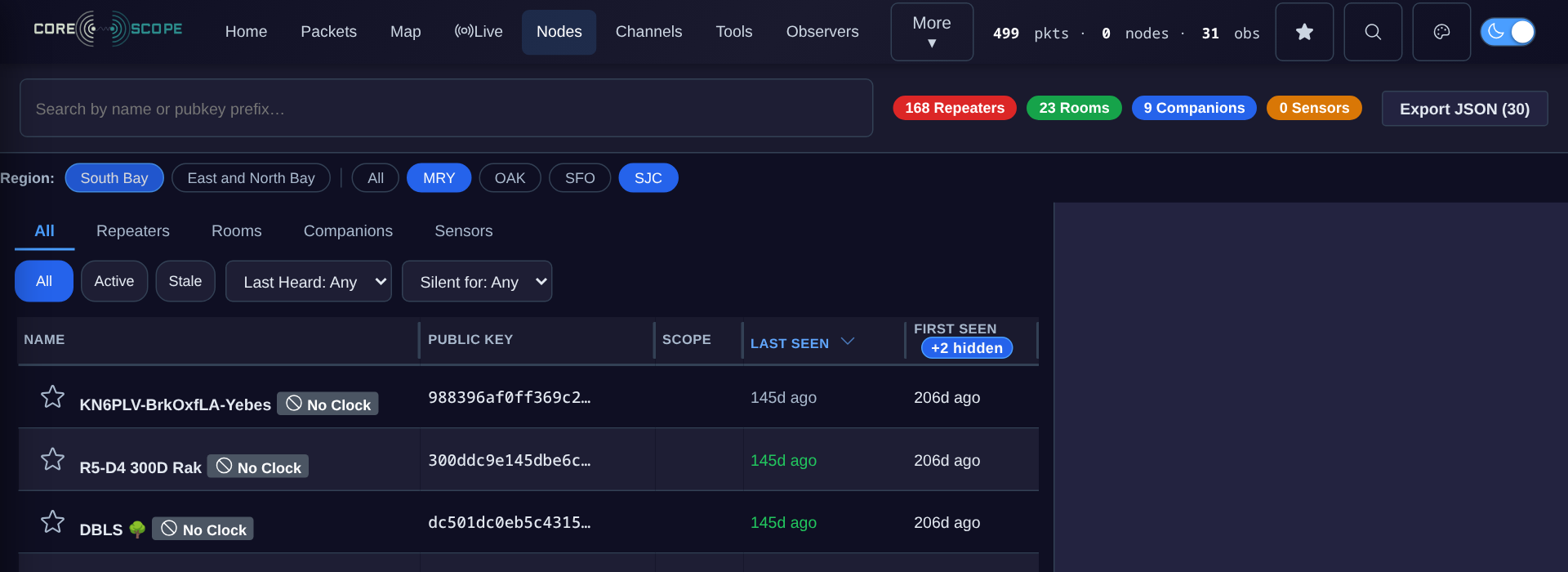 ## Config example ```json "regionQuickPicks": [ { "name": "South Bay", "description": "San Jose and Monterey observers", "regions": ["SJC", "MRY"] }, { "name": "East and North Bay", "description": "Oakland and San Francisco observers", "regions": ["OAK", "SFO"] } ] ``` Each pick needs a `name` and at least one code; `description` is optional (shown as the tooltip). Codes are trimmed, upper-cased and de-duplicated; a pick with no code that has an observer today is not shown. At most 20 picks of 200 codes. ## Browser validation The branch's server was run locally against a migrated copy of `test-fixtures/e2e-fixture.db` (observers in MRY, OAK, SFO, SJC) with three groups configured: "South Bay" (SJC, MRY, SCZ), "East and North Bay" (OAK, SFO, sts) and "Nowhere yet" (XXX). Checked in headless Chromium: | check | desktop 1280 px | phone 390 px (touch) | |---|---|---| | groups shown | South Bay, East and North Bay ("Nowhere yet" hidden) | same | | tap South Bay selects | SJC, MRY (SCZ has no observer) | same | | next `/api/packets` request | `region=SJC,MRY` | `region=SJC,MRY` | | selector label | "South Bay ▾" | "South Bay ▾" | | second tap | back to all regions | same | | button height | 24 px | 44 px | | page wider than viewport | no | no | | page errors | none | none | Checked on Packets (dropdown layout) and Nodes (pill layout). Three layout problems found this way on the phone were fixed before opening: a sideways-scrolling row clipped at the screen edge, the selector squeezed into a narrow column (the filter group is a non-wrapping flex row), and the two wrapped rows spread apart on Nodes (`align-content`). **Revision 1:** the first version put the picks in a separate row beside the selector; they moved inside the dropdown. Re-checked with a 14-region list and three picks on Packets: desktop 1280 px dark and phone 390 px light both keep the menu on screen (menu 340 px wide, page not wider than the viewport), the pick closes the menu and the trigger names the pick. **Revision 2:** picks are checkbox rows like **All** instead of chips. Re-checked on Packets at 1280 px dark and 390 px light: rows render bold under All, the divider separates the single regions, ticking a pick ticks its codes and names the trigger, no sideways scroll. Unrelated and not changed: on Nodes at 390 px the region row (existing pills included) starts flush with the screen edge. ## Tests - Red commit `81ea67d6`: the config type, a stub normaliser and endpoint returning nothing, and tests. - Go: cleaning (trim, upper-case, de-duplicate, drop incomplete groups), caps, nil config, and the endpoint's JSON. - Frontend, `tests/e2e/test-region-quick-picks.js` (moved from `tests/unit/` in `fced69a7`; it needs jsdom, so it runs in the E2E job like `test-table-sort.js`): the real `region-filter.js` in **jsdom** against faked config endpoints. Nine cases: rendering and hiding groups with no observer, selecting and re-querying, the selector label, toggling back, a hand-made selection marked active, the pill layout, no groups, a failed fetch, HTML escaping. Seven fail on the stub, all on assertions. - Green commit `0e33210e`: the implementation, styles, `config.example.json` (`regionQuickPicks` + `_comment_regionQuickPicks`), `docs/api-spec.md`, and the OpenAPI route list (`TestOpenAPICompleteness` requires it). The jsdom test also had a cross-realm comparison bug fixed in this commit (`Array.from` on arrays coming out of the jsdom window). - `make test`: 16 of 16 modules pass. Frontend suites: 195 of 196; the one failure, `test-issue-1956-release-routing.js`, needs CI's `GITHUB_REF_NAME` and fails the same way on `master` locally. - Red commit `f991060d` (revision): picks live inside the dropdown menu before the checkboxes, choosing one closes the menu, and in the pill layout they share the region bar; two fail on assertions against the old layout. Green commit `1f720e35`. Frontend 195 of 196 (same environment-only failure). - Red `134f5256` / green `da0adb50` (second revision): picks are checkbox rows between All and the single regions with a divider, no chips in the menu; ticking and unticking a pick row. The green commit also repairs `style.css`: `1f720e35` had prepended its block to the top of the file (its edit matched an earlier `.region-pill {`) and left the previous rules in place. The file now differs from `master` by 13 lines. ## Review notes - Groups are offered only when at least one of their codes appears in `/api/config/regions`, and only those codes are selected. The stored selection is pruned to known codes on load anyway, so selecting absent codes would not survive a reload. - Customizer (AGENTS.md rule 8): groups are operator configuration; a customizer editor could come later. ## SonarLint SonarQube Community rules (the SonarLint engine) were run on the files this PR touches, and only issues on lines it adds are listed. - **Fixed** in `b84ace4e`: - `normalizeQuickPickCodes` split out of the config normaliser (S3776, 17 > 15); - a comment on why a failed quick-pick fetch is ignored (S2486); - `for…of` in `activePick` (S4138); - in the tests: `node:` specifiers, `includes()`, and an explicit string comparator for sorted selections (S7772, S7765, S2871). - **Kept on purpose:** - S2486 is still reported on that `catch`. Swallowing the error is the intended behaviour: the filter works as before, just without picks. - S1523 on the `vm` test loader, as above. ## Checked against the repo rules - Rebased onto `master` (`673442cc`). Each red commit was re-run and still fails on its assertions; each green commit passes (TDD.md). - `make test`: all 16 modules pass. Frontend suites: all pass except `test-issue-1956-release-routing.js`, which needs CI's `GITHUB_REF_NAME` and fails the same way on `master` locally (#2160 addresses it). - No private data: test fixtures and examples use the codes the existing tests use (SJC/SFO/LAX, `#be`-style scopes). - No new `map[string]interface{}`, no hard-coded colours. `git add` was explicit, and there is one logical change per commit. 🤖 Generated with [Claude Code](https://claude.com/claude-code) https://claude.ai/code/session_01KaR4xu8gVykQBkH8yG8m6H --------- Co-authored-by: Claude Opus 5.5 <noreply@anthropic.com> |
||
|
efitenandClaude Opus 5.5
|
0737f10a5d |
feat(notify): optional external node alerts feed and the node.external event (#2177) (#2178)
Closes #2177. ## What Node notifications can mail alerts computed outside CoreScope. With `userManagement.notifications.externalAlerts` configured, users can choose a new event, `node.external`, which is off by default and only offered when configured: ```json "notifications": { "enabled": true, "externalAlerts": { "url": "http://coverage-job/alerts.json", "maxAgeHours": 48, "label": "Coverage" } } ``` The feed: ```json { "generatedAt": "2026-10-11T01:35:12Z", "alerts": [ { "pubkey": "<64 hex>", "key": "SE", "text": "never heard to the south-east", "url": "https://example.org/coverage" } ] } ``` Mail lines: `<name>: Coverage: never heard to the south-east, <time>` when an alert appears, `<name>: Coverage resolved (SE), <time>` when it is gone from a fresh feed. ## How - `cmd/server/notify_external.go`: feed types, `parseExternalFeed` (RFC 3339 `generatedAt`, age check, per-alert validation), `fetchExternalFeed` (200 only, 1 MB cap, 10 s timeout). - `notify_eval.go`: `evalExternal`. Subjects are `<pubkey>/<key>`; a `<pubkey>/*` row is the per-node baseline, so the first fresh feed after watching stores the current alerts without a mail (like `foreign.new`), and later alerts mail at once. `External == nil` (not configured, nobody chose it, or stale) leaves every `node.external` state as it is. - `notify_service.go`: the feed is fetched only when configured and at least one user chose the event. Each new reason the feed is unusable is logged once, and so is the recovery. Mail text and link: the alert's `url`, otherwise the node page. - `notify_handlers.go`: `availableEvents` and the new `externalLabel` include the event only when configured; PUT answers 400 for `node.external` otherwise. - `internal/users/notify.go`: event constant, `OptionalNodeNotifyEvents` (canonical order: node, optional, admin), `RemoveWatch` also deletes the node's `<pubkey>/...` rows. - Account page label, OpenAPI descriptions, `config.example.json` comment, `docs/user-guide/accounts.md` section. Decisions on the three open questions in #2177: the generic name `node.external`; the resolved mail names the key instead of repeating the text, so there is **no `users.db` schema change** (a bump would also make older binaries refuse the file); one feed. ## Invariants - Read/write separation (#1283): the server only reads the feed over HTTP. State rows go to `users.db` through `internal/users`, like the other events. - A dead, garbled or old feed never mails "resolved": `TestEvaluateExternalStaleFeedChangesNothing` and `TestNotifierMailsExternalAlertsAndSkipsAStaleFeed` (HTTP 502 and a 72 h old feed in a row, then a fresh empty feed resolves). ## Performance The evaluator adds one pass over the stored states (already read every tick) plus, per user with the event on and per watched node, the node's current alerts. Bounded by `maxWatchesPerUser` (50) times the alerts per node. The feed is fetched once per tick (default 5 minutes) only when someone chose the event, capped at 1 MB. No packet-store lock is taken for it. Nothing changes for instances without `externalAlerts`. ## Tests - `cmd/server`: `go test` green locally (Windows; `TestSaveGeoFilterPreservesFileMode` skipped as it needs Unix mode bits). New: `notify_external_test.go` (feed parsing and limits, HTTP fetch 200/404/oversized, config resolution, evaluator baseline/new/resolved/returning/stale/not chosen/notifications off, notifier end to end with a fake feed, account routes). - `internal/users`: green, 2 new tests (optional event and canonical order, `RemoveWatch` deletes external subjects only for that node). - Frontend: `test-all.sh` green, 1 new test in `test-notifications-ui.js` (label from `externalLabel`, escaped). - `scripts/check-xss-sinks.sh --file public/notifications.js`: clean. ## Not done - No E2E test: the account page change is one label, covered by the unit test. - Not run against a live instance yet. The first feed in use is the coverage job of on8ar.eu (`alerts.json`, 29 alerts at the moment). Co-authored-by: Claude Opus 5.5 <noreply@anthropic.com> |
||
|
efitenandClaude Opus 5.5
|
b2cda21a27 |
feat(server): companion linking routes, device tokens and bearer auth (#2175)
Part 2 of 3 for #2173 (companion linking): the server routes, bearer auth and the link handshake. Builds on #2174 (merged); `upstream/master` is merged in, so the diff shows only this part. Everything here is behind `userManagement.enabled` and answers 404 with it off. ## Changes in this PR **Device tokens and bearer auth** - `POST /api/auth/device-token`: email + password returns a bearer token, stored as a `kind = 'device'` session with a label. Same failure answers and the same rate limit as login. - Server-enforced scope for a bearer token: `/api/auth/me`, `/api/auth/logout`, `/api/account/companions*`, `/api/account/settings`. Everything else answers 403. - A bearer header only counts when there is no session cookie, so an auth proxy that adds its own `Authorization` header does not hide a logged-in browser. Cookies never accept a device token. - The sessions list on the account API carries `kind` and `label`; logout with a bearer token revokes that device. **Linking a companion** - `POST /api/account/companions/challenge` `{pubkey}` returns `{challenge, expiresAt, host}`: 32 random bytes, single use, 5 minutes, bound to the caller and the pubkey. - `POST /api/account/companions` `{pubkey, challenge, signature, name}`: the signature is the companion's Ed25519 signature over `corescope-link:<host>:<challenge>` (`internal/sigvalidate.VerifyMessage`). The challenge is consumed in every case. - A companion linked to another account moves to the caller (the newest proof wins). Both users get a `companion.transfer` audit row and the previous owner a mail. That mail is a security notice: it is sent whatever the node notification settings are. - `GET /api/account/companions` (with `lastSeenAt` from `client_receptions`) and `DELETE /api/account/companions/{pubkey}`. - Linking does not touch the synced `meshcore-my-nodes`: a companion is not a node to monitor. - Admin user detail lists linked companions; the account data export includes companions and device sessions. **Coverage and config** - `GET /api/rx-coverage?mine=1`: only coverage of the caller's linked companions (401 when logged out, 403 for a device token). With `gaps=1` (#2172) the reply carries no `gaps` member under `mine=1`, because the track query takes one companion and cannot narrow to a set yet (`TestRxCoverageMineOmitsGaps`). - `clientRxCoverage.requireLinkedCompanion` (default off) is read and reported in `/api/config/client`, which also announces `userManagement.companionLinking`, so CoreDrive RX shows its login only where linking exists. The ingestor side is part 3. - CORS: for origins in `corsAllowedOrigins`, the device-token routes alone also allow POST/PUT/DELETE and the `Authorization` and `Content-Type` headers. No credentialed CORS. Documented in `config.example.json`. - OpenAPI and `docs/api-spec.md` cover the new routes. ## Verification - 26 new tests in `cmd/server` and `internal/sigvalidate`, among them: `TestCompanionLinkFlow`, `TestCompanionLinkRejections` (signature by another key, malformed signature, challenge bound to another pubkey, unknown challenge; reuse and expiry are covered by the store tests in #2174), `TestCompanionTransfer`, `TestCompanionTransferMailIgnoresNotificationSettings`, `TestBearerScopedRoutes`, `TestBearerIgnoredWithCookie`, `TestDeviceTokenSharesLoginRateLimit`, `TestCORSBearerRoutes`, `TestCompanionRoutesAbsentWhenOff`, `TestRxCoverageMine`, `TestRxCoverageMineOmitsGaps` (fails without the `mine == nil` guard), `TestVerifyMessage`. - `cmd/server`, `internal/sigvalidate` and `internal/users`: `go vet` and `go test ./...` green, `gofmt` clean. - The linking flow runs on analyzer.on8ar.eu since 9 October 2026 with CoreDrive RX v1.19.0 (a real companion linked through the signed challenge). ## Not in this PR - The ingestor's linked-only filter, the account page (Devices, Companions), the "My coverage" toggle and the user docs: part 3. - Per-user broker credentials and per-user API keys (non-goals in the spec). --------- Co-authored-by: Claude Opus 5.5 (1M context) <noreply@anthropic.com> |
||
|
efitenandClaude Opus 5.5
|
f3004d977e |
feat(rx-coverage): show where a companion drove and received nothing (#2172)
The Mobile RX coverage page (`#/rx-coverage`) shows only cells where a companion received something. Where a companion drove and received nothing is just as useful for operators, and the data is already there: the RF sample track (`client_rf_samples`, #1905/#1906) and the receptions (`client_receptions`) use the same hex grid (`hexCellAt`, `zoomToHexRes`). This PR adds those cells as a hatched layer under the reception cells. ## Changes in this PR **Server** - `GET /api/rx-coverage?...&gaps=1` adds a `gaps` member to the FeatureCollection: cells with moving (non-stationary) track samples and no reception in the same `days` window and `bbox`, each with `samples`. `gaps_truncated` is set when more than 5000 cells qualify (the most-sampled are kept, same pattern as `coverageFeatureCap` and `rfNoiseFeatureCap`). - Gaps are only returned when `clientRfSamples` is on and there is no `node` filter: with `?node=` the question would be "this node was not heard", which these cells do not answer. `?rx=` limits both the track and the receptions to that companion. - Without `gaps=1` the payload is unchanged: the `gaps` member is omitted. - New code lives in `cmd/server/rx_coverage_gaps.go` (pure `aggregateGaps` plus `queryTrackPoints`); the handler change in `rx_dashboard.go` is 14 lines. - `/api/rx-coverage` is now documented in `openapi.go` and removed from `openapi_known_gaps.json` (#1670). **Frontend** (`public/rx-coverage.js`, `public/node-reach-coverage.css`) - A "Nothing received" toggle on the signal layer, on by default, only rendered with `MC_CLIENT_RF_SAMPLES`. Hidden on the noise layer. - Gap cells use a 45-degree hatch (an SVG pattern in a dedicated renderer, so they sit under the reception cells). The hatch is denser for cells driven through more often (1 / 2-3 / 4+ samples). Tooltip: sample count. Legend entry: "driven, nothing received". - Off state is deep-linkable as `gaps=0`. - New token `--nq-cov-gap` for light and dark. Plain grey (`--nq-cov-grey`) already means "received, no SNR", so the hatch keeps the two apart. ## Threshold: one sample Measured on a live network (analyzer.on8ar.eu, Belgium, September to October 2026), with cells of about 250 m: a cell with track samples and no reception in one half of a month, driven again in the other half. How often did it receive something the second time? | Minimum samples | Cells "nothing received" | Driven again | Received something later | |---|---|---|---| | 1 | 3971 | 1263 | 29% | | 2 | 1565 | 592 | 32% | | 3 | 619 | 243 | 35% | | 5 | 142 | 63 | 40% | A higher threshold hides cells without making the rest more reliable, so the threshold is 1 and the wording is "nothing received in this period", never "no coverage". Using every decoded packet as reception evidence (including 1-byte path hashes) gave 25% to 32%, so the capture rule for 1-byte hashes is not what drives this. The median cell has 2 samples. ## Verification - Go: 7 new tests in `rx_coverage_gaps_test.go` (gap/no gap, stationary excluded, single sample, cap keeps the most-sampled, endpoint, `?rx=` filter, no `gaps` member when not asked / with `?node=` / with RF samples off). The endpoint tests fail without the handler change. Full `cmd/server` suite green locally, `go vet` and `gofmt` clean. - E2E: `tests/e2e/test-rx-coverage-gaps-e2e.js` (4 steps: no toggle with RF samples off, on by default with hatched cells under the reception cells, toggle off with `gaps=0` and deep link, noise layer hides it). 2 steps fail without the frontend change. Existing `test-rx-coverage-noise-e2e.js` and `test-rx-coverage-viewport-e2e.js` still pass. Listed in `scripts/non-unit-tests.json`. - Frontend unit suite (`test-all.sh`) green. - Real data on a staging instance (7 days, bbox 50.8,4.9,51.3,5.8, z=12): 478 reception cells and 379 gap cells, no cell in both, reception features identical with and without `gaps=1`, 0.48 s to 0.52 s per request both ways. - Browser: checked on staging with real data (light theme), and light, dark and 390 px wide with mocked data. ## Not in this PR - A per-node variant on the Reach page ("this repeater transmitted while a companion was nearby, and was not heard"). That needs the transmit moments from `observations` and is a heavier query. - `deploy.yml` does not get a line for the new E2E file, like the other entries that are only in `non-unit-tests.json` (#2037). Co-authored-by: Claude Opus 5.5 <noreply@anthropic.com> |
||
|
efitenandClaude Opus 5.5
|
2456762179 |
feat: account data export and users.db backup (#2141)
A small follow-up to parts A to E of #2128: users can download all data the instance holds about them, and the server backs up `users.db`. Stacked on #2140. Review the commits after that branch. ## The situation - An instance with accounts holds personal data, but a user has no way to get a copy (GDPR articles 15 and 20). Self-delete already exists. - `users.db` is the only file the server writes, and nothing backs it up: `GET /api/backup` snapshots the analyzer database only. ## What this PR adds **Data export.** `GET /api/account/export` and a "Download my data" button on the account page give one JSON file with: - the profile, including activation and a pending email change; - sessions (times and user agent); - synced settings, own proposals, notification prefs and watches; - audit rows where the user is actor or target, with other accounts as an id only; - the mail log. Password hash, session and link tokens and the unsubscribe token are left out: they are credentials. Each export is audited as `user.export`. **users.db backup** - Daily `VACUUM INTO` snapshots through `internal/users`, on by default when user management is on. They go to `backups/` next to `users.db`, the 7 newest are kept, the directory is 0700 and the files 0600. Rotation only touches `users-<timestamp>.db` files and never the snapshot it just wrote. Config: `userManagement.backup {enabled, dir, keep}`. - `GET /api/admin/users-backup`: an admin downloads a fresh snapshot to keep off the server; audited as `user.backup`. - `docs/user-guide/accounts.md` gains a restore procedure. It covers what a restore brings back (accounts deleted after the snapshot, old passwords, revoked sessions) and how to clean that up afterwards. Spec: [`docs/specs/2026-10-08-account-export-and-users-backup-design.md`](https://github.com/efiten/CoreScope/blob/feat/account-export-backup/docs/specs/2026-10-08-account-export-and-users-backup-design.md). ## Verification - `internal/users` with `-race` and the `cmd/server` suite pass locally, 30 new Go tests. The file-mode tests skip on Windows. - `sh test-all.sh` exits 0; the XSS gate in diff mode passes. - User-management E2E: 27 of 27 steps locally. - On our production instance since 8 October 2026; the first snapshot there was 143 kB. ## Not in this PR - Importing an export into another instance. - Off-site upload of the snapshots. The admin download covers that by hand. --------- Co-authored-by: Claude Opus 5.5 <noreply@anthropic.com> |
||
|
efitenandClaude Opus 5.5
|
de364a8bb6 |
feat: mail notifications for watched nodes (user management part E) (#2140)
Part E of #2128: a logged-in user watches nodes and gets one mail when a watched node goes offline, comes back, or reports a low battery. Admins can add instance events: a new foreign node, and an observer going offline or back. This covers the per-user mail part of #775. Stacked on #2139 (part D, which builds on #2138). Review the commits after that branch. ## The situation A sysop learns that a repeater went silent, or that its battery is running down, only by opening CoreScope. #775 asks for notifications. Accounts (part A) now give a verified address to mail and a mailer with delivery status. ## What this PR adds **Events.** They use the instance thresholds, so a mail does not disagree with the node page: - `node.offline`: silent for the role's `healthThresholds` window. Last heard comes from the packet store, and repeaters and rooms count relayed traffic (#1598). - `node.battery`: advert telemetry below `batteryThresholds.lowMv`, recovered at `lowMv + 100`. - Admins only: `foreign.new` (once per node) and `observer.offline`. **Store.** Schema v5 with `notification_prefs`, `notification_watches` and `notification_state`. **Server** (only with `userManagement.notifications.enabled`) - A notifier next to the janitor, every `intervalMinutes` (5). The evaluator is a pure function of watches, prefs, stored states and node snapshots. - No burst after a restart or a new watch: a subject's first evaluation stores its state without mailing. The loop waits for the startup load. While ingest is stale (newest packet older than 30 minutes) the offline checks pause, and after recovery they wait one silent window. - One mail per user per check. Limits: 20 per user and 100 per instance per rolling 24 hours, 50 watches per user. A change over a limit is recorded and never mailed later. - Every mail has a one-click unsubscribe (`List-Unsubscribe` and `List-Unsubscribe-Post`). The GET only redirects to a confirm page, so link scanners cannot unsubscribe anyone. Node names are cleaned of control and bidi characters before they go into a mail. - Routes: `GET`/`PUT /api/account/notifications`, `PUT`/`DELETE /api/account/notifications/watches/{pubkey}`, `POST /api/account/notifications/watch-my-nodes` (copies the synced "my nodes" list), `GET`/`POST /api/notifications/unsubscribe`. `mailer.Message` gains `Headers`. **Frontend.** A "Notify me" toggle on the node pages, a Notifications section on the account page (`#/account?section=notifications`), an unsubscribe page, and the notification mail count on the admin overview. Spec: [`docs/specs/2026-10-07-node-notifications-design.md`](https://github.com/efiten/CoreScope/blob/feat/notifications/docs/specs/2026-10-07-node-notifications-design.md). ## Performance Each check reads watches, prefs and states from `users.db` (one query each), the watched nodes from the analyzer DB in chunks of 500, and last-heard times from the packet store. | Measurement | Result | |---|---| | One check on our staging instance, 130,000 packets in memory, 1 watcher | 6.9 ms, of which 0.93 ms holding the store read lock | | Evaluator benchmark, 100 users with 50 watches each, 2,000 nodes | 1.75 ms | No work is added to ingest, broadcast or any request path. ## Verification - `internal/users` and `internal/mailer` with `-race`; the `cmd/server` suite plus `-race` on the notifier tests; 74 new Go tests. The same Windows-only failure as noted in #2138 applies. - `sh test-all.sh` exits 0; the XSS gate in diff mode passes. - User-management E2E: 26 of 26 steps locally. With notifications off the new steps fail, so they do test the flag. - On our staging and production instance since 7 October 2026. ## Not in this PR - Other channels (Discord, Telegram, webhooks). Detection is separate from delivery, so one can be added. - The topology, RF and anomaly alerts of #775. - If the whole server starts after a feed outage that already ended, the grace window is unknown and a watcher can get one wrong offline mail. The user guide says so. --------- Co-authored-by: Claude Opus 5.5 <noreply@anthropic.com> |
||
|
efitenandClaude Opus 5.5
|
abbe6846ff |
feat: propose and approve hashtag channels (user management part D) (#2139)
Part D of #2128: logged-in users propose a hashtag channel, an admin approves, rejects or later revokes it, and the ingestor decrypts approved channels without a restart. It is the first consumer of a generic proposal table, and answers the request in #2092. Stacked on #2138 (part C). Review the commits after that branch; GitHub shows C's commits here until it is merged. ## The situation - An instance decrypts only the hashtag channels listed in `hashChannels`. Users who want a city or club channel shown have to ask the operator, who edits `config.json` and restarts the ingestor. - #2092 asked for a suggest-and-approve flow; a downstream fork (dborup/CoreScope#99) runs one with anonymous suggestions and a file queue. ## What this PR adds **Name rules (`internal/channel`).** `ValidateHashtagName`, mirrored in the browser: - at most 31 UTF-8 bytes including `#` (firmware `ChannelDetails.name[32]`), case preserved, `Public` refused in any case; - control, bidi, separator and format characters refused except ZWJ, plus invisible fillers (`Other_Default_Ignorable_Code_Point`, U+2800, non-ASCII spaces). Go and JS give the same verdict for every code point. **Store.** Schema v4, one generic `proposals` table (kind, subject, status pending/approved/rejected/revoked, proposer, reviewer, note). One row per (kind, subject); limits are checked in the same transaction as the change. **Server** (only with `userManagement.channelProposals.enabled`) - `POST /api/proposals`, `GET /api/account/proposals`, `GET /api/admin/proposals`, `POST /api/admin/proposals/{id}/approve|reject|revoke`. - 400 for an invalid name. 409 for a duplicate, a rejected name, or a name already in `hashChannels`/`channelKeys` ("this channel is already decrypted on this instance"). 429 over a limit (`maxPending` 100, `maxApproved` 128, `perUserPerDay` 5). - `GET /api/channels` gains `approvedChannels`, so approved channels are listed before they have traffic. With the feature off the response is byte-identical. **Ingestor.** Opens `users.db` with `mode=ro` every 60 seconds, re-validates the names, and swaps its key map through an `atomic.Pointer`. Configured channels always win, and a failed read keeps the last good set. The ingestor never writes `users.db`; AGENTS.md now says so. **Frontend.** "Propose for everyone" in the add-channel dialog, an "approved" marker in the channel list, "My proposals" on the account page, and an admin "Proposals" tab with a warning on approve. The packet detail pane now escapes the channel name: until now only the operator chose those names. Spec: [`docs/specs/2026-10-07-channel-proposals-design.md`](https://github.com/efiten/CoreScope/blob/feat/channel-proposals/docs/specs/2026-10-07-channel-proposals-design.md). ## Performance Every key is tried on each GRP_TXT that no key opens (`decodeGrpTxt`). Benchmark of that worst case: | Keys | Time per packet | |---|---| | 320 configured | 204 to 216 µs | | 320 configured + 128 approved | 272 to 320 µs | That is about +33%, linear in the key count and capped by `maxApproved`. With the feature off the decoder gets the identical map and no ticker runs. ## Verification - `internal/channel`, `internal/users` (with `-race`), `cmd/server` and `cmd/ingestor` pass locally, 53 new Go tests. The ingestor's `TestWriteStatsAtomic_SymlinkAtDestIsReplaced` needs symlink rights on Windows and fails on `master` too. - `sh test-all.sh` exits 0; the XSS gate in diff mode passes. - User-management E2E: 21 of 21 steps locally (propose, approve, the channel appears, revoke removes it). - On our staging and production instance since 7 October 2026. ## Not in this PR - Private (PSK) channels: their keys stay in the browser (#725). - Anonymous proposals. - Names that need ZWNJ (some Persian and Urdu spellings) and subdivision flags are refused, because ZWNJ and tag characters are format characters. Allowing them later only widens the rule, so no approved name gets stranded. --------- Co-authored-by: Claude Opus 5.5 <noreply@anthropic.com> |
||
|
efitenandClaude Opus 5.5
|
18a634c115 |
feat: admin dashboard with overview and audit log (user management part C) (#2138)
Part C of #2128: an admin area with an overview, the user table and a global audit log. Off by default like the rest of user management: with `userManagement` off nothing changes, and non-admins get no new UI. This is the first of 4 stacked PRs (C, D, E, then a small export/backup follow-up). Each later one contains this branch; review them in order. ## The situation - An admin could manage users one by one in `#/admin/users`, but nothing showed whether the instance needs attention: accounts stuck in activation, bouncing mail, someone guessing a password, an MQTT source that dropped. - The audit log existed (`internal/users/audit.go`) but could only be read per user, and logins were not recorded. ## What this PR adds **Store (`internal/users`)** - Schema v3: an index on `audit_log(at)`. - `AuditList` with filters (action or group prefix like `user.login.*`, user as actor or target, period) and keyset pagination; `PruneAudit`; `Stats` for the user figures. **Server** - `GET /api/admin/stats` (typed struct): accounts by status, admins, registrations and active users over 7 and 30 days, logins and failed logins in 24 hours, mail by final status, and the attention items computed server-side. - `GET /api/admin/audit`: filtered, newest first, `next` cursor. - `GET /api/admin/users` gains `bouncing=1`. - Logins are audited as `user.login` and `user.login.failed` (reason `wrong_password`, `pending` or `disabled`). An unknown address writes no row. The writes are asynchronous, so the login response does not wait on `users.db`. Login rows are pruned after 90 days. **Frontend** - `#/admin?tab=overview|users|audit`: `admin.js` (tab shell), `admin-overview.js` ("Needs attention", Users card, System card from the existing health, MQTT and observer endpoints), `admin-audit.js` (filters in the URL, "Load more"). `admin-users.js` becomes the Users tab; the old `#/admin/users` link rewrites to it. - `/api/healthz` is read on open and on Refresh only, not on the 60-second timer, because it walks every packet under a read lock. Spec: [`docs/specs/2026-10-07-admin-dashboard-design.md`](https://github.com/efiten/CoreScope/blob/feat/admin-dashboard/docs/specs/2026-10-07-admin-dashboard-design.md). ## Verification - `internal/users` and `cmd/server`: `go vet` and `go test` pass locally, 26 new Go tests. One upstream test, `TestSaveGeoFilterPreservesFileMode`, also fails on Windows on plain `master` (file modes) and is unrelated. - `sh test-all.sh` exits 0; the XSS gate in diff mode passes. - User-management E2E with the `e2etest` build: 13 of 13 steps locally. - Running on our staging and production instance since 7 October 2026. ## Not in this PR - Restricting existing pages (perf, MQTT status) to logged-in users or admins. The admin area adds no access mechanism of its own, so that stays a later router rule plus endpoint check. - Server-enforced customizer tab restrictions (#1508). - The 24-hour, 5-attempt and 10-minute attention thresholds are constants for now (AGENTS.md rule 8: customizer later). --------- Co-authored-by: Claude Opus 5.5 <noreply@anthropic.com> |
||
|
nullrouten0andClaude Mythos 5.1
|
4ce6d9f6d4 |
fix(ui): pin CDN script versions and add integrity hashes (#2121)
`leaflet.heat` and `chart.js` in `index.html`, and swagger-ui on `/api/docs`, were loaded from unpkg with no `integrity` attribute. `chart.js@4` and `swagger-ui-dist@5` also floated on a major version, so a new release would load unreviewed. A compromised CDN or package would run as our own code on every page. Leaflet itself already had a hash. **Fix:** pin `chart.js@4.5.1`, `leaflet.heat@0.2.0`, `swagger-ui-dist@5.33.1`, each with a sha384 hash and `crossorigin="anonymous"`. **How the hashes were made:** download each pinned file, `openssl dgst -sha384 -binary | base64`, then download again and check the hash matches. **Note:** bumping chart.js or swagger-ui now means updating the hash too. Vendoring them into `public/vendor/` (as markercluster already is) would remove the CDN dependency entirely; happy to do that instead if preferred. Running in production on our instance since 2026-10-07. 🤖 Generated with [Claude Code](https://claude.com/claude-code) Co-authored-by: Claude Mythos 5.1 <noreply@anthropic.com> |
||
|
efitenandClaude Opus 5.5
|
f3ae8ac25a |
feat: sync a logged-in user's settings across devices (part B) (#2130)
Part B of #2128: a logged-in user's settings follow them across devices. Log in on a phone and your own nodes, favorites, customizer and filters are there; a change on one device reaches the others within a minute or when you return to the tab. **This PR builds on #2129.** Until that one is merged, the diff here includes it. The commits for this part start at `docs(specs): settings sync for optional user management (sub-project B)`. ## The situation Everything a visitor sets up lives in one browser's `localStorage` (about 100 keys in `public/`). A second device or a cleared cache starts from zero (#895). ## What this PR adds **Storage.** `users.db` schema v2: one JSON document per user in `user_settings`, with a revision number and a generation id. A write succeeds only when the client's revision and generation match the stored ones, so two devices cannot overwrite each other silently. **Server.** `GET`, `PUT` and `DELETE /api/account/settings`, behind the same session and CSRF checks as the account routes. - The server owns the list of synced keys (61 keys, [`settings_allowlist.go`](https://github.com/efiten/CoreScope/blob/feat/settings-sync/cmd/server/settings_allowlist.go)) and sends it to the client, so the two cannot drift. - A hard denylist, checked first, refuses `meshcore-api-key`, every `corescope_channel_*` key and `live-channel-colors` (#725). The colour map is keyed by channel hash, and for a user-added channel that hash is `user:<name>`, which would expose hashtag channel names. - Documents are capped at 256 KiB, measured like `JSON.stringify`. PUT is limited to 60 requests per hour per user. A stale revision gets 409 with the current document. **Client** ([`settings-sync.js`](https://github.com/efiten/CoreScope/blob/feat/settings-sync/public/settings-sync.js)). Inert unless the feature is on and someone is logged in. - It wraps `localStorage.setItem` and `removeItem` for allowlisted keys only and pushes 2 seconds after the last change. - It pulls on login, page load, tab focus and every 60 seconds while the tab is visible. - **Merge:** three-way, against a per-device baseline that belongs to one user and one document generation. Lists (own nodes, favorites, saved filters) merge per item, so an item added anywhere is kept and an item removed on one device does not come back from another. Single values: the profile wins unless only this device changed it. - Remote changes are written without a push, theme and colour-blind preset are re-applied, and the current page re-renders (skipped on account pages and while the geofilter editor is open). **UI.** - Logout asks: keep my settings on this device (default), remove them from this device, or cancel. Channel keys are never removed: no copy exists anywhere else. - The account page gets a "Settings sync" section: last synced time, "Sync now", what is and is not synced, and "Delete synced settings from my account". ## Not synced Layout and device state (panel and column widths, collapsed panels, map positions, geofilter drafts), channel data (#725), the API key, and all `sessionStorage`. The full list is in the [spec](https://github.com/efiten/CoreScope/blob/feat/settings-sync/docs/specs/2026-10-06-user-settings-sync-design.md). ## Performance - One GET per page load, tab focus and minute while visible; one debounced PUT per burst of changes. - The `setItem` wrapper costs one Set lookup per write for non-synced keys. A synced write reads one small revision key, not the stored document. - The server reads or writes one row per request. ## Verification - `internal/users` and `cmd/server`: `go vet` and `go test` pass locally (22 new Go tests), including a test that every allowlisted key still occurs in `public/`, and denylist tests. - `tests/unit/test-settings-sync.js`: 79 passing (vm, real module). The cases cover the merge table, two tabs sharing one storage, stale answers after a push, delete while a push is in flight, and logout while the final push fails. - `sh test-all.sh` exits 0. - `tests/e2e/test-user-management-e2e.js` (10 steps, 4 of them new) passed locally with two browser contexts as two devices: a favorite and the packet time window travel from device 1 to device 2, a removal does not come back, and "remove from this device" clears the synced keys while a channel key stays. - Checked by hand on a staging instance with a desktop and a phone on one account. ## Not in this PR - On a shared browser where the previous user chose "keep", the next user's first login merges those settings into their own account. The user guide says to choose "remove" on shared computers. - Saved filter expressions are synced as typed, including any channel names written in them. The guide says so. - Realtime push between devices; the minute pull is the sync interval. --------- Co-authored-by: Claude Opus 5.5 (1M context) <noreply@anthropic.com> |
||
|
efitenandClaude Opus 5.5
|
d232072f85 |
feat: optional user accounts (part A: foundation) (#2129)
Part A of #2128: optional, off-by-default user accounts. With the feature off nothing changes; with it on, visitors can register and log in, and admins manage users and use the operator actions without the API key. PR #2130 (settings sync) builds on this one. The two are meant to be merged together. ## The situation - Operator actions (geofilter save and prune, backup, perf reset) need the shared `apiKey`. There is no per-person right. - Nothing in CoreScope knows who a visitor is, so the requests in #2128 that need that (#1835, #2092, #1508, #730) have nothing to build on. ## What this PR adds **Two new Go modules** - `internal/users`: a separate `users.db` (SQLite through `modernc.org/sqlite`) with users, sessions, single-use tokens, an audit log and a mail log. Passwords use argon2id. - `internal/mailer`: a `Mailer` interface with a Brevo client (send, delivery events, webhook parsing) and an in-memory fake for tests. **Server (`cmd/server`)**, active only with `userManagement.enabled` - 24 routes, all documented in OpenAPI under the `users` tag ([`auth_routes.go`](https://github.com/efiten/CoreScope/blob/feat/user-management/cmd/server/auth_routes.go)): - auth: register, activate, login, logout, me, forgot, reset; - account: profile, password, email change with confirmation, sessions, self-delete; - admin: list, detail, disable, enable, delete, role, resend activation, manual activation, mail status refresh; - a Brevo webhook, registered only when `mail.webhookSecret` is set. - `requireAdmin` replaces `requireAPIKey` at the 7 operator call sites: the API key **or** an admin session. With the feature off it is the old API-key gate (`TestRequireAdminWithoutUserManagementIsAPIKeyGate`). - `/api/config/client` gets `userManagement: {enabled: true}` only when the service started; with the feature off the response is byte-identical. **Frontend** - `auth.js` (header account control, request helper that adds the CSRF header), `account.js` (login, register, activate, forgot, reset, confirm email, my account), `admin-users.js` (`#/admin/users`, deep-linked filters), `account.css` (theme tokens only). - On phones the top-bar control is hidden, so a conditional entry goes into the bottom-nav "More" sheet and the nav drawer. - The customizer geofilter tab and the Perf "Reset stats" button use the admin session when there is one. **Config.** A `userManagement` block (`config.example.json`, [`docs/user-guide/accounts.md`](https://github.com/efiten/CoreScope/blob/feat/user-management/docs/user-guide/accounts.md)). The Brevo key can come from `CORESCOPE_BREVO_API_KEY`. The server refuses to start when the block is enabled but incomplete. ## Security choices - Session cookie `cs_session`: HttpOnly, SameSite=Lax, Secure when `publicBaseUrl` is https. Every cookie-authenticated state change needs the `X-CS-CSRF` header and a matching Origin. - Activation needs the token **and** the account password. Without the password, an attacker who keeps re-registering a known address could get the owner to activate an account that carries the attacker's password. - Register, forgot and email change answer identically for known and unknown addresses. A password reset ends all sessions, a password change ends all other sessions, and both end outstanding email-change links. - Rate limits: login 10 per 15 minutes, register and forgot 5 per hour, per IP and per address. The bucket count is capped. `trustedProxies` makes the per-IP limits see real client IPs behind a proxy. - Server logs carry `#<user id>`, never addresses, tokens or passwords; mail-provider error texts are redacted before logging. ## Performance No change to an existing hot path with the feature off. With it on: - One `users.db` lookup per authenticated request (session by token hash). - The admin user table rebuilds its `tbody` on each filter change. `users.List` caps the result at 1000 rows (`internal/users/users.go`), which bounds the rebuild. - `map[string]interface{}` in `openapi.go`: 79 before, 78 after. ## Verification - `internal/users`, `internal/mailer` and `cmd/server`: `go vet` and `go test -race` pass locally. 121 new Go tests. - `cmd/server` with `-tags e2etest`: vet and the e2e hook tests pass. - `sh test-all.sh` exits 0. `tests/unit/test-user-management-ui.js`: 67 passing (vm, real modules). - `tests/e2e/test-user-management-e2e.js` (6 steps) passed locally against an `e2etest` build with the fake mailer and against a feature-off build. CI builds the `e2etest` binary and runs the suite on a second server (`deploy.yml`). - On a staging instance with a real Brevo key: register, activation mail delivered, activate, admin table, "Refresh status" showing sent, deferred, delivered, opened and clicked. ## Not in this PR - Settings sync (#2130), the admin dashboard, approval flows and notifications (parts B to E of #2128). - A `requireReadAuth` mode (#1835). Sessions from this PR are what such a mode would accept. - Binary size and build time with `modernc.org/sqlite` linked next to `mattn/go-sqlite3` were not measured. Their driver names do not collide. #1992 discusses the driver choice. - No Brevo webhook was configured on staging; delivery status there came from "Refresh status". --------- Co-authored-by: Claude Opus 5.5 (1M context) <noreply@anthropic.com> |
||
|
efitenandClaude Opus 5.5
|
000d9ab030 |
feat(coverage): RF noise-floor layer on the Mobile RX coverage page (#2113)
The ingestor already stores the noise floor that CoreDrive RX companions
report with each GPS fix (`client_rf_samples`, opt-in through
`clientRfSamples`, `cmd/ingestor/client_rf_sample.go:62`), but nothing
reads it back. An operator who enables it collects the data and cannot
see it. This adds the read side: `GET /api/rf-noise` and a Signal/Noise
toggle on the Mobile RX coverage page.

## What it does

- **`GET /api/rf-noise?bbox=&z=&days=`** returns a GeoJSON hex grid with
the median, quietest and noisiest noise floor per cell, in the same
shape as `/api/rx-coverage`. It is registered always and 404s unless
`clientRfSamples.enabled` is true, the same pattern as the coverage
routes.
- **Stationary samples are excluded.** A parked companion logs hundreds
of readings at one point, which would otherwise define its cell.
- **Coverage page:** a Signal/Noise toggle, rendered only when
`/api/config/client` reports `clientRfSamples: true`. The noise layer
reuses the coverage colour tokens with the axis inverted, because a
lower dBm is quieter. Tiers are at -115 and -108 dBm.
- **Deep link:** `#/rx-coverage?layer=noise` opens on the noise layer.
- **Empty and failed answers** are labelled on the map ("No RF samples
in this view yet", or a retry hint), so a blank map never reads as
"feature off".

No new configuration key: it reads the existing `clientRfSamples`
section that the ingestor already uses. Default off, so nothing changes
for an instance that has not opted in.

## Where it comes from

Ported from the efiten/CoreScope fork, where it has run on
analyzer.on8ar.eu since September (fork commits `42d09f0e`, `80581c43`,
`cde95078`). The cherry-picks conflicted with upstream's newer
`routes.go`, `types.go` and `rx-coverage.js`, so the final state was
ported by hand. The fork-only `/scopes` route that sat next to it in the
same hunk is deliberately left out.

## Performance

The query is bounded by `sampled_at` (indexed, `idx_crf_prune`) and the
bbox, aggregation is one pass plus a per-cell sort, and the response is
capped at 5000 cells. Measured on analyzer.on8ar.eu, all of Belgium
(`bbox=49.4,2.4,51.6,6.5&z=9`), from a client in Belgium, so network
time included:

| window | samples | cells | response time |
|---|---|---|---|
| 7 days | 10,835 | 241 | 0.37 s |
| 30 days | 43,303 | 429 | 0.39 s |

That table holds 45,270 rows in total. It is only read when someone
opens the noise layer, never on ingest or WebSocket paths.

## Tests

- `cmd/server/rf_noise_test.go`: 8 tests for the aggregation (median and
extremes, stationary exclusion, the cell cap, empty input) and the gate
(404 when off, even with data present). All pass, and the full
`cmd/server` suite passes locally.
- `tests/unit/test-rx-coverage-noise.js` (new, in `test-all.sh`): the
colour axis runs the right way, including both tier bounds and a string
median from the API. Slices the real function out of `rx-coverage.js`
and fails on master's copy, which has no thresholds.
- `tests/e2e/test-rx-coverage-noise-e2e.js` (new, wired in `deploy.yml`
and `scripts/non-unit-tests.json`): no toggle when the flag is off;
Noise fetches `/api/rf-noise`, draws the cells, swaps legend and
subtitle, puts `layer=noise` in the hash; a deep link opens on the noise
layer and an empty answer shows the message. 3/3 locally; against
master's `rx-coverage.js` and `roles.js`, 1/3 (only the "flag off" case
passes, as it should).
- `test-rx-coverage-viewport-e2e.js` still passes. ESLint 8 reports 0
errors on the changed files.

## Not done

- The thresholds (-115 / -108 dBm) are fitted to the fork's own data
(1,241 moving samples at the time) and are constants in
`rx-coverage.js`. Per AGENTS.md rule 8 they belong in the customizer
eventually; not in this PR.
- The E2E suite mocks the API. The real endpoint is covered by the Go
tests and by the measurements above, not by a fixture with seeded
samples.

Co-authored-by: Claude Opus 5.5 <noreply@anthropic.com>
|
||
|
liquidraverandClaude Opus 5
|
b695b979a2 |
fix(nodes): keep paginating past a page that post-LIMIT filtering shortened (#2061)
## Problem `handleNodes` runs the geo-filter, `nodeBlacklist`, `hiddenNamePrefixes` and area passes **after** the SQL `LIMIT/OFFSET`, and rewrites `total` to the filtered length. A page that loses a row is therefore short **without being the last page**, and neither the page length nor `total` can tell a client whether to ask for another page. #1606 added the pagination loop and chose the page length as the canonical stop. That is correct only where nothing is ever filtered. Everywhere else the list truncates at the first filtered page boundary and strands every node behind it — the #1598 symptom reached by a different route: a node that is relaying right now simply stops being in the list. The comment at `app.js:240` rejects `total` for exactly the right reason, then picks the signal the same code path also breaks. ## Measured on a live 2346-node deployment Page sizes for the query the map issues: ``` offset=0 returned=500 ← full, loop continues offset=500 returned=499 ← one row filtered AFTER the LIMIT → loop STOPS offset=1000 returned=500 ← never requested offset=1500 returned=500 ← never requested offset=2000 returned=345 ← never requested ``` | stop rule | requests | nodes reached | |---|---:|---:| | short page (master) | 2 | **999** | | `has_more`, else empty page | 6 | **2344** | **1341 nodes, 57%, unreachable through the UI.** ### One hidden node truncates the whole list The deployment this came from has no `geoFilter` (`/api/config/geo-filter` returns `polygon: null`) and no `nodeBlacklist`. It has a single `hiddenNamePrefixes` entry — a deliberate operator choice — and exactly one node whose name starts with it: ``` public_key d4a46ea2…1054 (64 clean hex chars) name 🚫🔥☀️ role repeater last_seen 2026-09-22T10:09:38Z ``` `handleNodes` drops that row in the `IsNameHidden` pass, which runs after the SQL `LIMIT`. The row is counted by the `LIMIT` and by `COUNT(*)`, so the page it lands in comes back exactly one short — and stops every client that treats a short page as the end. Isolated against SQL on the same database, seconds apart: ``` SELECT lower(public_key) FROM nodes ORDER BY last_seen DESC LIMIT 500 OFFSET 500 -> 500 rows GET /api/nodes?limit=500&offset=500 -> 499 rows comm -23 sql.txt api.txt -> d4a46ea2e99cab132a3286ef3d9cce9099318790af7f25671fe83de453721054 ``` Deterministic — `offset=500` returned 499 on three consecutive requests. Not a CDN artifact either: `cf-cache-status: DYNAMIC`, origin `cache-control: no-store`, no `age` header, and four requests with deliberately unique cache keys all returned 499. So **one deliberately hidden node makes 1341 of 2344 nodes unreachable.** The hiding feature does exactly what it was asked to do for that one node, and takes 57% of the network with it, silently. A single `hiddenNamePrefixes` entry is enough; no geo-filter, blacklist or area filter is needed to reach this state. ### The cutoff moves, which is why this reads as intermittent The visible set is the sum of the pages up to and including the first short one, so the boundary sits wherever the unreturnable row currently sorts by `last_seen`, and jumps a whole page as ingest reorders the list. Same deployment, same code, same config, ~2h apart: | dropped row's rank | first short page | nodes visible | |---|---|---:| | inside 0–499 | page 1 | 499 | | inside 500–999 | page 2 | 999 | A node is visible or invisible purely by where it lands relative to that moving line, so affected nodes appear to vanish and return on their own. Two operators on this deployment reported exactly that, independently, while I was measuring. ### A named reproduction `HU-ZA-Lentihegy` (`5287a33f…`), reported missing from the map by an operator whose companion had logged its advert at 04:20 local the same morning. Ingest was fine. The row is in `nodes` with `last_seen` `2026-09-22T02:20:35Z` — the same advert, to the second — valid GPS, role `repeater`, 1033 adverts, and `/api/nodes/search?q=lentihegy` returns it. ``` rank by last_seen : 1081 cutoff at the time: 999 ``` It missed by 82 positions. Walking the same live endpoint, same moment: | stop rule | requests | nodes reached | Lentihegy | |---|---:|---:|---| | short page (master) | 2 | 999 | **not reached** | | `has_more`, else empty page | 6 | 2340 | reached | The practical shape of this on a busy mesh: 1081 nodes had been heard more recently than 9.4 hours, so on that deployment **anything last heard more than ~9 hours ago was invisible**, alive or not. `#/nodes` compounds it — its search box filters client-side over the truncated set, so the server-side `?search=` never runs and an operator cannot find the node by searching for it either, even though the endpoint would return it. ## Change **Server** — `NodeListResponse` gains `has_more`, computed from the raw SQL page against the real `COUNT(*)` before the filter passes run, so it survives them: ```go hasMore := offset+len(nodes) < total ``` Always emitted (no `omitempty`) so a client can tell `false` from an old server. No extra request in the fixed path: `has_more` ends the loop exactly, where the old rule needed a probe page. **Clients** — `app.js` `fetchAllNodes`, `nodes.js` `loadNodes` and `area-map.html`'s inline helper stop on `has_more`, falling back to a zero-length page against a server that predates it. An empty page always ends the loop, so a `has_more` against a concurrently-shrinking table cannot spin to `safetyCap`. Left alone: the three loops are still three copies. Collapsing them onto `fetchAllNodes` is a bigger change than this fix needs, and `nodes.js` has its own inter-page progress UI. Happy to do it separately if you want it. ## Testing - **Unit** (`tests/unit/test-fetch-all-nodes-pagination.js`): the fixture now models the real handler — a row counted by the LIMIT and by `COUNT(*)`, then removed from the page. Three new cases. Fails on the old rule at 499 of 1199. - **E2E** (`tests/e2e/test-map-nodes-pagination-e2e.js`, already wired into `deploy.yml`): the mock drops a page-1 row and emits `has_more`. Mutation-checked — restoring master's stop rule fails 3 of its steps. - **Go** (`cmd/server/nodes_pagination_has_more_test.go`): asserts `has_more` stays true on a page filtering shortened. Mutation-checked — recomputing it after the filter block fails the test. - Full server suite `go test -race`: ok, 41.4s. `gofmt` clean, `go vet` passes. - **Against a real binary**, not just mocks: fixture DB migrated with `corescope-migrate`, `hiddenNamePrefixes: ["SKCE"]`, `limit=3`. Page 1 returns 2 of 3 with `total` rewritten to 2 and `has_more=true`. Walking the real server with master's rule reaches 2 nodes; with `has_more`, all 199 visible of 200, the hidden one still hidden. The real frontend against that server loads 199 with no JS errors. Two existing expectations changed, both deliberate: 1. `surfaces ALL nodes past the 500 server cap` — 3 → 4 requests. That mock emits no `has_more`, so the 200-row final page can no longer end the loop (a short page is exactly what a filtered page looks like) and a zero-length probe follows. Against a current server `has_more` still ends it at 3. 2. `rows missing public_key are NOT collapsed into one` — its stub returned a constant body, which would now be paged to `safetyCap`. It serves one page then empties. Local `test-all.sh` exits 1 on two XSS-gate self-tests (`good-2-tested.js`, `good-4-tested.js`) via a `UnicodeEncodeError` printing an emoji under Windows cp1252. Identical on clean `origin/master` in a scratch worktree, so it is pre-existing and platform-local, not this branch. There is a second identical filter block further down `routes.go` on another list endpoint. Likely the same class; not touched here. If you would rather land your own version of this, say so and I will close mine. 🤖 Generated with [Claude Code](https://claude.com/claude-code) Co-authored-by: Claude Opus 5 <noreply@anthropic.com> |
||
|
efitenandClaude Opus 5
|
52b9474d7a |
feat(map): filter repeaters by region name (#1862) (#2022)
Fixes #1862 ## What Adds a **Region Scope** picker to the map controls: pick `#be` and the map keeps the nodes that declare `#be` or were seen carrying `#be` traffic. It combines with the #2006 scope-state filter and persists in localStorage the same way. While a region is picked, a small "Region: #be · reset" chip sits on the map itself, so the filter stays visible when the controls panel is collapsed (the default on phones) and can be cleared from there. ## API `/api/nodes` and `/api/nodes/{pubkey}` gain two fields on repeater/room rows: - `declared_regions`: named regions from the node's newest declared-regions answer, split by the same function the Scope Audit now uses for `declaredRegions` (`splitDeclaredRegions`, `cmd/server/scope_config_state.go`), so both pages list a repeater under the same names. `[]` means it answered and named no region. Absent means it never answered, other roles, no declared-regions source, or the declared-regions lookup failed. - `declared_regions_truncated`: present, and `true`, only when that answer was flagged as truncated, so the list is partial. Never `false`: the `nodes.configured_scope` source does not record truncation, so absence does not mean the list is complete. The observed side reuses `transported_scopes`. Documented in `docs/api-spec.md` and the served OpenAPI spec. ### Why no `?hashRegion=` query parameter The observed side lives in the in-memory store. Filtering it after the SQL `LIMIT`/`OFFSET` would corrupt `total` and paging, and the map pages through `/api/nodes`. Same reasoning as the Data path section of #2001. ## Map behaviour - Filtering is client-side over the nodes `fetchAllNodes` already loaded: no new request. One pass over the loaded nodes to build the picker counts, one Set lookup per node per render. The marker filter is `nodePassesMapFilters` (`public/map.js:219`) and the observer stand-down `observerLayerShown` (`:212`), both exported and tested. - The picker and hint count only nodes with a map position, the same test the marker filter applies first, so a count never promises markers the map cannot draw. - The observer layer stands down while a region is picked, for the same reason it does for the scope-state filter. - The popup lists declared and observed regions separately. A truncated declared answer carries the same `truncated` badge the Scope Audit shows. - Absence is not read as a finding: the hint under the picker says a node left off the map is not proof it lacks the region. ## Tests - Go: `node_declared_regions_api_test.go` covers `declared_regions` on list and detail endpoints, the no-source case, agreement with `/api/scope-audit`, `declared_regions_truncated` (truncated, truncated-empty, complete, configured_scope-only, newer untruncated answer, companion) and the OpenAPI schema. - JS: `test-issue-1862-map-region-filter.js` (30 tests) covers the pure pieces (evidence, counts, options, hint, popup rows, `nodePassesMapFilters`, `observerLayerShown`) and, at page level, runs the registered map page through `init()` and `loadNodes()` in a vm sandbox: picker built from loaded nodes, markers filtered by a stored region, observer pins standing down, popup rows, the change handler persisting, and the chip showing, resetting and rendering its text as text. - Mutation-checked: removing the region check, the observer stand-down, the picker build in `loadNodes`, the popup rows, the persist on change, the chip reset, or the truncated flag (Go or JS) each fails a test. `test-issue-2001-map-scope-state.js` still passes. - `go test ./...` in `cmd/server` passes; `check-css-vars` and `check-xss-sinks --diff` are clean. ## Staging validation Build `c646310f`, Chrome, no console errors: - Picking `#be`: chip "Region: #be · reset" at the top of the map, hint "221 nodes with a map position have evidence for #be: 129 declare it, 191 seen carrying its traffic. Absence here is not proof: ...". - Clicking reset: picker back to "All regions", stored choice cleared, chip hidden. - First version, same instance: `declared_regions` on 136 of 500 `/api/nodes` rows; returning to "All regions" blocked the main thread 5.4 s against 3.2 s for the existing Status filter returning to "All". The review measured the region filter's own added work at about 0.08 ms per render plus popup rows that are already built for every marker, so most of that time is the existing full re-render. ## Not verified - The chip placement at phone width, and on narrow desktop widths where it may sit under the expanded controls panel. - The truncated badge with real truncated answers (staging has none today). - `test-map-clustering.js` has one failing test on `upstream/master` too; untouched here. - Marker badges from the original issue body are not implemented; the popup rows are the per-node display. --------- Co-authored-by: Claude Opus 5 (1M context) <noreply@anthropic.com> |
||
|
efitenandClaude Opus 5
|
efdb3ea0b3 |
feat(analytics): retransmission pressure over time (#1699) (#2023)
## Summary Adds `GET /api/analytics/retransmissions` and a "Retransmission Pressure (proxy)" chart on the Analytics Topology tab, implementing the metric agreed in #1699: for each flood, the number of distinct repeaters in the union of the paths of all its observations (`[A]`, `[A,B,C]`, `[A,D]` gives 4), averaged per time bucket. Topology is the tab that already shows hop counts and repeaters in paths, so the chart sits there instead of in a new tab. ## Definition - Flood routes only (`route_type` 0/1); TRACE excluded. Direct routes carry the route still to travel (firmware `src/Mesh.cpp:78-106,334-342`), zero-hop sends are direct (`src/Mesh.cpp:717-737`), TRACE path bytes are SNR values (`src/Mesh.cpp:59-61`, refused by `sendFlood` at `src/Mesh.cpp:637-641`). Firmware commit 0679dbef. - **Flood events, not hashes.** `transmissions.hash` is UNIQUE and the packet hash excludes the path (`src/Packet.cpp:41-50`), so when the same bytes flood again the observations land on the same transmission. Observations are sorted by time and split into events wherever two consecutive observations are more than 5 minutes apart. Each event is counted on its own and bucketed by its first observation. - Why 5 minutes: a node holds a flood for at most 32 s (`src/Dispatcher.cpp:11,243-251`) plus a random retransmit delay. On live over 7 days, 72,806 of 74,347 flood transmissions span 60 s or less, and of 1,372,283 consecutive observation gaps, 52 fall between 60 s and 300 s against 1,823 above 300 s. - Events that start before the store retention floor (now minus `retentionHours`) are left out for every request shape. The store keeps older observations only for hashes heard again recently, so they do not represent that period. Eviction of those transmissions is tracked in #2024. - A flood event heard only with an empty path counts as 0 repeaters. - **Prefixes are not resolved to nodes, and a prefix counts once per event**, whether it repeats across observations or inside one path. On live (7 days), a repeated 2-byte prefix inside one path occurs in 1.08% of flood transmissions and 6,178 of 6,596 such repeats match exactly one known node; for 3-byte it is 0.69% and 104 of 104. That is one node forwarding again after its 160-slot cyclic duplicate filter dropped the hash (`src/helpers/SimpleMeshTables.h:9,52-57`). A repeated 1-byte prefix (44.9% of 1-byte transmissions) is mostly two nodes; counting it once keeps the value a lower bound. `summary.one_byte_packets` reports how many events that affects. - Observations are stored once per observer and path per hash, so a later event of the same hash only holds pairs not stored before; its count is a lower bound too. On live these are 1,466 of 75,356 events (1.9%), and they are kept in the average. - Resolution was not used: on live, 1-byte observations nearly all have `resolved_path` NULL, and cold load refuses context-based resolution of history (`cmd/server/neighbor_persist.go:155-168`). - Buckets `5m|15m|1h|6h|1d`. `region` filters on observers like `/api/analytics/rf`, after the event split; a region with no known observers is not filtered, the same as the other analytics endpoints. `area` is not supported. ## Implementation - `cmd/server/retransmission_pressure.go:255` `addPath`: scans path JSON directly into a generation-stamped hash set, no allocation per observation. - `cmd/server/retransmission_pressure.go:367` `computeRetransmissionPressure`: one pass under `s.mu.RLock`. Per flood transmission it sorts the observations by cached parsed time into a reused scratch slice, splits events and counts each in `addEvent` (`:319`). O(T + O log k + H). - `cmd/server/retransmission_pressure.go:470` `GetRetransmissionPressure`: default shape from the recomputer (#1659 warm-up gate). Other shapes come from a typed TTL cache (max 64 entries) cleared on new paths and eviction (`cmd/server/store.go:2289,2336`); concurrent misses on one key share one compute through singleflight (`store.go:204`). - `cmd/server/retransmission_pressure.go:515` handler, `cmd/server/routes.go:331`, `cmd/server/openapi.go:108`, `docs/api-spec.md:1283`. - `public/analytics.js:761` card, `:855` `renderRetransmissionChart` (CSS variables only, lines break at missing buckets, caption states it is a proxy, names the observer coverage bias, the once-per-flood prefix rule and the 5 minute event split), `:829` loader with stale-response guard. ## Performance - `BenchmarkComputeRetransmissionPressure`, 50k transmissions x 20 observations, `-cpu 1`, i5-1335U: median 161 ms/op (132 ms/op before the event split); first pass after startup with timestamps not yet parsed 192 ms/op. About 22 KB and 281 allocations per op. - On staging the default shape is served from the recomputer in 0.3 s; the post-load recompute of this recomputer took 994 ms on a 121k-transmission store (log line quoted in #2025). A 336h store would be about twice that, every recompute interval, under the store read lock. ## Tests - `cmd/server/retransmission_pressure_test.go`: union counting (reporter example, overlaps, once per event for 1/2/3-byte, width/case, growth); route/TRACE/zero-hop filter, bucketing, window by event start; event split and the 5 minute settle gap (boundary, chained steps, unsorted input), retention floor; region filter, region applied after the split, unknown region, 1-byte share; recomputer read, TTL cache invalidation on new paths and on eviction, cache expiry, singleflight, recomputer gate wiring, handler, warm-up gate. - `test-issue-1699-retransmission-chart.js` (33 tests, registered in `test-all.sh` and `deploy.yml`). - Mutation-checked: 18 mutations of the event split, floor, prefix rule, bucketing, region order, cache clears, expiry, gate wiring and singleflight, all killed. - `go test ./...` in cmd/server passes; `scripts/check-css-vars.js` OK. ## Staging validation Build `c646310f` (this rework plus #2025 and the other review follow-ups), after a container restart and full load: default shape 74,974 flood events, average 27.08 repeaters, 169 hourly buckets from 2026-09-06 16:00 (the 168h floor) to the current hour, highest hourly average 53.3. Before the rework the same instance showed buckets back to 2026-07-18, averages up to 148, and for the first minutes after a restart only 5,911 packets. ## Merge order with #2025 #2025 fixes the recomputer startup for all analytics endpoints (the stale first snapshot seen here). Whichever of the two merges second has to add `recompRetransmissions` to `analyticsRecomputersLocked`, wire it to that PR's `loadedGate` instead of `LoadComplete`, bump the recomputer count in `TestAnalyticsRecomputers_PostLoadOrder` from 9 to 10, and make `TestStartAnalyticsRecomputers_RetransmissionsGatedOnLoadComplete` call `signalStartupLoadDone()`. That resolution is what ran on staging. ## Not verified - Recompute timing on a production-size (336h) store; only extrapolated. - Phone-width layout and dark theme of the reworked chart. - E2E Playwright suite. Fixes #1699 --------- Co-authored-by: Claude Opus 5 (1M context) <noreply@anthropic.com> |
||
|
efitenandClaude Opus 5
|
a059299588 |
feat(node-analytics): hop-count statistics per node (#1812) (#2021)
## Summary
Adds per-node hop-count statistics so repeater operators can choose
`flood.max`, `flood.max.unscoped` and `flood.max.advert` from what their
node actually sees.

- New endpoint `GET /api/nodes/{pubkey}/hop_analytics?days=N`
(`cmd/server/routes.go:299`, `cmd/server/node_hop_analytics.go:312`),
separate from `/analytics` as requested in the issue.
- New card "Hop Count at This Node" on the node analytics page
(`public/node-hop-analytics.js`, wired at
`public/node-analytics.js:130,174`): histogram of hop counts with a box
plot on the same x axis, filters `flood.max` (default),
`flood.max.advert`, `flood.max.unscoped`, driven by the existing range
picker.
- The existing "Hop Distribution" chart is unchanged: it shows path
length at the observer, a different quantity.
- No `direct` tag, although the issue lists one: for DIRECT packets the
path is the remaining route and no flood limit applies, so there is no
hop count to report.

## Hop count definition (firmware 0679dbef)
- `src/helpers/RoutingPolicy.h:15-21`: limits compare
`getPathHashCount()`; `.unscoped` applies to route type FLOOD, `.advert`
to adverts.
- `src/Mesh.cpp:344-350`: `routeRecvPacket` checks with n hashes in the
path, then writes its own hash at index n. So hops = the node's
zero-based index in the path, no +1.
- `src/Mesh.cpp:265-285`: a node forwards a flood once;
`src/Mesh.cpp:651,680`: an originator never forwards its own flood.
- DIRECT packets are excluded: their path is the remaining route
(`src/Mesh.cpp:78-103,334-341`).

Response: `{timeRange, packets: [{hash, timestamp, hops, tags}],
ambiguous}`. Tags: `flood`, `scoped` or `unscoped`, `advert`. Documented
in `docs/api-spec.md:679` and `cmd/server/openapi.go:90`.

## Attribution
`cmd/server/node_hop_analytics.go:198-309`. The result depends only on
the observed paths, the prefix map and the neighbor graph, so it is the
same after a restart as after live ingest.

- Every observation of every flood packet in the window is read.
`byNode` holds the server resolver's pick at ingest and other picks
after a cold load; `byPathHop` indexes only each packet's longest path,
which for a busy relay often runs through another branch of the flood.
- A packet counts when the node's prefix sits at exactly one index
across its observations, and either the node is the only relay candidate
for that prefix (`prefixMap.relayCandidates`,
`cmd/server/store.go:6795`), or the hop resolves to the node under the
ingestor's strict rule (`cmd/ingestor/path_resolver.go:143-214`) in at
least one observation and to another node in none. Strict rule: earlier
hops identified without a tiebreak, exactly one candidate adjacent in
`neighbor_edges` to the previous hop (the originator for hop 0 of an
advert), nodes already on the path excluded.
- The server resolver's tiebreaks (affinity, GPS distance, advert count,
pubkey order) are not used.
- Everything else with the node's prefix goes to `ambiguous`. In
practice that is most packets with a colliding 1-byte path hash.

On a read-only 7-day dump of a 1,669-node mesh DB, for one busy
repeater: 23,081 packets attributed, 11,437 ambiguous. Taking candidates
from `byPathHop` instead gave 9,995 attributed, with the histogram mode
moved from 2 to 3-5 hops.

## Performance
Scans `s.packets` under the read lock, no SQL per packet. Per
observation: one substring test for the node's first prefix byte; the
hop scan only for observations containing it; the strict walk only for
colliding prefixes, with per-request caches for candidates and
adjacency. `BenchmarkNodeHopPackets` models one 7-day request at that
scale (73,782 flood packets, 1,430,280 observations): 44-87 ms/op, 13.4
MB, 40 allocs on a throttling laptop.

Response size for that repeater over 7 days: about 23k entries, 2.3 MB
JSON, 375 KB gzipped. `hash` and `timestamp` are 61% of the raw and 91%
of the gzipped bytes; they stay because the issue asks for them so a
client can join entries to packets and bin by time.

## Tests
- Go: `cmd/server/node_hop_analytics_test.go`: 12 unit tests, a
live-ingest test through `IngestNewFromDB` (a colliding prefix without
independent attribution goes to `ambiguous`, not to the node the
resolver picked), live ingest versus cold load of the same DB, route
test, benchmark. 15 mutations of the attribution logic each fail a test.
- JS: `test-node-hop-analytics.js` (filters, histogram, quartiles and
whiskers with a fixture that separates 1.5 IQR from 3 IQR, render),
registered in `test-all.sh` and `.github/workflows/deploy.yml`.
- `gofmt`, `go vet ./...`, `go test ./...` in `cmd/server`,
`scripts/check-css-vars.js` pass.

## Staging validation
Build `c646310f` (this PR's review follow-up together with the other
open follow-ups), after a container restart and full load, on a busy
Belgian repeater:

- `hop_analytics?days=7`: 23,302 packets, 11,548 ambiguous, median 4,
adverts never above hop 7 (matching the firmware default
`flood_max_advert = 8`, `examples/simple_repeater/MyMesh.cpp:922`), 1.2
s. The first version reported 23,035 packets and 86 ambiguous in 534 ms,
because it trusted the resolver's pick for colliding prefixes.
- The card rendered on the first version with no console errors; the
rework does not touch the frontend beyond a test fixture.

## Not verified
- Response time and lock hold for 30 days on the busiest node on a
14-day store.
- Server relay candidates exclude companions and listeners while the
ingestor's prefix index does not, so a few strict attributions can
differ from the ingestor's persisted `resolved_path`.
- Identical numbers across a second container restart were shown in a Go
test, not repeated on staging.
- Dark theme, phone width, and switching the range picker in the
browser.
- Filter state is not reflected in the URL hash (the range picker is not
either).

Fixes #1812

---------

Co-authored-by: Claude Opus 5 (1M context) <noreply@anthropic.com>
|
||
|
efiten
|
2c8c1161b5 |
feat(#1975): network-wide Scope Audit page, fed by confirmed scopes (#1976)
One row per repeater whose configured region list is known, answering a question no other view answers: you declare these regions, but were you seen forwarding them? default_scope says what a node's adverts were observed under and transported_scopes (#1751) says what it carried, but nothing lined the declared list up against observed forwarding. The declared side merges every confirmed-scope source the database carries, newest answer per node wins, rather than naming one. On a stock install only nodes.configured_scope (#1865/#1971) exists and it degrades to the one-source case; deployments that collect the same fact another way keep working. Reading a single hard-coded source would have rendered an empty page on the very instance the evidence came from. Declared and observed are compared through normScope, so a leading "#" and a bare region name are one region. Unobserved regions render neutral, not red: absence over a short window is weak evidence, which the page header already states in words. Ported from a long-running fork deployment with its 17 server tests, rewired to the upstream data source, plus 14 frontend cases asserting rendered markup. |
||
|
efitenandClaude Opus 5
|
e7b3a2e77f |
chore(#1856): remove POST /api/packets, which has never worked (#1959)
Part 1 of #1856. Part 2 (the hash migration reporting false success) is #1958. ## It has never worked `handlePostPacket` writes to the server's DB handle, and that handle is read-only. `cmd/server/db.go:106`: ```go dsn := fmt.Sprintf("file:%s?mode=ro&_journal_mode=WAL&_busy_timeout=5000", path) ``` Every call answered `500 attempt to write a readonly database`. **This is the second report.** #1196 raised it on 2026-06-13, a fix was merged that corrected v2 column names to v3, and the issue was closed. That fix could not have worked, because the column names were never why the write failed. Its comment is still sitting at `routes.go:1288`, next to code that has never executed successfully in production. ## Why remove rather than build a handoff **It cannot break a caller.** An endpoint that has only ever returned 500 has no working consumer. This is not a breaking API change, it is documentation catching up with reality. Nothing in `public/` calls it. **It was actively misleading.** `openapi.go` advertised it as "Ingest a packet" and it sits behind `requireAPIKey`, which reads as a live, protected write endpoint. **Its test hid the breakage.** `TestPostPacketPersistsV3Schema` asserted the observation row is written and passed for four months, because the test DB is opened read-write while production is not. That is how #1196 came to be closed as fixed. **Ingest is MQTT-only by design since #1283.** Re-adding an HTTP write path re-opens the invariant that change established. If manual injection is wanted later for testing or replay, it belongs on the ingestor side and deserves its own issue. The repository already has the handoff shape for that: the server writes `request-<id>.json` and the ingestor consumes it (`cmd/ingestor/prune_geofilter.go`). ## What went The route, `handlePostPacket` (103 lines), the now-unused `PacketIngestResponse` type, the `openapi.go` entry, the round-trip test, and the section plus table-of-contents line in `docs/api-spec.md`. The `packetpath` import in `routes.go` became unused and went with it. `+4/-225` across 6 files. ## The auth tests The four `requireAPIKey` tests used `"/api/packets"` only as a request path while building their own handler with `s.requireAPIKey(...)`, so they never touched the route. I checked that by **running them**, not by reading the code: ``` --- PASS: TestRequireAPIKey_RejectsWeakKey --- PASS: TestRequireAPIKey_AcceptsStrongKey --- PASS: TestRequireAPIKey_EmptyKeyDisablesEndpoints --- PASS: TestRequireAPIKey_WrongKeyUnauthorized ``` Their paths now point at `/api/admin/prune-geo-filter`, which still exists, so they no longer name a removed endpoint. Re-ran after that change: still 4 of 4. `/api/packets/observations` is a different endpoint and is untouched. Verified: `gofmt` clean, `go vet` clean, `cmd/server` suite ok in 62.9s. Co-authored-by: Claude Opus 5 (1M context) <noreply@anthropic.com> |
||
|
Michael J. ArcanandWaydroid Builder
|
d2ef624c2e |
feat(api): flood_advert_count_7d on the node detail endpoint (#1831)
Adds, per node, how many distinct FLOOD adverts it originated in the last 7 days. Zero-hop adverts (route_type DIRECT) are excluded, so a nearby observer hearing a node's cheap local adverts does not inflate the number - the existing advert_count mixes both kinds and cannot tell a chatty flooder (mesh-wide airtime) from the recommended 240-minute zero-hop cadence (local only). Consumers (the ArcScope repeater advisor) rate advert hygiene against the community practice of one flood advert every ~49h; with the mixed total, a correctly configured repeater looked chatty whenever an observer sat within zero-hop range. Implemented like the relay-liveness fields: a pure, unit-tested counter over (first_seen, route_type, hash) entries with the same timestamp parsing and hash dedup, fed by a from_pubkey-indexed query capped at the 2000 most recent advert rows. The flood route-type constant is named advertRouteTypeFlood so this merges independently of the open unscoped-relay PR (#1823). --------- Co-authored-by: Waydroid Builder <build@waydroid.local> |
||
|
Michael J. ArcanandWaydroid Builder
|
bd0a58e14c |
feat(api): add unscoped_relay_count_24h per-node field (#1823)
## What Adds a per-node API field `unscoped_relay_count_24h` on repeater/room nodes: the number of the node's 24h relay-hops that were unscoped floods (route_type == ROUTE_TYPE_FLOOD). A strict subset of relay_count_24h. ## Why A well-configured repeater runs `flood.max.unscoped 0` and should not rebroadcast unscoped floods — each one is re-sent by every repeater that hears it, so one packet turns into mesh-wide traffic. Exposing this lets clients (the ArcScope repeater advisor) detect and flag that base-config problem from observed packets. ## How Computed like relay_count_24h in both paths (bulk /api/nodes + per-node detail) with a route_type==FLOOD filter; reuses the byPathHop index, no migration. Wired into both handlers + OpenAPI schema + unit tests (per-node and bulk). Co-authored-by: Waydroid Builder <build@waydroid.local> |
||
|
|
17654dd090 |
docs(api): document per-node usefulness metrics in OpenAPI (#1769)
Documented Node schema (the four #672 usefulness axes + composite + A-F grade + relay fields) and response schemas on the node endpoints. Documentation-only; no behaviour change. Pairs with #1762 (documents the metrics it adds). Co-authored-by: Waydroid Builder <build@waydroid.local> Co-authored-by: Claude Opus 4.8 (1M context) <noreply@anthropic.com> |
||
|
Kpa-clawbotandopenclaw-bot
|
efd66ea3f5 |
feat(mqtt): per-source status endpoint + Observers panel (#1682)
## Summary Adds MQTT source status visibility per #1043 acceptance criteria: - **Ingestor:** per-source counter registry (`cmd/ingestor/source_status.go`) tracking `connected`, `lastConnectUnix`, `lastDisconnectUnix`, `lastPacketUnix`, `connectCount`, `disconnectCount`, `packetsTotal`, `packetsLast5m` (sliding 5-min window via per-second buckets keyed by unix second — no stale-leak), `lastError`. Wired at the existing OnConnect / ConnectionLost / DefaultPublish callsites alongside the liveness watchdog. Idempotent registration so counters survive reconnects. Snapshot emitted in the existing stats file under `source_statuses` (additive, `omitempty`). - **Backend:** new `GET /api/mqtt/status` handler reads the ingestor stats file and returns the per-source list. **Broker passwords are masked** via a regex over the `scheme://user:pass@host` form (covers mqtt/mqtts/tcp/ssl/ws/wss). Mask is also applied to `lastError` as defense-in-depth (broker libs occasionally quote the failing URL). OpenAPI completeness gate satisfied with a `routeDescriptions` entry. - **Frontend:** small self-contained panel (`public/mqtt-status-panel.js`) mounted above the Observers table. Auto-refreshes every 10s, color-codes each row (green = connected + recent packet, yellow = connected idle, red = disconnected), and tears down its timer on SPA route change. ## TDD - Red commit `f19a93b5` — stub `/api/mqtt/status` handler + assertion test that the broker password is `****`-redacted. Test fails on the assertion (handler passes the URL through verbatim). Compile-clean — assertion-fail, not build-fail. - Green commit `77042e41` — `maskBrokerURL` helper + table-driven unit tests across all schemes + handler rewires to mask both `Broker` and `LastError`. - Subsequent commits land the ingestor wiring and the frontend panel. ## Tests ``` $ cd cmd/server && go test -run 'TestMqttStatus|TestMaskBrokerURL' -v ./... PASS: TestMqttStatus_MasksBrokerPassword PASS: TestMqttStatus_EmptyWhenNoStatsFile PASS: TestMaskBrokerURL_Patterns (10 subtests) $ cd cmd/ingestor && go test -run 'TestSourceStatus|TestSnapshotSourceStatuses' -v ./... PASS: TestSourceStatus_BasicLifecycle PASS: TestSourceStatus_Disconnect PASS: TestSnapshotSourceStatuses_ReturnsAll $ node test-mqtt-status-panel.js 7 passed, 0 failed ``` Full `go test ./...` clean in both `cmd/server` and `cmd/ingestor`. ## Preflight overrides - `cross-stack`: justified — issue #1043 is intrinsically full-stack (ingestor stats → server endpoint → observers panel). Per-stack split would land an unreachable endpoint or a fetch with no backend. - `check-xss-sinks` (public/mqtt-status-panel.js:55): justified — the flagged `innerHTML=` is a fully-static literal (empty-state placeholder, no payload data interpolated). All payload-bearing `innerHTML=` sites in this file run through `escapeHTML` (defined in the same file); the test `renderPanel never echoes a plaintext password (defense-in-depth)` exercises the rendered HTML against payload strings. ## Acceptance criteria - [x] `/api/mqtt/status` returns per-source connection state — `cmd/server/mqtt_status.go` - [x] UI panel shows all configured sources with live status — `public/mqtt-status-panel.js` - [x] Connection state updates on reconnect/disconnect events — `MarkConnect` / `MarkDisconnect` wired in `cmd/ingestor/main.go` - [x] Broker URLs don't expose passwords in the API response — `maskBrokerURL` + 13 test cases - [x] Works with 1-N sources — registry is keyed per-source, snapshot iterates the map **Partial fix for #1043** — per-packet `mqtt_source` attribution (the issue's "Follow-up" section) is **deferred** per the `mc-bot-triaged:v1` triage and the autofix comment ("Per-packet attribution deferred to follow-up issue"). That work requires a new observation-row column and DB schema migration, both explicitly out of scope for this PR. Refs #1043 --------- Co-authored-by: openclaw-bot <bot@openclaw.local> |
||
|
Kpa-clawbotandMeshCore Bot
|
1da2034341 |
refactor(db): move all writes from server to ingestor; server truly read-only (fixes #1283) (#1286)
**Red commit:**
|
||
|
Kpa-clawbotandcorescope-bot
|
b06adf9f2a |
feat: /api/backup — one-click SQLite database export (#474) (#1022)
## Summary Implements `GET /api/backup` — one-click SQLite database export per #474. Operators can now grab a complete, consistent snapshot of the analyzer DB with a single authenticated request — no SSH, no scripts, no DB tooling. ## Endpoint ``` GET /api/backup X-API-Key: <key> # required → 200 OK Content-Type: application/octet-stream Content-Disposition: attachment; filename="corescope-backup-<unix>.db" <body: complete SQLite database file> ``` ## Approach Uses SQLite's `VACUUM INTO 'path'` to produce an atomic, defragmented copy of the database into a fresh file: - **Consistent**: VACUUM INTO runs at read isolation — the snapshot reflects a single point in time even while the ingestor is writing to the WAL. - **Non-blocking**: writers continue uninterrupted; we never hold a write lock. - **Works on read-only connections**: verified manually against a WAL-mode source DB (`mode=ro` connection successfully produces a snapshot). - **No corruption risk**: even if the live on-disk DB has issues, VACUUM INTO surfaces what the server can read rather than copying broken pages byte-for-byte. The snapshot is staged in `os.MkdirTemp(...)` and removed after the response body is fully streamed (deferred cleanup). Requesting client IP is logged for audit. The issue suggested an alternative in-memory rebuild path; `VACUUM INTO` is simpler, faster, and produces a strictly more accurate copy of what the server actually sees, so going with it. ## Security - Mounted under `requireAPIKey` middleware — same gate as other admin endpoints (`/api/admin/prune`, `/api/perf/reset`). - Returns 401 without a valid `X-API-Key` header. - Returns 403 if no API key is configured server-side. - `X-Content-Type-Options: nosniff` set on the response. ## TDD - **Red** (`99548f2`): `cmd/server/backup_test.go` adds `TestBackupRequiresAPIKey` + `TestBackupReturnsValidSQLiteSnapshot`. Stub handler returns 200 with no body so the tests fail on assertions (Content-Type / Content-Disposition / SQLite magic header), not on import or build errors. - **Green** (`837b2fe`): real implementation lands; both tests pass; full `go test ./...` suite stays green. ## Files - `cmd/server/backup.go` — handler implementation - `cmd/server/backup_test.go` — red-then-green tests - `cmd/server/routes.go` — route registration under `requireAPIKey` - `cmd/server/openapi.go` — OpenAPI metadata so `/api/openapi` advertises the endpoint ## Out of scope (follow-ups) - Rate limiting (issue suggested 1 req/min). Not added here — admin-key-gated endpoint with a fast snapshot path is acceptable for v1; happy to add a token-bucket limiter in a follow-up if operators report hammering. - UI button to trigger the download (frontend work — separate PR). Fixes #474 --------- Co-authored-by: corescope-bot <bot@corescope.local> |
||
|
Kpa-clawbotandyou
|
0f5e2db5cf |
feat: auto-generated OpenAPI 3.0 spec endpoint + Swagger UI (#530) (#632)
## Summary

Auto-generated OpenAPI 3.0.3 spec endpoint (`/api/spec`) and Swagger UI
(`/api/docs`) for the CoreScope API.

## What

- **`cmd/server/openapi.go`** — Route metadata map
(`routeDescriptions()`) + spec builder that walks the mux router to
generate a complete OpenAPI 3.0.3 spec at runtime. Includes:
- All 47 API endpoints grouped by tag (admin, analytics, channels,
config, nodes, observers, packets)
- Query parameter documentation for key endpoints (packets, nodes,
search, resolve-hops)
  - Path parameter extraction from mux `{name}` patterns
  - `ApiKeyAuth` security scheme for API-key-protected endpoints
  - Swagger UI served as a self-contained HTML page using unpkg CDN

- **`cmd/server/openapi_test.go`** — Tests for spec endpoint (validates
JSON structure, required fields, path count, security schemes,
self-exclusion of `/api/spec` and `/api/docs`), Swagger UI endpoint, and
`extractPathParams` helper.

- **`cmd/server/routes.go`** — Stores router reference on `Server`
struct for spec generation; registers `/api/spec` and `/api/docs`
routes.

## Design Decisions

- **Runtime spec generation** vs static YAML: The spec walks the actual
router, so it can never drift from registered routes. Route metadata
(summaries, descriptions, tags, auth flags) is maintained in a parallel
map — the test enforces minimum path count to catch drift.
- **No external dependencies**: Uses only stdlib + existing gorilla/mux.
Swagger UI loaded from unpkg CDN (no vendored assets).
- **Security tagging**: Auth-protected endpoints (those behind
`requireAPIKey` middleware) are tagged with `security: [{ApiKeyAuth:
[]}]` in the spec, matching the actual middleware configuration.

## Testing

- `go test -run TestOpenAPI` — validates spec structure, field presence,
path count ≥ 20, security schemes
- `go test -run TestSwagger` — validates HTML response with swagger-ui
references
- `go test -run TestExtractPathParams` — unit tests for path parameter
extraction

---------

Co-authored-by: you <you@example.com>
|
