mirror of
https://github.com/Kpa-clawbot/meshcore-analyzer.git
synced 2026-10-13 20:57:44 +00:00
4e91c5cf0bb2e35e12a074580f4d993c32cb6f00
11
Commits
| Author | SHA1 | Message | Date | |
|---|---|---|---|---|
 Alex BandClaude Opus 5.5 Alex BandClaude Opus 5.5
|
352a0ccd19 |
feat(region-filter): configurable region quick picks (#2170)
## Summary **Independent of every other open PR.** Choosing a pick saves the selection, redraws the control and notifies the page's listeners itself, exactly as a click in the control does, so it re-queries straight away whether or not #2168 (`setSelected` notifies) is merged; with both in, nothing fires twice. Region quick picks are named groups of region (IATA) codes, offered as one-tap choices inside the region filter, e.g. "Northern California" for a dozen airport codes instead of ticking each box. One deployment has been injecting these into the page through an nginx `sub_filter` and a script that wraps `window.RegionFilter`; this makes them a configured feature. ```jsonc "regionQuickPicks": [ { "name": "Northern California", "description": "Bay Area and Sacramento observers.", "regions": ["SJC", "SFO", "OAK", "SMF"] } ] ``` - **Server:** `GET /api/config/region-quick-picks` returns the groups cleaned up: names and codes trimmed, codes upper-cased and de-duplicated in their configured order, groups without a name or codes dropped, at most 20 groups of 200 codes, always a list. `/api/config/regions` is unchanged. - **Region filter:** loads the groups with the regions and offers every group with at least one observer today, inside the region control: - dropdown layout: rows of the same kind as **All** (checkbox and bold name), directly under All with a divider before the single regions; the row is ticked while that pick is the selection, ticking it selects the pick and closes the menu, unticking goes back to all; - pill layout: the picks lead the same bar, set off from the single regions by a thin divider. - A tap selects the group's codes that have an observer and re-queries straight away. - The selector then reads the group's name ("South Bay ▾") instead of "2 Regions", and the button shows as pressed. Selecting the same codes by hand does the same. - Tapping the active group again goes back to all regions. - A failed fetch, or no configured groups, leaves the filter exactly as before. - **Mobile:** the rows take the menu's 44 px row height under `(pointer: coarse)`; the pill-bar picks reuse `.region-pill` and its touch target. Inside `.filter-bar` (Packets) the existing touch rule for inputs made every region checkbox a 44 px square; the checkbox is now 20 px and the 44 px row is the tap target. - **Semantics:** like every region filter, a group means "heard by observers in these regions", not "located there"; `config.example.json` says so. No existing issue covers this. ## Screenshot Nodes page with two picks configured (example config below), after tapping **South Bay**: the pick and its codes (SJC, MRY) are selected, and the list re-queried for them. Taken against `test-fixtures/e2e-fixture.db`. 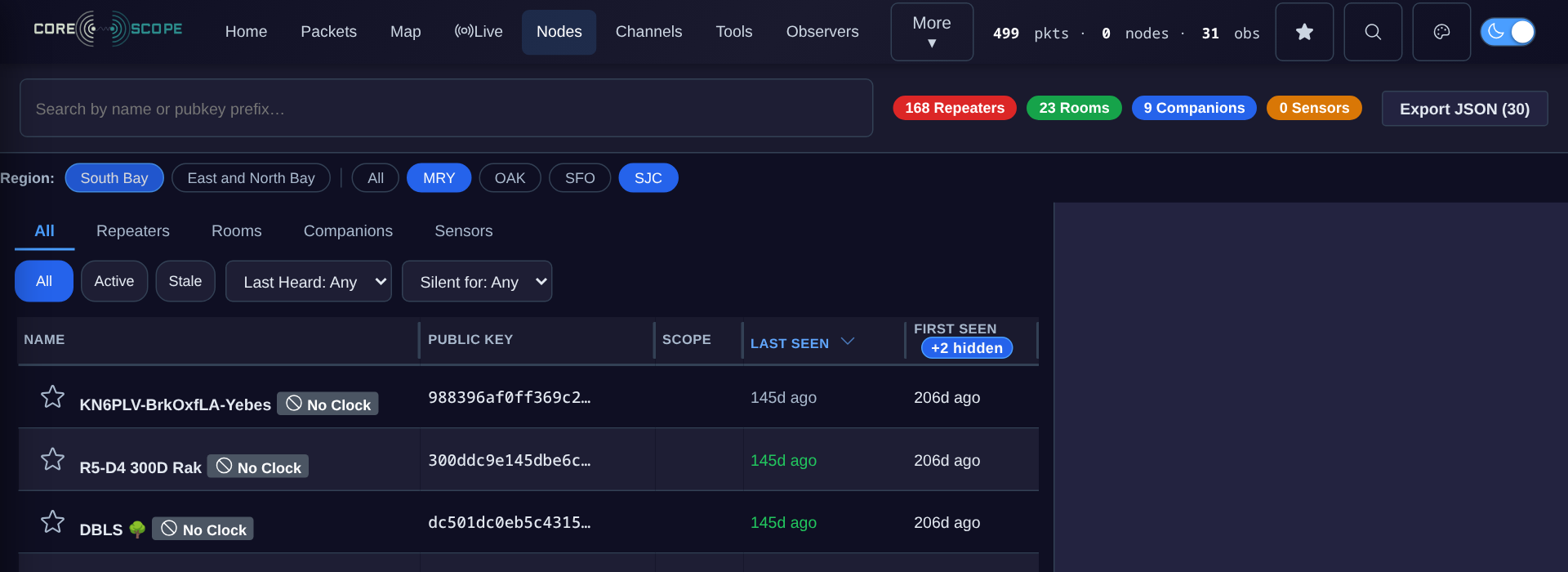 ## Config example ```json "regionQuickPicks": [ { "name": "South Bay", "description": "San Jose and Monterey observers", "regions": ["SJC", "MRY"] }, { "name": "East and North Bay", "description": "Oakland and San Francisco observers", "regions": ["OAK", "SFO"] } ] ``` Each pick needs a `name` and at least one code; `description` is optional (shown as the tooltip). Codes are trimmed, upper-cased and de-duplicated; a pick with no code that has an observer today is not shown. At most 20 picks of 200 codes. ## Browser validation The branch's server was run locally against a migrated copy of `test-fixtures/e2e-fixture.db` (observers in MRY, OAK, SFO, SJC) with three groups configured: "South Bay" (SJC, MRY, SCZ), "East and North Bay" (OAK, SFO, sts) and "Nowhere yet" (XXX). Checked in headless Chromium: | check | desktop 1280 px | phone 390 px (touch) | |---|---|---| | groups shown | South Bay, East and North Bay ("Nowhere yet" hidden) | same | | tap South Bay selects | SJC, MRY (SCZ has no observer) | same | | next `/api/packets` request | `region=SJC,MRY` | `region=SJC,MRY` | | selector label | "South Bay ▾" | "South Bay ▾" | | second tap | back to all regions | same | | button height | 24 px | 44 px | | page wider than viewport | no | no | | page errors | none | none | Checked on Packets (dropdown layout) and Nodes (pill layout). Three layout problems found this way on the phone were fixed before opening: a sideways-scrolling row clipped at the screen edge, the selector squeezed into a narrow column (the filter group is a non-wrapping flex row), and the two wrapped rows spread apart on Nodes (`align-content`). **Revision 1:** the first version put the picks in a separate row beside the selector; they moved inside the dropdown. Re-checked with a 14-region list and three picks on Packets: desktop 1280 px dark and phone 390 px light both keep the menu on screen (menu 340 px wide, page not wider than the viewport), the pick closes the menu and the trigger names the pick. **Revision 2:** picks are checkbox rows like **All** instead of chips. Re-checked on Packets at 1280 px dark and 390 px light: rows render bold under All, the divider separates the single regions, ticking a pick ticks its codes and names the trigger, no sideways scroll. Unrelated and not changed: on Nodes at 390 px the region row (existing pills included) starts flush with the screen edge. ## Tests - Red commit `81ea67d6`: the config type, a stub normaliser and endpoint returning nothing, and tests. - Go: cleaning (trim, upper-case, de-duplicate, drop incomplete groups), caps, nil config, and the endpoint's JSON. - Frontend, `tests/e2e/test-region-quick-picks.js` (moved from `tests/unit/` in `fced69a7`; it needs jsdom, so it runs in the E2E job like `test-table-sort.js`): the real `region-filter.js` in **jsdom** against faked config endpoints. Nine cases: rendering and hiding groups with no observer, selecting and re-querying, the selector label, toggling back, a hand-made selection marked active, the pill layout, no groups, a failed fetch, HTML escaping. Seven fail on the stub, all on assertions. - Green commit `0e33210e`: the implementation, styles, `config.example.json` (`regionQuickPicks` + `_comment_regionQuickPicks`), `docs/api-spec.md`, and the OpenAPI route list (`TestOpenAPICompleteness` requires it). The jsdom test also had a cross-realm comparison bug fixed in this commit (`Array.from` on arrays coming out of the jsdom window). - `make test`: 16 of 16 modules pass. Frontend suites: 195 of 196; the one failure, `test-issue-1956-release-routing.js`, needs CI's `GITHUB_REF_NAME` and fails the same way on `master` locally. - Red commit `f991060d` (revision): picks live inside the dropdown menu before the checkboxes, choosing one closes the menu, and in the pill layout they share the region bar; two fail on assertions against the old layout. Green commit `1f720e35`. Frontend 195 of 196 (same environment-only failure). - Red `134f5256` / green `da0adb50` (second revision): picks are checkbox rows between All and the single regions with a divider, no chips in the menu; ticking and unticking a pick row. The green commit also repairs `style.css`: `1f720e35` had prepended its block to the top of the file (its edit matched an earlier `.region-pill {`) and left the previous rules in place. The file now differs from `master` by 13 lines. ## Review notes - Groups are offered only when at least one of their codes appears in `/api/config/regions`, and only those codes are selected. The stored selection is pruned to known codes on load anyway, so selecting absent codes would not survive a reload. - Customizer (AGENTS.md rule 8): groups are operator configuration; a customizer editor could come later. ## SonarLint SonarQube Community rules (the SonarLint engine) were run on the files this PR touches, and only issues on lines it adds are listed. - **Fixed** in `b84ace4e`: - `normalizeQuickPickCodes` split out of the config normaliser (S3776, 17 > 15); - a comment on why a failed quick-pick fetch is ignored (S2486); - `for…of` in `activePick` (S4138); - in the tests: `node:` specifiers, `includes()`, and an explicit string comparator for sorted selections (S7772, S7765, S2871). - **Kept on purpose:** - S2486 is still reported on that `catch`. Swallowing the error is the intended behaviour: the filter works as before, just without picks. - S1523 on the `vm` test loader, as above. ## Checked against the repo rules - Rebased onto `master` (`673442cc`). Each red commit was re-run and still fails on its assertions; each green commit passes (TDD.md). - `make test`: all 16 modules pass. Frontend suites: all pass except `test-issue-1956-release-routing.js`, which needs CI's `GITHUB_REF_NAME` and fails the same way on `master` locally (#2160 addresses it). - No private data: test fixtures and examples use the codes the existing tests use (SJC/SFO/LAX, `#be`-style scopes). - No new `map[string]interface{}`, no hard-coded colours. `git add` was explicit, and there is one logical change per commit. 🤖 Generated with [Claude Code](https://claude.com/claude-code) https://claude.ai/code/session_01KaR4xu8gVykQBkH8yG8m6H --------- Co-authored-by: Claude Opus 5.5 <noreply@anthropic.com> |
||
|
efitenandClaude Opus 5.5
|
f3004d977e |
feat(rx-coverage): show where a companion drove and received nothing (#2172)
The Mobile RX coverage page (`#/rx-coverage`) shows only cells where a companion received something. Where a companion drove and received nothing is just as useful for operators, and the data is already there: the RF sample track (`client_rf_samples`, #1905/#1906) and the receptions (`client_receptions`) use the same hex grid (`hexCellAt`, `zoomToHexRes`). This PR adds those cells as a hatched layer under the reception cells. ## Changes in this PR **Server** - `GET /api/rx-coverage?...&gaps=1` adds a `gaps` member to the FeatureCollection: cells with moving (non-stationary) track samples and no reception in the same `days` window and `bbox`, each with `samples`. `gaps_truncated` is set when more than 5000 cells qualify (the most-sampled are kept, same pattern as `coverageFeatureCap` and `rfNoiseFeatureCap`). - Gaps are only returned when `clientRfSamples` is on and there is no `node` filter: with `?node=` the question would be "this node was not heard", which these cells do not answer. `?rx=` limits both the track and the receptions to that companion. - Without `gaps=1` the payload is unchanged: the `gaps` member is omitted. - New code lives in `cmd/server/rx_coverage_gaps.go` (pure `aggregateGaps` plus `queryTrackPoints`); the handler change in `rx_dashboard.go` is 14 lines. - `/api/rx-coverage` is now documented in `openapi.go` and removed from `openapi_known_gaps.json` (#1670). **Frontend** (`public/rx-coverage.js`, `public/node-reach-coverage.css`) - A "Nothing received" toggle on the signal layer, on by default, only rendered with `MC_CLIENT_RF_SAMPLES`. Hidden on the noise layer. - Gap cells use a 45-degree hatch (an SVG pattern in a dedicated renderer, so they sit under the reception cells). The hatch is denser for cells driven through more often (1 / 2-3 / 4+ samples). Tooltip: sample count. Legend entry: "driven, nothing received". - Off state is deep-linkable as `gaps=0`. - New token `--nq-cov-gap` for light and dark. Plain grey (`--nq-cov-grey`) already means "received, no SNR", so the hatch keeps the two apart. ## Threshold: one sample Measured on a live network (analyzer.on8ar.eu, Belgium, September to October 2026), with cells of about 250 m: a cell with track samples and no reception in one half of a month, driven again in the other half. How often did it receive something the second time? | Minimum samples | Cells "nothing received" | Driven again | Received something later | |---|---|---|---| | 1 | 3971 | 1263 | 29% | | 2 | 1565 | 592 | 32% | | 3 | 619 | 243 | 35% | | 5 | 142 | 63 | 40% | A higher threshold hides cells without making the rest more reliable, so the threshold is 1 and the wording is "nothing received in this period", never "no coverage". Using every decoded packet as reception evidence (including 1-byte path hashes) gave 25% to 32%, so the capture rule for 1-byte hashes is not what drives this. The median cell has 2 samples. ## Verification - Go: 7 new tests in `rx_coverage_gaps_test.go` (gap/no gap, stationary excluded, single sample, cap keeps the most-sampled, endpoint, `?rx=` filter, no `gaps` member when not asked / with `?node=` / with RF samples off). The endpoint tests fail without the handler change. Full `cmd/server` suite green locally, `go vet` and `gofmt` clean. - E2E: `tests/e2e/test-rx-coverage-gaps-e2e.js` (4 steps: no toggle with RF samples off, on by default with hatched cells under the reception cells, toggle off with `gaps=0` and deep link, noise layer hides it). 2 steps fail without the frontend change. Existing `test-rx-coverage-noise-e2e.js` and `test-rx-coverage-viewport-e2e.js` still pass. Listed in `scripts/non-unit-tests.json`. - Frontend unit suite (`test-all.sh`) green. - Real data on a staging instance (7 days, bbox 50.8,4.9,51.3,5.8, z=12): 478 reception cells and 379 gap cells, no cell in both, reception features identical with and without `gaps=1`, 0.48 s to 0.52 s per request both ways. - Browser: checked on staging with real data (light theme), and light, dark and 390 px wide with mocked data. ## Not in this PR - A per-node variant on the Reach page ("this repeater transmitted while a companion was nearby, and was not heard"). That needs the transmit moments from `observations` and is a heavier query. - `deploy.yml` does not get a line for the new E2E file, like the other entries that are only in `non-unit-tests.json` (#2037). Co-authored-by: Claude Opus 5.5 <noreply@anthropic.com> |
||
|
efitenandClaude Opus 5.5
|
d232072f85 |
feat: optional user accounts (part A: foundation) (#2129)
Part A of #2128: optional, off-by-default user accounts. With the feature off nothing changes; with it on, visitors can register and log in, and admins manage users and use the operator actions without the API key. PR #2130 (settings sync) builds on this one. The two are meant to be merged together. ## The situation - Operator actions (geofilter save and prune, backup, perf reset) need the shared `apiKey`. There is no per-person right. - Nothing in CoreScope knows who a visitor is, so the requests in #2128 that need that (#1835, #2092, #1508, #730) have nothing to build on. ## What this PR adds **Two new Go modules** - `internal/users`: a separate `users.db` (SQLite through `modernc.org/sqlite`) with users, sessions, single-use tokens, an audit log and a mail log. Passwords use argon2id. - `internal/mailer`: a `Mailer` interface with a Brevo client (send, delivery events, webhook parsing) and an in-memory fake for tests. **Server (`cmd/server`)**, active only with `userManagement.enabled` - 24 routes, all documented in OpenAPI under the `users` tag ([`auth_routes.go`](https://github.com/efiten/CoreScope/blob/feat/user-management/cmd/server/auth_routes.go)): - auth: register, activate, login, logout, me, forgot, reset; - account: profile, password, email change with confirmation, sessions, self-delete; - admin: list, detail, disable, enable, delete, role, resend activation, manual activation, mail status refresh; - a Brevo webhook, registered only when `mail.webhookSecret` is set. - `requireAdmin` replaces `requireAPIKey` at the 7 operator call sites: the API key **or** an admin session. With the feature off it is the old API-key gate (`TestRequireAdminWithoutUserManagementIsAPIKeyGate`). - `/api/config/client` gets `userManagement: {enabled: true}` only when the service started; with the feature off the response is byte-identical. **Frontend** - `auth.js` (header account control, request helper that adds the CSRF header), `account.js` (login, register, activate, forgot, reset, confirm email, my account), `admin-users.js` (`#/admin/users`, deep-linked filters), `account.css` (theme tokens only). - On phones the top-bar control is hidden, so a conditional entry goes into the bottom-nav "More" sheet and the nav drawer. - The customizer geofilter tab and the Perf "Reset stats" button use the admin session when there is one. **Config.** A `userManagement` block (`config.example.json`, [`docs/user-guide/accounts.md`](https://github.com/efiten/CoreScope/blob/feat/user-management/docs/user-guide/accounts.md)). The Brevo key can come from `CORESCOPE_BREVO_API_KEY`. The server refuses to start when the block is enabled but incomplete. ## Security choices - Session cookie `cs_session`: HttpOnly, SameSite=Lax, Secure when `publicBaseUrl` is https. Every cookie-authenticated state change needs the `X-CS-CSRF` header and a matching Origin. - Activation needs the token **and** the account password. Without the password, an attacker who keeps re-registering a known address could get the owner to activate an account that carries the attacker's password. - Register, forgot and email change answer identically for known and unknown addresses. A password reset ends all sessions, a password change ends all other sessions, and both end outstanding email-change links. - Rate limits: login 10 per 15 minutes, register and forgot 5 per hour, per IP and per address. The bucket count is capped. `trustedProxies` makes the per-IP limits see real client IPs behind a proxy. - Server logs carry `#<user id>`, never addresses, tokens or passwords; mail-provider error texts are redacted before logging. ## Performance No change to an existing hot path with the feature off. With it on: - One `users.db` lookup per authenticated request (session by token hash). - The admin user table rebuilds its `tbody` on each filter change. `users.List` caps the result at 1000 rows (`internal/users/users.go`), which bounds the rebuild. - `map[string]interface{}` in `openapi.go`: 79 before, 78 after. ## Verification - `internal/users`, `internal/mailer` and `cmd/server`: `go vet` and `go test -race` pass locally. 121 new Go tests. - `cmd/server` with `-tags e2etest`: vet and the e2e hook tests pass. - `sh test-all.sh` exits 0. `tests/unit/test-user-management-ui.js`: 67 passing (vm, real modules). - `tests/e2e/test-user-management-e2e.js` (6 steps) passed locally against an `e2etest` build with the fake mailer and against a feature-off build. CI builds the `e2etest` binary and runs the suite on a second server (`deploy.yml`). - On a staging instance with a real Brevo key: register, activation mail delivered, activate, admin table, "Refresh status" showing sent, deferred, delivered, opened and clicked. ## Not in this PR - Settings sync (#2130), the admin dashboard, approval flows and notifications (parts B to E of #2128). - A `requireReadAuth` mode (#1835). Sessions from this PR are what such a mode would accept. - Binary size and build time with `modernc.org/sqlite` linked next to `mattn/go-sqlite3` were not measured. Their driver names do not collide. #1992 discusses the driver choice. - No Brevo webhook was configured on staging; delivery status there came from "Refresh status". --------- Co-authored-by: Claude Opus 5.5 (1M context) <noreply@anthropic.com> |
||
|
efitenandClaude Opus 5.5
|
000d9ab030 |
feat(coverage): RF noise-floor layer on the Mobile RX coverage page (#2113)
The ingestor already stores the noise floor that CoreDrive RX companions
report with each GPS fix (`client_rf_samples`, opt-in through
`clientRfSamples`, `cmd/ingestor/client_rf_sample.go:62`), but nothing
reads it back. An operator who enables it collects the data and cannot
see it. This adds the read side: `GET /api/rf-noise` and a Signal/Noise
toggle on the Mobile RX coverage page.

## What it does

- **`GET /api/rf-noise?bbox=&z=&days=`** returns a GeoJSON hex grid with
the median, quietest and noisiest noise floor per cell, in the same
shape as `/api/rx-coverage`. It is registered always and 404s unless
`clientRfSamples.enabled` is true, the same pattern as the coverage
routes.
- **Stationary samples are excluded.** A parked companion logs hundreds
of readings at one point, which would otherwise define its cell.
- **Coverage page:** a Signal/Noise toggle, rendered only when
`/api/config/client` reports `clientRfSamples: true`. The noise layer
reuses the coverage colour tokens with the axis inverted, because a
lower dBm is quieter. Tiers are at -115 and -108 dBm.
- **Deep link:** `#/rx-coverage?layer=noise` opens on the noise layer.
- **Empty and failed answers** are labelled on the map ("No RF samples
in this view yet", or a retry hint), so a blank map never reads as
"feature off".

No new configuration key: it reads the existing `clientRfSamples`
section that the ingestor already uses. Default off, so nothing changes
for an instance that has not opted in.

## Where it comes from

Ported from the efiten/CoreScope fork, where it has run on
analyzer.on8ar.eu since September (fork commits `42d09f0e`, `80581c43`,
`cde95078`). The cherry-picks conflicted with upstream's newer
`routes.go`, `types.go` and `rx-coverage.js`, so the final state was
ported by hand. The fork-only `/scopes` route that sat next to it in the
same hunk is deliberately left out.

## Performance

The query is bounded by `sampled_at` (indexed, `idx_crf_prune`) and the
bbox, aggregation is one pass plus a per-cell sort, and the response is
capped at 5000 cells. Measured on analyzer.on8ar.eu, all of Belgium
(`bbox=49.4,2.4,51.6,6.5&z=9`), from a client in Belgium, so network
time included:

| window | samples | cells | response time |
|---|---|---|---|
| 7 days | 10,835 | 241 | 0.37 s |
| 30 days | 43,303 | 429 | 0.39 s |

That table holds 45,270 rows in total. It is only read when someone
opens the noise layer, never on ingest or WebSocket paths.

## Tests

- `cmd/server/rf_noise_test.go`: 8 tests for the aggregation (median and
extremes, stationary exclusion, the cell cap, empty input) and the gate
(404 when off, even with data present). All pass, and the full
`cmd/server` suite passes locally.
- `tests/unit/test-rx-coverage-noise.js` (new, in `test-all.sh`): the
colour axis runs the right way, including both tier bounds and a string
median from the API. Slices the real function out of `rx-coverage.js`
and fails on master's copy, which has no thresholds.
- `tests/e2e/test-rx-coverage-noise-e2e.js` (new, wired in `deploy.yml`
and `scripts/non-unit-tests.json`): no toggle when the flag is off;
Noise fetches `/api/rf-noise`, draws the cells, swaps legend and
subtitle, puts `layer=noise` in the hash; a deep link opens on the noise
layer and an empty answer shows the message. 3/3 locally; against
master's `rx-coverage.js` and `roles.js`, 1/3 (only the "flag off" case
passes, as it should).
- `test-rx-coverage-viewport-e2e.js` still passes. ESLint 8 reports 0
errors on the changed files.

## Not done

- The thresholds (-115 / -108 dBm) are fitted to the fork's own data
(1,241 moving samples at the time) and are constants in
`rx-coverage.js`. Per AGENTS.md rule 8 they belong in the customizer
eventually; not in this PR.
- The E2E suite mocks the API. The real endpoint is covered by the Go
tests and by the measurements above, not by a fixture with seeded
samples.

Co-authored-by: Claude Opus 5.5 <noreply@anthropic.com>
|
||
|
Sylvain Rabot
|
a4a447acea |
fix(packets): pack short columns, one expand arrow, Full Names toggle (#2090)
The packets table wastes most of its width on short columns, draws two arrows on grouped rows, and cuts every observer and hop name short. This fixes all three and adds a way to read the full path when it does not fit. ## Why the columns were wide `makeColumnsResizable` measured each column once on load and stored the widths as **percentages** of the table. Percentages grow with the screen: on a 2000px display "17s ago" sat in a 180px column. The measurement also read the virtual-scroll spacer row — a single `colspan` cell as wide as the table — as column 0, so the expand column came out 160px wide locally and about 950px on a live instance with grouped rows. Measured on the fixture at 2000px: | Column | Before | After | |---|---|---| | Expand | 162–230px | 32px | | Time | 111px | 67px | | Size | 64px | 46px | | HB | 44px | 29px | | Scope | 80px | 48px | | Path / Details | ~180px each | ~650px each | ## The change **Column packing.** A new `fitColumnsToContent` (`app.js`) sizes every column except Path and Details to its widest cell, in px; those two split what is left. Every visible column gets an explicit width and the table gets their sum: a spacer row keeps a slot for each hidden column, and leaving any column `auto` hands those slots a share of the slack as a blank strip at the right edge. When space is short (detail panel open, narrow window) the widest fixed columns give way first, then Path and Details shrink to 60px, and only then does the wrapper scroll. The split itself is a pure function, `distributeColumnWidths`, with unit tests. It re-lays out when the container resizes (detail panel), when TableResponsive hides or reveals columns (a new `table-columns-changed` event), and after sorting or a column toggle. After each render `grow()` widens columns for the rows just inserted and never narrows them, so nothing jitters while scrolling. Drag handles store px; double-clicking one resets it. Path and Details have no handle. `makeColumnsResizable`, still used by the nodes, observers and analytics tables, now skips `colspan` rows when measuring; other rows are measured as before. **One expand arrow.** A CSS `::before` "▶" sat next to the SVG caret, which pointed up when collapsed. The glyph is gone and the caret points right, then down. **Full Names.** A toolbar toggle next to Hex Paths shows observer and hop names untruncated. It is saved per browser; a link can carry `fullNames=1`, which applies to that page without overwriting the visitor's saved preference. Paths stay on one line: the virtual scroller positions rows at one fixed height, so wrapping would make scrolling jump. **The "+N" path pill, and a full-path popover.** Hops past the column edge were meant to go behind a "+N" pill (#1124), but the pill was appended after the overflowing chips and so sat past the clipped edge: it never showed. It is now sticky at the right edge, opaque on hover, and counts hop chips only (it used to count warning icons too). Hovering or focusing it shows the full path, one hop per line and numbered; click, Enter or Space pins it until an outside click or Escape, and it closes when the page changes or its row scrolls away. Clicking the pill no longer selects the row underneath. **Two related fixes.** - Rows drawn before `/api/observers` resolves show raw 64-char pubkeys. `loadObservers` now re-renders and re-measures, instead of leaving Observer at the pubkey's width (~600px under Full Names). - Group child rows indented every cell by 20px, which misaligned them with the headers and widened every column on expand. Only the Time cell is indented now. Anyone who had dragged packet columns gets the new defaults once: the old percentage key is dropped. ## Performance `grow()` runs after every `renderVisibleRows`, so it is on the hot path. Measured in Chromium on the fixture, 300 iterations, three runs: | Case | Cost | |---|---| | Full render, 63 rows measured | +0.88–0.93ms over the forced reflow alone | | Scroll step (incremental render) | ~73 `Range` rect reads, only the inserted rows | | Large jump / re-render | ~569 rect reads | Before narrowing `grow()` to inserted rows, one scroll step with 92 rendered rows made 5,472 rect reads. The DOM row count is bounded by the virtual-scroll window, so the cost does not grow with the packet count. `distributeColumnWidths` is a binary search over at most ~10 columns. ## Tests - `tests/e2e/test-packets-compact-columns-e2e.js`, 16 cases: short columns stay under fixed px bounds at 1920px; Path and Details take the freed width; hiding both still fills the wrapper; no blank strip and no horizontal scroll, with and without the detail panel, at 1920, 1100, 1000 and 375px; responsive reveal and re-hide refit; stale percentage widths dropped; drag follows the pointer and double-click resets; expanding a group leaves widths alone; Full Names untruncates, keeps paths on one line, persists and round-trips through the URL; the Observer column shrinks back when observer names arrive late; the pill popover lists every hop vertically, closes when the pointer leaves, pins on click without selecting the row, closes on Escape and on navigation, and opens on keyboard focus. Registered in `scripts/non-unit-tests.json` and `deploy.yml`. - On `master` the suite fails where it should, and restoring each fix's old behaviour (child-row indent, the late-observer refit) turns its case red. - `tests/unit/test-packets.js`: `distributeColumnWidths` (room to spare, rounding, widest-first capping, floors, dragged columns, the 60px minimum, overflow), the single chevron and no `::before` glyph, Full Names on flat and grouped observer cells, and the Full Names CSS. - `tests/unit/test-xss-escape-sinks.js` now builds the real `obsCellName` from source: escaping moved into it. Removing its `escapeHtml` turns both observer-cell tests red. - `test-issue-1189-composed-cell.js` and `test-issue-2012-clear-filters-selection.js` evaluate packets.js fragments with injected helpers and needed `obsCellName` / `showFullNames` added. - Existing packets E2E suites pass on this branch and on master against a CI-prepared fixture: scope column, #1128 (layout and multi-viewport), #1122, #1188, #1648, table sort, #1692, #1486. - Unit: 182 of 183 suites pass locally; `test-issue-1956-release-routing.js` could not create a temp directory in my sandbox and is unrelated. ## Browser validation Checked in Chromium against the fixture at 2000, 1920, 1280 (panel open and closed), 1100 and 375px, and with the seeded grouped row expanded and collapsed. Screenshots taken at each step; the table fills its container exactly, grouped rows show one arrow, and the pill popover lists full names. ## Not done, deliberately - **No width cap on Observer under Full Names.** A cap brings back the truncation the toggle removes, and Observer is already the first column to give way when space is short. - **Customizer.** The floors (60px flex minimum, 64px shrink floor, 32px expand, 58px Rpt) are hardcoded, per AGENTS rule 8; exposing them in the customizer can follow. - **Wrapping paths.** Rejected because of the fixed row height above; the pill popover is the way to read a long path. |
||
|
efitenandClaude Opus 5
|
25f8426d32 |
test: make every suite in tests/e2e run, and tell the truth when it does (#2053)
Closes #2037. Step 1 (#2045) wired in the nine suites that already passed. This is steps 2 and 3: the four that ran and failed, and the five that could not run at all. After this, the count of suites in `tests/e2e` invoked by nothing goes from 18 to 0. ## Step 2 — the four that ran and failed Triaged against a fixture server in CI with full output kept, not the four-line tail the first probe saved. | suite | verdict | |---|---| | `test-packets-scope-column.js` | passes on master today. It failed on 2026-09-18, so something between the two fixed it. Wired in unchanged rather than investigated. | | `test-node-reach-e2e.js` | test wrong. It waited for the reach map whenever any *link* had GPS; `public/node-reach.js` builds the map only when the *node* has coordinates. Guaranteed 10s timeout on a node with positioned neighbours and no position of its own. | | `test-channel-modal-e2e.js` | both failures test-side. The Add button's visible label was shortened to "+ Add" with the accessible name moved to `aria-label` (`public/channels.js:746`); and `.ch-section-mychannels` is conditional on the visitor having added a channel, which has not happened at that point in the suite. | | `test-touch-targets.js` | three test-side, two a product finding. | The three test-side touch-target failures were the harness measuring controls that are not shown: `.compare-btn` (the CTA was removed in #1646, and `style.css` says so), `.ch-back-btn` (`display:none` outside the mobile channels layout), and `.filter-toggle-btn` (`display:none` on mobile since #1461; the control shown is the navbar mirror, which `mobile-page-actions.js:70` builds as a `.nav-btn`, so it was already measured). All three are dropped from the table with the reason recorded in the file. The remaining two are **not** a test problem: `.nav-btn` and `.ch-icon-btn` are each declared twice in `public/style.css`, 48px in the touch-target block and 44px in their own component rule, and the later one wins. Rather than lower the blanket or hide the failures, the suite now has `DEFAULT_MIN = 48` plus a `MIN_OVERRIDES` table holding those two at their effective 44, so a third selector dropping to 44 still fails the build. The contradiction is **#2052**, with both ways out costed; the override entries should go when it is settled. ## Step 3 — the five that could not run None is deleted. I checked each selector and seam against the product before deciding, and every one still targets a surface that exists and that nothing else covers. Four were written against `@playwright/test`, a runner the project neither installs nor uses anywhere else. Adopting a second runner for twelve tests costs more than porting them, and the precedent is already set: `test-path-inspector-coverage-e2e.js` exists, as its own header says, because `test-path-inspector-e2e.js` could not run. So they are ported to the plain-node Chromium pattern the other 109 suites use. - **`test-issue-1522-trace-url-sync-e2e.js`** — the trace hash in the URL, both directions. `test-e2e-playwright.js` covers that the page loads and searches; it never looks at the URL, which is the whole of #1522. - **`test-marker-outline-weight.js`** — the canvas pulse ring never thins below 2px. There is no CSS rule to read and axe cannot see inside a canvas, so sampling the seam is the only way. Added a guard that the ring was actually visible, so the weight check cannot pass vacuously on a pulse that never rendered. - **`test-pr-1490-live-map-gpu-animations-e2e.js`** — the queue drains, the engine sleeps again, the fading trails stay under the cap of 5, and the canvas sits on `animationsPane` rather than under the markers. - **`test-path-inspector-e2e.js`** — reduced to what nothing else covers: the map side pane, the `/#/traces/<hash>` redirect, the tools landing. Its standalone-page test duplicated the wired coverage suite and is dropped. Its "switching candidate clears prior polyline" case ended after the click with a comment and no assertion, which is the same green-but-empty problem this issue is about; it now compares path counts, and skips loudly when the fixture yields too few candidates. The fifth, **`test-table-sort.js`**, needed `jsdom`, which was declared nowhere. It is a unit test of `public/table-sort.js` filed under `tests/e2e`, so: `jsdom` is a devDependency (lockfile updated, `npm ci` stays consistent), the file moved to `tests/unit/`, and the `domIntegration` group in `scripts/non-unit-tests.json` is gone with its only member. It runs 22 tests. 20 passed immediately; 2 had rotted, because #1648 M2 replaced the up/down glyphs with Phosphor sprites and the direction moved out of `textContent` into the `<use href>`. Those two now read the sprite ref and the `aria-sort` value, so they also guard the accessible announcement. ## Verification `tests/unit/test-table-sort.js` 22/22 and `test-test-inventory.js` pass locally; the E2E suites need a fixture server, which I cannot build here (no cgo toolchain since #1992), so CI is their first run as committed. The triage above was measured in CI, not assumed. ## Not done The per-assertion skips named in the second comment on #2037 are untouched: the two flaky packet-detail cases, the fixture-data ones, and the two `clientRxCoverage` suites that skip wholesale while reporting success. Those need a fixture deployment with coverage enabled, which is its own change. I have not opened it. Option 2 from the issue, making `test-test-inventory.js` require a `deploy.yml` line for every `tests/e2e` file, is also not here. It is the right guard and it is now enforceable, since the list is finally at zero, but it belongs in its own change where a red build means what it says. --------- Co-authored-by: Claude Opus 5 (1M context) <noreply@anthropic.com> |
||
|
efitenandClaude Opus 5
|
5c016a210a |
fix(analytics): show a building state on the distance index's 202, and stop caching it (#2051)
Closes #1997. ## What was wrong `/api/analytics/distance` answers `202 {status:"building", retry_after_seconds:5}` with no `summary` until the lazy index (#1011) has been built. 1. `renderDistanceTab` read `data.summary.totalHops` straight away. The TypeError is caught by the tab's own try/catch, so it never reaches `window.onerror`: it is painted into the tab as `Failed to load distance analytics: Cannot read properties of undefined (reading 'totalHops')`. 2. `api()` caches any `res.ok` body, and `res.ok` is true for 202, so the placeholder was stored for the `analyticsRF` TTL. Even a correct retry read the cached "building" body back. That is the half that made the broken state outlast the index build. ## What changed - `public/app.js:173` skips the cache write when `res.status === 202`. A 200 still caches, unchanged. - `public/analytics.js` renders a building notice and retries itself, honouring `retry_after_seconds` clamped to [1s, 30s]. The timer is cleared on tab switch and in `destroy()`, and a new render supersedes a pending retry, so two renders cannot write into the same tab. The notice uses `.text-center`/`.text-muted` rather than the `.spinner` class used at `analytics.js:1683`, because `.spinner` has no CSS anywhere in the repo and renders nothing. ## Tests `tests/unit/test-issue-1997-distance-building.js` (7 assertions, wired into `test-all.sh`) pins the two pure decisions the renderer makes and `api()`'s refusal to cache a 202 while still caching a 200. Red-run on the unfixed sources: 6 of 7 fail, and the "a 200 is still cached" control stays green. `tests/e2e/test-issue-1997-distance-building-e2e.js` (classified in `scripts/non-unit-tests.json`, invoked from `deploy.yml` with `CHROMIUM_REQUIRE=1`) serves both responses by route interception, so it does not depend on whether the server under test has an index built. It asserts: the building state appears, the tab does not paint the error text, a retry arrives with no interaction, the retry replaces the placeholder once the server answers 200, and no retry fires after leaving the tab. Check (2) deliberately asserts on the rendered text and not on `pageerror`: the TypeError is caught, so a `pageerror` assertion would pass on the broken build too. ## Verification No local cgo toolchain here since #1992, so I could not build a server to run the E2E against. Instead I ran its five steps in Playwright against a live instance with this branch's `public/app.js` and `public/analytics.js` injected in place of the deployed ones (both files are byte-identical between that instance and upstream master, so the injection is faithful): | check | deployed build | this branch | |---|---|---| | (1) building state shown | fail | pass | | (2) not rendered as data | fail | pass | | (3) retried on its own | fail (1 request) | pass (2 requests) | | (4) real payload after retry | fail | pass | | (5) no retry after leaving the tab | pass | pass | (5) passes on the broken build too: it schedules no retry at all, so it is a control and only means anything together with (3). The committed E2E suite has not been run as committed. CI is its first real run. ## Not done - The server still recomputes on every 202 poll rather than signalling readiness. - No other analytics tab was audited for the same assume-a-summary pattern. - One pre-existing unit suite (`test-preflight-xss-gate.js`) fails on this Windows machine with a cp1252 `UnicodeEncodeError` from its Python helper, on a clean tree as well as with this change. Unrelated, and green on Linux CI. Co-authored-by: Claude Opus 5 (1M context) <noreply@anthropic.com> |
||
|
liquidraver
|
84eba41592 |
fix(live): anchor the legend toggle to .live-page so the VCR bar stops eating its clicks (#2049)
The PACKET TYPES legend could not be dismissed on Live: clicking the palette toggle did nothing, while document.querySelector('#legendToggleBtn').click() from the console worked. That asymmetry was the diagnosis, since a synthesised click skips hit testing.

Residual half of #1833. That fix corrected the button's offset to calc(var(--vcr-bar-height) + 10px) but left the anchor: .legend-toggle-btn was position: fixed, so the offset resolved against the viewport, while the .vcr-bar it clears is absolute inside .live-page, whose height subtracts --bottom-nav-reserve (56px + safe-area at <=768). The two anchors disagreed by exactly the reserve, dropping the button into the bar's band, and .vcr-bar at z-index 1000 against the button's 500 took every real click. The window is 641-768px: below 641 both buttons are display:none, above 768 the reserve is 0, which is why neither the desktop nor the phone layout test saw it.

Both buttons are now position: absolute, resolving against the same containing block as the bar. .feed-show-btn carried the identical defect but missed the bar by 16px because --legend-toggle-stack parks it a row higher, so that change prevents a break rather than repairs one.

Three review rounds, each verified rather than argued:
- The new E2E was classified in non-unit-tests.json but had no deploy.yml line, so it would never have run (#2037). Now wired in, and it covers both buttons.
- The '.feed-show-btn is display:none at <=768' claim was wrong (it is <=640), which the author measured and corrected.
- Its first real execution failed on its own setup: getComputedStyle().getPropertyValue() on an unregistered custom property returns the unevaluated declaration ('calc(56px + 0px)'), so the non-zero check could not work. It now asserts the measured gap instead, and deliberately does not pin 56 because the gap measures 58 on CI.

Final run: 14 passed, 0 failed. The discriminating assertion is (f), each button's offset net of the bar being identical at 720 and 1440 (11px and 123px slack); under the old anchor those differ by the reserve. (g) pins the desktop layout unmoved.

Merged by the interim maintainer without a second human reviewer: CI and the review above are the independent checks.

Fixes #1833
|
||
|
liquidraver
|
bbf54cfe1b |
fix(rx-coverage): open at the configured map default, with its own saved viewport (#2033)
The coverage page opened at a hardcoded [51.0, 4.8] zoom 8 regardless of deployment, ignoring /api/config/map (#2032). It now follows the same precedence as the main map (URL hash, then saved position, then /api/config/map, then [37.6, -122.1] zoom 9) and persists its own position across visits, syncing lat/lon/zoom into the hash so a view is shareable. The saved position lives under its own key, rx-coverage-view, and the page never reads or writes the main map's map-view: sharing the configured default was the bug, sharing the session position was not. Both suites assert map-view stays untouched after a pan, so reintroducing a shared write fails instead of passing quietly. Also fixed here: selectedRx is now percent-encoded into the hash, and a generation counter stops a late /api/config/map response or a stale 150ms layout timer from building a map for a page that was already left. Reviewed twice. Verified by mutation rather than by reading: writing map-view too, ignoring the saved coverage position, and dropping the /api/config/map fetch each make the unit suite exit 1, so it covers the feature, the fix and the rejected alternative. The deploy.yml invocation was confirmed to land inside Run Playwright E2E tests (fail-fast) by parsing the workflow, and CI run 35261689694 is the E2E suite's first real execution: Go prints 'RX coverage viewport regressions OK' and Playwright prints 'RX coverage viewport browser regressions OK'. Worth recording for the next reviewer: that E2E asserted localStorage.getItem('map-view'), so wiring it into deploy.yml without updating the assertion would have turned the job red on its first ever run. It was registered in scripts/non-unit-tests.json but invoked by nothing, the gap tracked as #2037. Merged by the interim maintainer without a second human reviewer: CI and the mutation checks above are the independent checks. Fixes #2032 |
||
|
Alex B
|
893773338e |
chore(tests): move root test-*.js into tests/unit and tests/e2e (#2036)
Moves 290 root test-*.js into tests/unit (177, listed in test-all.sh) and tests/e2e (113, classified in scripts/non-unit-tests.json), per #1981 and PR-D of #1385. Root goes from 348 entries to 48. test-all.sh and test-fixtures/ stay put. The inventory guard now fails if a test reappears in the root or sits in the wrong folder.
Verified independently of the diff: the invoked sets are unchanged (test-all.sh 177 before and after, deploy.yml 96 before and after, both identical as sets), and a full local run of test-all.sh on master and on the branch produced 4702 output lines each whose only differences are absolute paths, stack-trace line numbers shifted by the REPO_ROOT line, the inventory wording and two perf ratios. The guard was mutation-checked: a test back in the root, a unit suite in tests/e2e, and a suite dropped from test-all.sh each make it exit 1. CI run 35246304316 ran 97 suites from tests/e2e and is green.
Follow-up
|
||
|
n30nex
|
cd9b4c04d0 |
test: unify frontend test runs and prevent inventory drift (#1965)
Make `test-all.sh` the authoritative standalone frontend runner for npm and CI. Restore stale assertions and reject missing, duplicate, removed or undocumented inventory entries. Fixes #1858. Rebased onto `a2f039d4`. Retains release-routing, map scope-state and Scope Audit stylesheet tests, adds `test-packets-local-channels.js` to the sorted runner, and classifies `test-neighbor-map-btn-clip-e2e.js` under browser. Its separate CI browser step is preserved. Inventory: 280 root suites, 167 standalone, 113 requiring separate setup. The icon repair fixes two suites red on master: `test-issue-1648-m2-emoji-scan.js` and `test-issue-1648-m6-final-sweep.js`. Node/live configured-scope confirmations now use the existing accessible Phosphor check sprite. Values, visibility conditions and scanner assertions are preserved. - Red evidence: `89e45a9` inventory assertions; `4e255df` accessible confirmation assertion. The latest rebase also reproduced both unclassified-file failures before adding their entries. This follow-up only changes runner/classification configuration and counts; no test files modified. - Local validation: all 167 standalone suites; 27 M2 browser checks and 16 neighbor geometry checks in Chromium. Syntax, whitespace, PII, CSS-variable and XSS checks passed. - Browser coverage includes populated/empty/null configured scopes in node and live views. - No new dependencies, requests, application settings or Go changes. Workflow outside the unit step matches master. - Windows validation uses process-local UTF-8 settings. Encoding and node-reach confirmation follow-ups remain separate, as requested. ## Preflight override External `run-all.sh` is unavailable; applicable repository checks were run directly. |
