mirror of
https://github.com/Kpa-clawbot/meshcore-analyzer.git
synced 2026-10-13 08:57:17 +00:00
 Alex BandClaude Opus 5.5
a4ee3a7328
Alex BandClaude Opus 5.5
a4ee3a7328
## Summary Builds on the transport view from #2167 and #2169 (both merged); rebased onto `master` (`352a0ccd`), so the diff is this PR's six commits only. The Scope Audit was the one analysis page without the region selector. This adds the shared region filter to it, for both the declared and the transport view. `?region=SFO,SJC` means what it means on every other endpoint: count only forwarding **heard by observers in those regions**, not repeaters located there. - **API** (`GET /api/scope-audit`, both modes): - The region codes are resolved to their observers first (a handful of rows), then the audit's hop scan gets `AND o.observer_idx IN (…)` on v3, or `o.observer_id IN (…)` on v2. The 3.5M-row hop scan never joins `observers`. - `All` means no filter (shared `normalizeRegionCodes`). Codes with no observer match nothing, instead of silently widening to every observer. - Responses echo the normalised codes as `region`. The declared and transport caches and their singleflight keys now include the region, so each region set is cached separately with the existing TTLs. - Declared-region verification (`regionEvidence`) is deliberately left unfiltered: it corroborates what a repeater declares from its own traffic, which doesn't depend on where a hop was heard. - **Page:** the shared `RegionFilter` sits with the view and window controls; a change reloads the view, and the selection persists like every other page. The transport view's text box is relabelled **Scope** (it already sends `?scope=` since the rename in #2167), so the page no longer has two controls called Region. - **Docs:** `docs/api-spec.md` (parameter, both response shapes) and the OpenAPI parameters for the route (`mode`, `scope` and `region` were all missing). Partial fix for #2142 (its region filter for rollout tracking), together with #2167 and #2169. ## Performance The unfiltered path must not get slower: it's the same query with an empty clause. `BenchmarkComputeScopeTransport` (from #2167, 1,200 repeaters), the PR it stacks on vs this branch, `-count 8`: | | before | after | | |---|---|---|---| | sec/op | 220.3 ms | 218.0 ms | ~ (p=0.065) | | B/op | 43.77 MiB | 43.70 MiB | ~ | | allocs/op | 833.5k | 833.5k | ~ | **Filtered requests, measured on staging** (a copy of a production database): the first version drove `o.observer_idx IN (…)` from `idx_observations_observer_idx`, reading every observation the region's observers ever made. Fixed in `80414242` with a unary `+` (the same treatment as #2166), so the scan starts from the `first_seen` window and filters per row. Red test `67e063b1` asserts the query plan against a fixture with the real indexes. | scan, one region over 24h (13 observers) | plan | time | hop rows | |---|---|---|---| | `o.observer_idx IN (…)` | observer index | 13.44 s | 102,114 | | `+o.observer_idx IN (…)` | `first_seen` window | **0.25 s** | 102,114 | | unfiltered | `first_seen` window | 0.35 s | 225,983 | Cold end-to-end requests on staging after the fix: 24h declared, unfiltered 0.84 s · one region 0.48 s (was 16.7 s) · two regions 0.22 s · transport, one region 0.42 s · transport, six regions 0.75 s · 7d, one region 3.46 s. 24h transport, live data: 383 repeaters unfiltered, 204 heard by one country's observers. ## Tests - Red `629e4f36` (Go): extends the audit fixture with an `observers` table and `observations.observer_idx`. Covers the declared view ignoring a scope heard only by another region's observer, the transport view listing only repeaters heard in the region, `region=All`, per-region caching, a region with no observers, and the echoed codes. Five fail on assertions; `region=All` passes because the stub ignores the filter, which is the behaviour it pins. - Green `6f1b1e1c`: the implementation, plus a v2-schema case (`observer_id`), so both branches of the clause are covered. - Red `b4933d68` / green `08ecc172` (frontend): `apiPath` carries the selection in both views and adds nothing when none is selected. The region control on the page is a net-new UI surface. - `go test` (cmd/server) passes. Frontend suites: 193 of 194. The one failure, `test-issue-1956-release-routing.js`, needs CI's `GITHUB_REF_NAME` and fails the same way on `master` locally. ## Screenshot The same transport view with the shared region filter set to **SJC**: only forwarding heard by San Jose observers counts, so 7 repeaters are listed instead of 44, with their carried scopes counted from those observers alone. Taken against `test-fixtures/e2e-fixture.db` with fictional scopes. 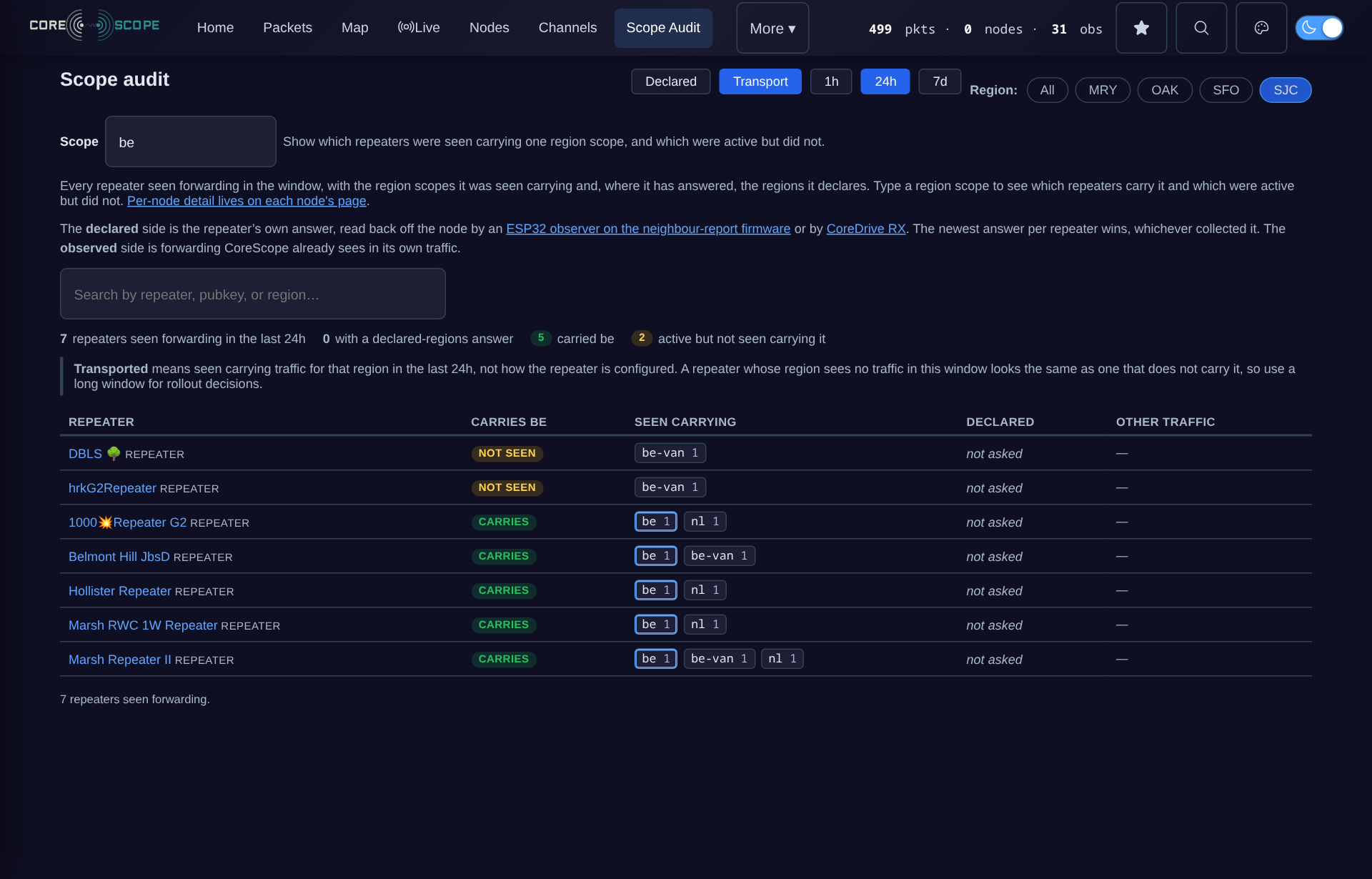 ## Browser validation The branch's server was run locally with 14 configured regions (dropdown layout), checked in headless Chromium at 1280, 900, 700 and 390 px (touch): | check | 1280 | 900 | 700 | 390 touch | |---|---|---|---|---| | ticking SJC re-requests with `®ion=SJC` | yes | yes | yes | yes | | menu fully on screen | yes | yes | yes | yes | | page wider than viewport | no | no | no | no | | page errors | none | none | none | none | Found and fixed this way: the filter is the right-most control on desktop, and the menu (which opens rightwards) ran 66 px off the page. It now opens leftwards above 640 px. On a phone the controls wrap, the filter starts a line, and the default applies. ## SonarLint SonarQube Community rules (the SonarLint engine) were run on the files this PR touches, and only issues on lines it adds are listed. - **S3776 on `ScopeAuditForwardingHeardIn`:** complexity 55. The function it generalises, `ScopeAuditForwarding`, is 54 on `master`; the region clause adds one point. - **S3776 on `computeScopeAudit`:** complexity 65, unchanged from `master`. - Both pre-date this PR. Splitting them is better as a refactor PR of its own than mixed into a feature. - The page code's findings were fixed in the transport-view PR it stacks on. ## Checked against the repo rules - Rebased onto `master` (`673442cc`). Each red commit was re-run and still fails on its assertions; each green commit passes (TDD.md). - `make test`: all 16 modules pass. Frontend suites: all pass except `test-issue-1956-release-routing.js`, which needs CI's `GITHUB_REF_NAME` and fails the same way on `master` locally (#2160 addresses it). - No private data: test fixtures and examples use the codes the existing tests use (SJC/SFO/LAX, `#be`-style scopes). - No new `map[string]interface{}`, no hard-coded colours. `git add` was explicit, and there is one logical change per commit. 🤖 Generated with [Claude Code](https://claude.com/claude-code) https://claude.ai/code/session_01KaR4xu8gVykQBkH8yG8m6H --------- Co-authored-by: Claude Opus 5.5 <noreply@anthropic.com>

1616 lines
64 KiB
Go
1616 lines
64 KiB
Go
package main
|
|
|
|
// Issue #1975: the network-wide Scope Audit, GET /api/scope-audit.
|
|
//
|
|
// One row per repeater whose configured region list is known, answering a
|
|
// question no other view answers: you declare these regions, but were you
|
|
// actually seen forwarding them? default_scope says what a node's adverts were
|
|
// observed under and transported_scopes (#1751) says what it carried, but
|
|
// nothing lines the declared list up against observed forwarding, so a
|
|
// repeater configured for eight regions that only ever forwards one looks
|
|
// healthy everywhere else.
|
|
//
|
|
// Declared side: nodes.configured_scope, written by the observer /neighbors
|
|
// ingest from #1865/#1971. Observed side: forwarder hops in the window,
|
|
// aggregated per target. Both sides are compared through normScope, so the
|
|
// leading "#" that configured_scope carries and a bare region name are the
|
|
// same region.
|
|
//
|
|
// Ported from a long-running fork deployment. The measurements quoted in
|
|
// #1975 come from a 1179-repeater instance.
|
|
|
|
import (
|
|
"database/sql"
|
|
"fmt"
|
|
"log"
|
|
"net/http"
|
|
"sort"
|
|
"strings"
|
|
"sync"
|
|
"sync/atomic"
|
|
"time"
|
|
|
|
"golang.org/x/sync/singleflight"
|
|
)
|
|
|
|
// ScopeObservation is one region scope this repeater has been observed
|
|
// forwarding traffic for, within the query window.
|
|
type ScopeObservation struct {
|
|
Scope string `json:"scope"` // matched region name (transmissions.scope_name)
|
|
Packets int64 `json:"packets"`
|
|
FirstSeen string `json:"firstSeen"`
|
|
LastSeen string `json:"lastSeen"`
|
|
}
|
|
|
|
// RouteTypeMix is the route-type breakdown of packets this node was
|
|
// observed FORWARDING — i.e. packets on which this pubkey was the last hop
|
|
// of a FLOOD-family route (RouteTransportFlood, RouteFlood). It does NOT
|
|
// mean "packets in which this node appears anywhere in the path": a DIRECT
|
|
// or TRANSPORT_DIRECT packet's last path hop is the route's far end, never
|
|
// the transmitter, so crediting it here would attribute forwarding this node
|
|
// never did. Direct and TransportDirect are therefore always zero by
|
|
// construction — the forwarder join can never match those route types.
|
|
|
|
// scopeConformanceForwarderRouteTypesSQL restricts the forwarder join to the
|
|
// only route types whose path[last] is the packet's actual transmitter:
|
|
// RouteTransportFlood (0) and RouteFlood (1). A DIRECT route consumes hops
|
|
// from the front, so its path[last] is the route's far end rather than the
|
|
// forwarder — including RouteDirect (2) / RouteTransportDirect (3) here
|
|
// would misattribute a scope to a node that never forwarded the packet.
|
|
const scopeConformanceForwarderRouteTypesSQL = "t.route_type IN (0, 1)"
|
|
|
|
// minForwarderHopHexLen is the shortest path_json hop ScopeConformance will
|
|
// treat as an attribution: 4 hex chars = 2 bytes. Matches deriveHeardKey's
|
|
// floor (cmd/ingestor/client_reception.go: "exclude 1-byte (collision-prone),
|
|
// matching Reach") — a 1-byte/2-hex-char hash collides too often across a
|
|
// real fleet, and attributing a scope to the wrong node is worse than
|
|
// attributing none.
|
|
const minForwarderHopHexLen = 4
|
|
|
|
type DeclaredRegions struct {
|
|
Regions []string `json:"regions"`
|
|
ObservedAt string `json:"observedAt"`
|
|
Truncated bool `json:"truncated"`
|
|
}
|
|
|
|
// splitRegionsCSV parses regions_csv (comma-separated, "#" prefixes already
|
|
// stripped by the firmware) into a slice, always non-nil.
|
|
func splitRegionsCSV(csv string) []string {
|
|
regions := []string{}
|
|
if csv == "" {
|
|
return regions
|
|
}
|
|
for _, part := range strings.Split(csv, ",") {
|
|
part = strings.TrimSpace(part)
|
|
if part != "" {
|
|
regions = append(regions, part)
|
|
}
|
|
}
|
|
return regions
|
|
}
|
|
|
|
// CurrentDeclaredRegions returns pubkey's most recently declared region
|
|
// list, or nil (not an error) when the repeater has never successfully
|
|
// answered, or when node_declared_regions is absent (an older database that
|
|
// predates this table).
|
|
//
|
|
// "Most recent" is ordered by the greatest observed_at, NEVER ingested_at —
|
|
// mirrors the ingestor's own CurrentDeclaredRegions exactly: a drive
|
|
// buffered offline can arrive days late, and ordering by arrival would let
|
|
|
|
// declaredRegionsTablePresent reports whether node_declared_regions exists,
|
|
// re-probing while it has not been seen. The startup probe alone is not
|
|
// enough: the ingestor creates the table as part of its own schema setup, and
|
|
// supervisord starts both processes together, so a server that probed first
|
|
// would ignore every mobile-client region answer until its next restart.
|
|
// Once seen the answer latches, so the steady state costs nothing; until
|
|
// then it is one sqlite_master lookup per caller, and both callers sit
|
|
// behind 30s caches.
|
|
func (db *DB) declaredRegionsTablePresent() bool {
|
|
if db.hasDeclaredRegionsTable || db.declaredRegionsTableLate.Load() {
|
|
return true
|
|
}
|
|
var n int
|
|
if err := db.conn.QueryRow(`SELECT COUNT(*) FROM sqlite_master WHERE type = 'table' AND name = 'node_declared_regions'`).Scan(&n); err != nil || n == 0 {
|
|
return false
|
|
}
|
|
db.declaredRegionsTableLate.Store(true)
|
|
return true
|
|
}
|
|
|
|
type DeclaredRegionsRow struct {
|
|
Target string
|
|
ObservedAt string
|
|
RegionsCSV string
|
|
Truncated bool
|
|
}
|
|
|
|
// AllCurrentDeclaredRegions returns the newest confirmed region list per node,
|
|
// merged across every source this database happens to carry.
|
|
//
|
|
// A confirmed list is a repeater's own answer about which regions it is
|
|
// configured to forward, read back off the node rather than inferred from
|
|
// traffic. Upstream that answer arrives one way, via the observer /neighbors
|
|
// report which #1865/#1971 writes to nodes.configured_scope. It is not the
|
|
// only possible collector: neighbor reports have also landed in
|
|
// meshcore-packet-capture and openHop, and some deployments gather the same
|
|
// answer over a companion app. So the lookup merges rather than hard-coding a
|
|
// single table, and an instance with only the stock source is simply the
|
|
// one-source case.
|
|
//
|
|
// Newest answer wins, compared on the recorded instant. Both sources store
|
|
// that in canonical UTC RFC3339, so a lexicographic compare is chronological;
|
|
// a row with no instant loses to any row that has one, and only wins against
|
|
// nothing at all.
|
|
//
|
|
// A node that has never answered is absent, never synthesized as declaring
|
|
// nothing: "no answer" and "answered with nothing" are different states and
|
|
// the audit distinguishes them.
|
|
func (db *DB) AllCurrentDeclaredRegions() ([]DeclaredRegionsRow, error) {
|
|
merged := map[string]DeclaredRegionsRow{}
|
|
|
|
keep := func(r DeclaredRegionsRow) {
|
|
if r.Target == "" {
|
|
return
|
|
}
|
|
if cur, ok := merged[r.Target]; ok && cur.ObservedAt >= r.ObservedAt {
|
|
return
|
|
}
|
|
merged[r.Target] = r
|
|
}
|
|
|
|
if db.hasConfiguredScope {
|
|
rows, err := db.conn.Query(`
|
|
SELECT public_key, COALESCE(configured_scope_at, ''), configured_scope
|
|
FROM nodes
|
|
WHERE configured_scope IS NOT NULL
|
|
`)
|
|
if err != nil {
|
|
return nil, fmt.Errorf("declared regions from configured_scope: %w", err)
|
|
}
|
|
for rows.Next() {
|
|
var d DeclaredRegionsRow
|
|
if err := rows.Scan(&d.Target, &d.ObservedAt, &d.RegionsCSV); err != nil {
|
|
rows.Close()
|
|
return nil, fmt.Errorf("declared regions from configured_scope scan: %w", err)
|
|
}
|
|
// Truncated has no equivalent on this source: the /neighbors report
|
|
// has a size cap but does not say whether it fired, and claiming
|
|
// false would invent a fact. The page omits the caveat instead.
|
|
keep(d)
|
|
}
|
|
if err := rows.Err(); err != nil {
|
|
rows.Close()
|
|
return nil, fmt.Errorf("declared regions from configured_scope rows: %w", err)
|
|
}
|
|
rows.Close()
|
|
}
|
|
|
|
if db.declaredRegionsTablePresent() {
|
|
rows, err := db.conn.Query(`
|
|
WITH ranked AS (
|
|
SELECT target, observed_at, regions_csv, truncated,
|
|
ROW_NUMBER() OVER (PARTITION BY target ORDER BY observed_at DESC) AS rn
|
|
FROM node_declared_regions
|
|
)
|
|
SELECT target, observed_at, regions_csv, truncated
|
|
FROM ranked
|
|
WHERE rn = 1
|
|
`)
|
|
if err != nil {
|
|
return nil, fmt.Errorf("declared regions from node_declared_regions: %w", err)
|
|
}
|
|
for rows.Next() {
|
|
var d DeclaredRegionsRow
|
|
var truncated int
|
|
if err := rows.Scan(&d.Target, &d.ObservedAt, &d.RegionsCSV, &truncated); err != nil {
|
|
rows.Close()
|
|
return nil, fmt.Errorf("declared regions from node_declared_regions scan: %w", err)
|
|
}
|
|
d.Truncated = truncated == 1
|
|
keep(d)
|
|
}
|
|
if err := rows.Err(); err != nil {
|
|
rows.Close()
|
|
return nil, fmt.Errorf("declared regions from node_declared_regions rows: %w", err)
|
|
}
|
|
rows.Close()
|
|
}
|
|
|
|
if len(merged) == 0 {
|
|
return nil, nil
|
|
}
|
|
out := make([]DeclaredRegionsRow, 0, len(merged))
|
|
for _, r := range merged {
|
|
out = append(out, r)
|
|
}
|
|
// Stable output: the handler ranks rows itself, but a deterministic order
|
|
// keeps responses comparable between calls on unchanged data.
|
|
sort.Slice(out, func(i, j int) bool { return out[i].Target < out[j].Target })
|
|
return out, nil
|
|
}
|
|
|
|
// scopeAuditNodeIdentity is the name/role display identity for one
|
|
// scope-audit row, resolved in bulk (one IN query for every declared
|
|
// target) rather than one GetNodeByPubkey call per repeater.
|
|
|
|
type scopeAuditNodeIdentity struct {
|
|
Name *string
|
|
Role *string
|
|
}
|
|
|
|
// scopeAuditNodeIdentities resolves name/role for pubkeys in a single query.
|
|
// A pubkey with no matching nodes row (deleted, pruned) resolves to the zero
|
|
// value rather than being an error — GET /api/scope-audit still has a
|
|
// PublicKey to identify and link the row.
|
|
func (db *DB) scopeAuditNodeIdentities(pubkeys []string) map[string]scopeAuditNodeIdentity {
|
|
result := make(map[string]scopeAuditNodeIdentity, len(pubkeys))
|
|
if len(pubkeys) == 0 {
|
|
return result
|
|
}
|
|
placeholders := make([]string, len(pubkeys))
|
|
args := make([]interface{}, len(pubkeys))
|
|
for i, k := range pubkeys {
|
|
placeholders[i] = "?"
|
|
args[i] = strings.ToLower(k)
|
|
}
|
|
rows, err := db.conn.Query(
|
|
"SELECT public_key, name, role FROM nodes WHERE public_key IN ("+strings.Join(placeholders, ",")+")",
|
|
args...)
|
|
if err != nil {
|
|
return result
|
|
}
|
|
defer rows.Close()
|
|
for rows.Next() {
|
|
var pk string
|
|
var name, role sql.NullString
|
|
if rows.Scan(&pk, &name, &role) != nil {
|
|
continue
|
|
}
|
|
id := scopeAuditNodeIdentity{}
|
|
if name.Valid {
|
|
v := name.String
|
|
id.Name = &v
|
|
}
|
|
if role.Valid {
|
|
v := role.String
|
|
id.Role = &v
|
|
}
|
|
result[strings.ToLower(pk)] = id
|
|
}
|
|
return result
|
|
}
|
|
|
|
// normScope strips a leading '#' so the two sides of the declared/observed
|
|
// comparison can be matched at all — mirrors public/node-scopes.js's
|
|
// normScope exactly. transmissions.scope_name keeps the '#' (region keys
|
|
// are configured as hashRegions: ["#belgium", "#eu"]); regions_csv arrives
|
|
// from the firmware with the prefix already stripped. Comparing raw
|
|
// silently inverts the whole comparison while looking entirely plausible.
|
|
|
|
func normScope(s string) string {
|
|
if strings.HasPrefix(s, "#") {
|
|
return s[1:]
|
|
}
|
|
return s
|
|
}
|
|
|
|
// scopeAuditTargetAgg is one declared target's forwarding aggregate for the
|
|
// GET /api/scope-audit scan window: named scopes it forwarded (key =
|
|
// normScope'd name) plus a count of the plain-FLOOD (unscoped) packets it
|
|
// forwarded — the signal the wildcard-contradiction check needs, since '*'
|
|
// governs exactly those packets, not any named scope.
|
|
|
|
type scopeAuditTargetAgg struct {
|
|
scopes map[string]*ScopeObservation
|
|
unscopedPackets int64
|
|
// unmatchedPackets counts packets this target was observed forwarding
|
|
// that carried a transport scope no configured region key matched
|
|
// (transmissions.scope_name = the empty string). Deliberately NOT folded
|
|
// into unscopedPackets: those two are opposites. Unscoped means the packet
|
|
// carried no scope at all (scope_name SQL NULL) and is what '*' governs;
|
|
// unmatched means it IS scoped and this instance simply holds no key for
|
|
// that region, so '*' says nothing about it. See scopeNameForDB in the
|
|
// ingestor for the encoding.
|
|
//
|
|
// A non-zero value is a caveat on this target's notObserved entries: any
|
|
// of them may be a region this instance cannot name rather than one the
|
|
// repeater is not forwarding.
|
|
unmatchedPackets int64
|
|
|
|
// unmatchedTxIDs are the transmissions behind unmatchedPackets, kept so
|
|
// declared-region verification can test this target's own declarations
|
|
// against this target's own unnameable traffic (scope_verify.go). The same
|
|
// (target, txID) de-duplication that guards unmatchedPackets guards this,
|
|
// so one packet reaching a target by two hops cannot corroborate twice.
|
|
//
|
|
// Bounded by scopeVerifyMaxPacketsPerTarget, which unmatchedPackets is NOT:
|
|
// the count stays the honest total, this is the working set.
|
|
unmatchedTxIDs []int64
|
|
|
|
// ambiguousHops counts forwarder-hop observations in the window whose
|
|
// truncated hash prefix matched this target AND at least one other
|
|
// declared target — see ScopeAuditForwarding's doc comment for why
|
|
// those hops are attributed to neither candidate instead of both.
|
|
ambiguousHops int64
|
|
}
|
|
|
|
// scopeAuditPrefixIndex builds, for every even hex length from
|
|
// minForwarderHopHexLen up to a full 64-char pubkey, a lowercase prefix ->
|
|
// []target map. A forwarder hop of any valid truncated-hash length then
|
|
// resolves to its matching declared target(s) via a single map lookup,
|
|
// instead of a per-target SQL join — this is what keeps
|
|
// ScopeAuditForwarding's underlying scan a single query independent of how
|
|
// many repeaters have declared a region list.
|
|
func scopeAuditPrefixIndex(targets []string) map[int]map[string][]string {
|
|
byLen := make(map[int]map[string][]string)
|
|
for _, t := range targets {
|
|
t = strings.ToLower(t)
|
|
for l := minForwarderHopHexLen; l <= len(t); l += 2 {
|
|
m, ok := byLen[l]
|
|
if !ok {
|
|
m = map[string][]string{}
|
|
byLen[l] = m
|
|
}
|
|
prefix := t[:l]
|
|
m[prefix] = append(m[prefix], t)
|
|
}
|
|
}
|
|
return byLen
|
|
}
|
|
|
|
// scopeAuditForwarderScanQuery is the single full-window scan behind
|
|
// GET /api/scope-audit. Unlike scopeConformanceQuery (one EXISTS-correlated
|
|
// call per pubkey — fine for one node, but 37+ repeater-sized loop of them
|
|
// would each re-scan the same first_seen index range), this scans the
|
|
// FLOOD-family window exactly once and returns every forwarder hop found.
|
|
//
|
|
// "Every forwarder hop" means every hop of the path, not only path[last] —
|
|
// see scopeConformanceQuery's doc comment for why, and note that this query
|
|
// returns one ROW PER HOP, so a single transmission now yields as many rows as
|
|
// it has hops (mean 7.08 on the live network). ScopeAuditForwarding's
|
|
// "<target>|<txID>" de-duplication is what keeps that from counting a
|
|
// transmission twice for one target, and it is now load-bearing rather than
|
|
// belt-and-braces: one path can carry the same target on several hops.
|
|
// It applies the SAME three conditions scopeConformanceQuery does —
|
|
// minForwarderHopHexLen, scopeConformanceForwarderRouteTypesSQL, and the
|
|
// explicit json_valid guard against a single malformed path_json row
|
|
// erroring the whole query — but does not join against any target list:
|
|
// attribution to a specific declared target happens in Go
|
|
// (ScopeAuditForwarding), against the small in-memory prefix index built by
|
|
// scopeAuditPrefixIndex, so the SQL cost stays O(rows in window) regardless
|
|
// of len(targets).
|
|
var scopeAuditForwarderScanQuery = `
|
|
SELECT t.id, je.value
|
|
FROM transmissions t
|
|
JOIN observations o ON o.transmission_id = t.id
|
|
JOIN json_each(o.path_json) je
|
|
WHERE t.first_seen >= ?
|
|
AND ` + scopeConformanceForwarderRouteTypesSQL + `
|
|
AND o.path_json IS NOT NULL
|
|
AND json_valid(o.path_json)
|
|
AND json_array_length(o.path_json) > 0
|
|
AND LENGTH(je.value) >= ` + fmt.Sprint(minForwarderHopHexLen) + `
|
|
`
|
|
|
|
// observerRegionClause returns the condition that limits a query over
|
|
// observations aliased o to those heard by observers in codes, with its
|
|
// arguments. No codes means no condition. Codes that resolve to no observer
|
|
// match nothing, rather than silently widening to every observer.
|
|
func (db *DB) observerRegionClause(q interface {
|
|
Query(string, ...interface{}) (*sql.Rows, error)
|
|
}, codes []string) (string, []interface{}, error) {
|
|
if len(codes) == 0 {
|
|
return "", nil, nil
|
|
}
|
|
col, obsCol := "o.observer_id", "id"
|
|
if db.isV3 {
|
|
col, obsCol = "o.observer_idx", "rowid"
|
|
}
|
|
placeholders := strings.TrimSuffix(strings.Repeat("?,", len(codes)), ",")
|
|
args := make([]interface{}, len(codes))
|
|
for i, c := range codes {
|
|
args[i] = c
|
|
}
|
|
rows, err := q.Query("SELECT "+obsCol+" FROM observers WHERE UPPER(TRIM(iata)) IN ("+placeholders+")", args...)
|
|
if err != nil {
|
|
return "", nil, err
|
|
}
|
|
defer rows.Close()
|
|
var ids []interface{}
|
|
for rows.Next() {
|
|
var id interface{}
|
|
if err := rows.Scan(&id); err != nil {
|
|
return "", nil, err
|
|
}
|
|
ids = append(ids, id)
|
|
}
|
|
if err := rows.Err(); err != nil {
|
|
return "", nil, err
|
|
}
|
|
if len(ids) == 0 {
|
|
return " AND 0", nil, nil
|
|
}
|
|
// The unary + keeps SQLite off the observer index. Driven from it, the
|
|
// scan reads every observation the region's observers ever made and checks
|
|
// the window per row (13.4s for one region over 24h on a live-shaped database);
|
|
// driven from the first_seen window like the unfiltered scan, 0.25s.
|
|
return " AND +" + col + " IN (" + strings.TrimSuffix(strings.Repeat("?,", len(ids)), ",") + ")", ids, nil
|
|
}
|
|
|
|
// scopeAuditWindowMetaQuery reads the two per-TRANSMISSION facts the hop scan
|
|
// used to carry on every hop row: the scope name and the timestamp. It applies
|
|
// the identical window and route-type filter, so it covers every transmission
|
|
// the hop scan can produce, and both run inside one read transaction so the
|
|
// two see the same snapshot.
|
|
//
|
|
// Splitting these out is why the hop scan carries two columns instead of four.
|
|
// Measured on the live-shaped staging database on 2026-09-07, a 7d window
|
|
// yields 3,470,188 hop rows against 79,652 transmissions: 43 hop rows per
|
|
// transmission, each of which was re-reading the same scope_name and
|
|
// first_seen. SQLite spends 2.7s of the 16.7s that window cost; the rest was
|
|
// the Go side scanning columns it already knew.
|
|
//
|
|
// Every SQL-side attempt to shrink the hop scan itself measured worse on that
|
|
// same database and was rejected: a first-4-hex prefix filter against the
|
|
// declared targets takes 20.9s (and needs lower() on both sides, because 80%
|
|
// of stored hops are uppercase), GROUP BY t.id, hop takes 38.0s, and
|
|
// SELECT DISTINCT t.id, path_json takes 17.7s. The 3.47M rows are inherent:
|
|
// 1,368,761 observations carrying a path, ~2.5 usable hops each.
|
|
|
|
// ScopeAuditForwarding runs scopeAuditForwarderScanQuery once for the whole
|
|
// window and attributes every forwarder hop it finds to targets, by the same
|
|
// truncated-hash prefix match ScopeConformance uses for a single pubkey.
|
|
//
|
|
// A hop is attributed only when its prefix matches EXACTLY ONE declared
|
|
// target. This endpoint exists to find a repeater that declares a region and
|
|
// is not actually forwarding it — crediting a hop to every target sharing
|
|
// its prefix would let a colliding neighbour's traffic silently paper over a
|
|
// real gap, and crediting nobody (the alternative of dropping the hop
|
|
// entirely) would invent failures for targets that simply share a collision-
|
|
// prone prefix. Instead, an ambiguous hop is credited to NEITHER candidate,
|
|
// and every candidate's ambiguousHops counter is incremented instead, so the
|
|
// row can say "this notObserved might just be a prefix collision" rather
|
|
// than presenting it as a confirmed finding. See scopeAuditTargetAgg's
|
|
// ambiguousHops field and ScopeAuditRow.AmbiguousHops.
|
|
//
|
|
// Each (target, transmission) pair is counted at most once even if seen via
|
|
// multiple observations, for both the attributed and the ambiguous count —
|
|
// the same de-duplication scopeConformanceQuery gets for free from EXISTS,
|
|
// done explicitly here since this scan is not correlated per target.
|
|
|
|
// scopeAuditWindowMetaQuery reads the two per-TRANSMISSION facts the hop scan
|
|
// used to carry on every hop row: the scope name and the timestamp. It applies
|
|
// the identical window and route-type filter, so it covers every transmission
|
|
// the hop scan can produce, and both run inside one read transaction so the
|
|
// two see the same snapshot.
|
|
//
|
|
// Splitting these out is why the hop scan carries two columns instead of four.
|
|
// Measured on the live-shaped staging database on 2026-09-07, a 7d window
|
|
// yields 3,470,188 hop rows against 79,652 transmissions: 43 hop rows per
|
|
// transmission, each of which was re-reading the same scope_name and
|
|
// first_seen. SQLite spends 2.7s of the 16.7s that window cost; the rest was
|
|
// the Go side scanning columns it already knew.
|
|
//
|
|
// Every SQL-side attempt to shrink the hop scan itself measured worse on that
|
|
// same database and was rejected: a first-4-hex prefix filter against the
|
|
// declared targets takes 20.9s (and needs lower() on both sides, because 80%
|
|
// of stored hops are uppercase), GROUP BY t.id, hop takes 38.0s, and
|
|
// SELECT DISTINCT t.id, path_json takes 17.7s. The 3.47M rows are inherent:
|
|
// 1,368,761 observations carrying a path, ~2.5 usable hops each.
|
|
var scopeAuditWindowMetaQuery = `
|
|
SELECT t.id, t.scope_name, t.first_seen
|
|
FROM transmissions t
|
|
WHERE t.first_seen >= ?
|
|
AND ` + scopeConformanceForwarderRouteTypesSQL + `
|
|
`
|
|
|
|
// scopeAuditTxMeta is one transmission's contribution to the aggregate, held
|
|
// once per transmission rather than once per hop.
|
|
|
|
// scopeAuditTxMeta is one transmission's contribution to the aggregate, held
|
|
// once per transmission rather than once per hop.
|
|
type scopeAuditTxMeta struct {
|
|
scopeName sql.NullString
|
|
firstSeen string
|
|
}
|
|
|
|
// scopeAuditWindowMeta loads scopeAuditWindowMetaQuery into a map keyed by
|
|
// transmission id. Runs on the caller's transaction so it shares the hop
|
|
// scan's snapshot.
|
|
|
|
// scopeAuditWindowMeta loads scopeAuditWindowMetaQuery into a map keyed by
|
|
// transmission id. Runs on the caller's transaction so it shares the hop
|
|
// scan's snapshot.
|
|
func scopeAuditWindowMeta(tx *sql.Tx, sinceISO string) (map[int64]scopeAuditTxMeta, error) {
|
|
rows, err := tx.Query(scopeAuditWindowMetaQuery, sinceISO)
|
|
if err != nil {
|
|
return nil, fmt.Errorf("scope audit window meta: %w", err)
|
|
}
|
|
defer rows.Close()
|
|
|
|
meta := map[int64]scopeAuditTxMeta{}
|
|
for rows.Next() {
|
|
var id int64
|
|
var m scopeAuditTxMeta
|
|
if err := rows.Scan(&id, &m.scopeName, &m.firstSeen); err != nil {
|
|
return nil, fmt.Errorf("scope audit window meta scan: %w", err)
|
|
}
|
|
meta[id] = m
|
|
}
|
|
if err := rows.Err(); err != nil {
|
|
return nil, fmt.Errorf("scope audit window meta rows: %w", err)
|
|
}
|
|
return meta, nil
|
|
}
|
|
|
|
// scopeAuditSeenKey identifies one (target, transmission) pair for the
|
|
// de-duplication below. A struct key rather than the string it used to be
|
|
// built into: the hop scan reaches millions of rows on a 7d window, and every
|
|
// candidate hop was allocating a fresh "<target>|<txID>" string to ask a
|
|
// question that a comparable struct answers without allocating.
|
|
|
|
// scopeAuditSeenKey identifies one (target, transmission) pair for the
|
|
// de-duplication below. A struct key rather than the string it used to be
|
|
// built into: the hop scan reaches millions of rows on a 7d window, and every
|
|
// candidate hop was allocating a fresh "<target>|<txID>" string to ask a
|
|
// question that a comparable struct answers without allocating.
|
|
type scopeAuditSeenKey struct {
|
|
target string
|
|
txID int64
|
|
}
|
|
|
|
// ScopeAuditForwarding runs scopeAuditForwarderScanQuery once for the whole
|
|
// window and attributes every forwarder hop it finds to targets, by the same
|
|
// truncated-hash prefix match ScopeConformance uses for a single pubkey.
|
|
//
|
|
// A hop is attributed only when its prefix matches EXACTLY ONE declared
|
|
// target. This endpoint exists to find a repeater that declares a region and
|
|
// is not actually forwarding it — crediting a hop to every target sharing
|
|
// its prefix would let a colliding neighbour's traffic silently paper over a
|
|
// real gap, and crediting nobody (the alternative of dropping the hop
|
|
// entirely) would invent failures for targets that simply share a collision-
|
|
// prone prefix. Instead, an ambiguous hop is credited to NEITHER candidate,
|
|
// and every candidate's ambiguousHops counter is incremented instead, so the
|
|
// row can say "this notObserved might just be a prefix collision" rather
|
|
// than presenting it as a confirmed finding. See scopeAuditTargetAgg's
|
|
// ambiguousHops field and ScopeAuditRow.AmbiguousHops.
|
|
//
|
|
// Each (target, transmission) pair is counted at most once even if seen via
|
|
// multiple observations OR via several hops of one path (a routing loop, or two
|
|
// hops colliding on the same truncated prefix), for both the attributed and the
|
|
// ambiguous count — the same de-duplication scopeConformanceQuery gets for free
|
|
// from EXISTS, done explicitly here since this scan is not correlated per
|
|
// target. Since the scan reads every hop rather than only path[last], this is
|
|
// the only thing keeping one transmission from counting several times for the
|
|
// same target; TestScopeAuditForwardingCountsOneTransmissionOncePerTarget pins
|
|
// it.
|
|
|
|
// ScopeAuditForwarding runs scopeAuditForwarderScanQuery once for the whole
|
|
// window and attributes every forwarder hop it finds to targets, by the same
|
|
// truncated-hash prefix match ScopeConformance uses for a single pubkey.
|
|
//
|
|
// A hop is attributed only when its prefix matches EXACTLY ONE declared
|
|
// target. This endpoint exists to find a repeater that declares a region and
|
|
// is not actually forwarding it — crediting a hop to every target sharing
|
|
// its prefix would let a colliding neighbour's traffic silently paper over a
|
|
// real gap, and crediting nobody (the alternative of dropping the hop
|
|
// entirely) would invent failures for targets that simply share a collision-
|
|
// prone prefix. Instead, an ambiguous hop is credited to NEITHER candidate,
|
|
// and every candidate's ambiguousHops counter is incremented instead, so the
|
|
// row can say "this notObserved might just be a prefix collision" rather
|
|
// than presenting it as a confirmed finding. See scopeAuditTargetAgg's
|
|
// ambiguousHops field and ScopeAuditRow.AmbiguousHops.
|
|
//
|
|
// Each (target, transmission) pair is counted at most once even if seen via
|
|
// multiple observations OR via several hops of one path (a routing loop, or two
|
|
// hops colliding on the same truncated prefix), for both the attributed and the
|
|
// ambiguous count — the same de-duplication scopeConformanceQuery gets for free
|
|
// from EXISTS, done explicitly here since this scan is not correlated per
|
|
// target. Since the scan reads every hop rather than only path[last], this is
|
|
// the only thing keeping one transmission from counting several times for the
|
|
// same target; TestScopeAuditForwardingCountsOneTransmissionOncePerTarget pins
|
|
// it.
|
|
func (s *PacketStore) ScopeAuditForwarding(sinceISO string, targets []string) (map[string]*scopeAuditTargetAgg, error) {
|
|
return s.ScopeAuditForwardingHeardIn(sinceISO, targets, nil)
|
|
}
|
|
|
|
// ScopeAuditForwardingHeardIn is ScopeAuditForwarding restricted to hops heard
|
|
// by observers in the given IATA regions (normalised codes; nil means every
|
|
// observer). The regions are resolved to their observers first and the scan
|
|
// filters on the observation's own observer column, so the hop scan never
|
|
// joins the observers table.
|
|
func (s *PacketStore) ScopeAuditForwardingHeardIn(sinceISO string, targets []string, regionCodes []string) (map[string]*scopeAuditTargetAgg, error) {
|
|
byLen := scopeAuditPrefixIndex(targets)
|
|
result := make(map[string]*scopeAuditTargetAgg, len(targets))
|
|
|
|
// One read transaction for both queries. The hop scan and the per-
|
|
// transmission metadata are two passes over the same window, and a
|
|
// transmission arriving between them would otherwise appear in the hop scan
|
|
// with no metadata to attribute it by — rare, but the fix is a shared
|
|
// snapshot rather than a rule about what to do with the leftovers.
|
|
tx, err := s.db.conn.Begin()
|
|
if err != nil {
|
|
return nil, fmt.Errorf("scope audit forwarder scan begin: %w", err)
|
|
}
|
|
defer tx.Rollback()
|
|
|
|
meta, err := scopeAuditWindowMeta(tx, sinceISO)
|
|
if err != nil {
|
|
return nil, err
|
|
}
|
|
|
|
observerClause, observerArgs, err := s.db.observerRegionClause(tx, regionCodes)
|
|
if err != nil {
|
|
return nil, fmt.Errorf("scope audit region observers: %w", err)
|
|
}
|
|
rows, err := tx.Query(scopeAuditForwarderScanQuery+observerClause, append([]interface{}{sinceISO}, observerArgs...)...)
|
|
if err != nil {
|
|
return nil, fmt.Errorf("scope audit forwarder scan: %w", err)
|
|
}
|
|
defer rows.Close()
|
|
|
|
getAgg := func(target string) *scopeAuditTargetAgg {
|
|
agg, ok := result[target]
|
|
if !ok {
|
|
agg = &scopeAuditTargetAgg{scopes: map[string]*ScopeObservation{}}
|
|
result[target] = agg
|
|
}
|
|
return agg
|
|
}
|
|
|
|
seen := make(map[scopeAuditSeenKey]bool) // (target, txID) already counted (attributed or ambiguous)
|
|
|
|
// hopBuf lower-cases the hop in place instead of through strings.ToLower.
|
|
// 80% of the hops in this database are stored uppercase (1,026,814 of
|
|
// 1,284,897 in a 24h window, measured 2026-09-07) because
|
|
// packetpath.DecodePathFromRawHex writes them that way, and the great
|
|
// majority of them match no declared target at all — so the allocation
|
|
// ToLower makes is paid millions of times to answer "no". byLen's keys are
|
|
// lowercase, and a map index expression on string(bytes) does not allocate.
|
|
var hopBuf [64]byte
|
|
for rows.Next() {
|
|
var txID int64
|
|
var hopRaw sql.RawBytes
|
|
if err := rows.Scan(&txID, &hopRaw); err != nil {
|
|
return nil, fmt.Errorf("scope audit forwarder scan scan: %w", err)
|
|
}
|
|
n := len(hopRaw)
|
|
if n > len(hopBuf) {
|
|
// Longer than a full pubkey: cannot be any target's prefix. The
|
|
// SQL floor guards the short end, this guards the long one.
|
|
continue
|
|
}
|
|
for i := 0; i < n; i++ {
|
|
c := hopRaw[i]
|
|
if 'A' <= c && c <= 'Z' {
|
|
c += 'a' - 'A'
|
|
}
|
|
hopBuf[i] = c
|
|
}
|
|
candidates := byLen[n][string(hopBuf[:n])]
|
|
if len(candidates) == 0 {
|
|
continue
|
|
}
|
|
|
|
if len(candidates) > 1 {
|
|
for _, target := range candidates {
|
|
key := scopeAuditSeenKey{target: target, txID: txID}
|
|
if seen[key] {
|
|
continue
|
|
}
|
|
seen[key] = true
|
|
getAgg(target).ambiguousHops++
|
|
}
|
|
continue
|
|
}
|
|
txMeta, ok := meta[txID]
|
|
if !ok {
|
|
// Impossible while both queries share one snapshot and one WHERE
|
|
// clause; treated as "nothing to attribute" rather than silently
|
|
// counted as unscoped, which is what a zero-valued meta would do.
|
|
continue
|
|
}
|
|
scopeName, firstSeen := txMeta.scopeName, txMeta.firstSeen
|
|
for _, target := range candidates {
|
|
key := scopeAuditSeenKey{target: target, txID: txID}
|
|
if seen[key] {
|
|
continue
|
|
}
|
|
seen[key] = true
|
|
|
|
agg := getAgg(target)
|
|
if !scopeName.Valid {
|
|
agg.unscopedPackets++
|
|
continue
|
|
}
|
|
if scopeName.String == "" {
|
|
// Unmatched: transport-scoped, but no configured region key
|
|
// matched code1. Still not part of the declared/observed
|
|
// comparison — it names no region, so it can never satisfy a
|
|
// declaration — but it is the evidence that a notObserved
|
|
// finding on this row may be a gap in this instance's
|
|
// hashRegions rather than in the repeater's forwarding.
|
|
agg.unmatchedPackets++
|
|
if len(agg.unmatchedTxIDs) < scopeVerifyMaxPacketsPerTarget {
|
|
agg.unmatchedTxIDs = append(agg.unmatchedTxIDs, txID)
|
|
}
|
|
continue
|
|
}
|
|
name := normScope(scopeName.String)
|
|
so, ok := agg.scopes[name]
|
|
if !ok {
|
|
so = &ScopeObservation{Scope: name, FirstSeen: firstSeen, LastSeen: firstSeen}
|
|
agg.scopes[name] = so
|
|
}
|
|
so.Packets++
|
|
if firstSeen < so.FirstSeen {
|
|
so.FirstSeen = firstSeen
|
|
}
|
|
if firstSeen > so.LastSeen {
|
|
so.LastSeen = firstSeen
|
|
}
|
|
}
|
|
}
|
|
if err := rows.Err(); err != nil {
|
|
return nil, fmt.Errorf("scope audit forwarder scan rows: %w", err)
|
|
}
|
|
return result, nil
|
|
}
|
|
|
|
// Scope audit configuration-state values — see ScopeAuditRow.ConfigState and
|
|
// scopeAuditConfigState.
|
|
|
|
const (
|
|
ScopeConfigFull = "full" // named regions AND '*'
|
|
ScopeConfigNoScopes = "no-scopes" // '*' only, no named regions
|
|
ScopeConfigNoUnscoped = "no-unscoped" // named regions, no '*'
|
|
ScopeConfigNoFlood = "no-flood" // neither named regions nor '*'
|
|
)
|
|
|
|
// scopeAuditConfigState classifies a repeater's declared-regions answer into
|
|
// one of four configuration states, from ONLY the two fields the caller has
|
|
// already parsed out of the raw declared list (namedRegions and wildcard) —
|
|
// never re-derived from regions_csv, which splitRegionsCSV/normScope have
|
|
// already reduced to exactly these two facts.
|
|
//
|
|
// The firmware exports the FLOOD-allowed set (region_map.exportNamesTo(...,
|
|
// REGION_DENY_FLOOD) in examples/simple_repeater/MyMesh.cpp), so "no named
|
|
// regions in the export" does not strictly prove "no regions defined": a
|
|
// repeater with regions defined but every one of them marked deny-flood
|
|
// exports exactly the same list as one with no region tree at all, and the
|
|
// two are indistinguishable from this data alone. That caveat lands on
|
|
// ScopeConfigNoScopes and ScopeConfigNoFlood, both of which read "zero named
|
|
// regions in the export". It does NOT land on the wildcard half of the
|
|
// classification: '*' absent from the export is exact, not an inference —
|
|
// it means the wildcard denies flooding, i.e. plain unscoped floods are not
|
|
// forwarded, full stop. That exactness is why ScopeConfigNoUnscoped needs no
|
|
// caveat, and why ScopeConfigNoFlood's "no unscoped forwarding" half is
|
|
// exact even though its "no named regions" half is not.
|
|
func scopeAuditConfigState(namedRegions []string, wildcard bool) string {
|
|
switch {
|
|
case len(namedRegions) > 0 && wildcard:
|
|
return ScopeConfigFull
|
|
case len(namedRegions) == 0 && wildcard:
|
|
return ScopeConfigNoScopes
|
|
case len(namedRegions) > 0 && !wildcard:
|
|
return ScopeConfigNoUnscoped
|
|
default:
|
|
return ScopeConfigNoFlood
|
|
}
|
|
}
|
|
|
|
// ScopeAuditRow is one repeater's declared-vs-observed comparison for
|
|
// GET /api/scope-audit — the network-wide answer to "which repeaters
|
|
// declare a region they are not actually forwarding". Every field is
|
|
// already normalised (no leading '#') and '*' is never present in
|
|
// DeclaredRegions/NotObserved/UndeclaredObserved — see DeclaredWildcard and
|
|
// WildcardContradiction for its counterpart.
|
|
|
|
type ScopeAuditRow struct {
|
|
PublicKey string `json:"publicKey"`
|
|
// Name/Role are pointers so "we hold no nodes row for this target" serialises
|
|
// as null rather than "". A declared-regions row can name a repeater this
|
|
// instance has never recorded, and an empty string would make that
|
|
// indistinguishable from a node we DO know that simply has no name — the
|
|
// same absent-is-not-empty rule the declared side already follows.
|
|
Name *string `json:"name"`
|
|
Role *string `json:"role"`
|
|
|
|
DeclaredRegions []string `json:"declaredRegions"` // '*' excluded — see DeclaredWildcard
|
|
DeclaredWildcard bool `json:"declaredWildcard"` // '*' present in the raw declared list
|
|
// ConfigState is scopeAuditConfigState(DeclaredRegions, DeclaredWildcard)
|
|
// — one of ScopeConfigFull/NoScopes/NoUnscoped/NoFlood, the config-state
|
|
// reading of those same two fields so a caller does not have to
|
|
// re-derive it from them. See scopeAuditConfigState's doc comment for
|
|
// the caveat on the "no named regions" half of NoScopes/NoFlood.
|
|
ConfigState string `json:"configState"`
|
|
DeclaredAt string `json:"declaredAt"` // ISO — age of the declared answer, not the window
|
|
Truncated bool `json:"truncated"` // declared list may have had entries silently dropped
|
|
|
|
// NotObserved is declared regions with zero matched-forwarding observed
|
|
// in the window — the headline this endpoint exists to surface.
|
|
NotObserved []string `json:"notObserved"`
|
|
// UndeclaredObserved is scopes this repeater was observed forwarding
|
|
// that are absent from its declared list.
|
|
UndeclaredObserved []ScopeObservation `json:"undeclaredObserved"`
|
|
|
|
// ObservedUnscopedPackets is plain-FLOOD (no transport scope) packets
|
|
// this repeater was observed forwarding in the window — the '*'
|
|
// counterpart, per DeclaredWildcard's doc comment.
|
|
ObservedUnscopedPackets int64 `json:"observedUnscopedPackets"`
|
|
// WildcardContradiction is true when this repeater was observed
|
|
// forwarding unscoped floods but its declared list omits '*' — it says
|
|
// it does NOT forward them, and the traffic says otherwise.
|
|
WildcardContradiction bool `json:"wildcardContradiction"`
|
|
|
|
// AmbiguousHops counts forwarder-hop observations in the window whose
|
|
// truncated hash prefix matched this target's pubkey AND at least one
|
|
// other declared target's — see ScopeAuditForwarding's doc comment for
|
|
// why those hops are attributed to neither and instead counted here on
|
|
// every candidate. A non-zero value is a caveat, not a finding: any
|
|
// NotObserved entry on this row could be explained by a colliding
|
|
// neighbour's traffic rather than a real absence, and any
|
|
// UndeclaredObserved entry is unaffected by it (ambiguous hops are never
|
|
// attributed to a scope at all).
|
|
AmbiguousHops int64 `json:"ambiguousHops"`
|
|
|
|
// ObservedUnmatchedPackets counts packets this repeater was observed
|
|
// forwarding whose transport scope matched no region key this instance
|
|
// holds. Like AmbiguousHops it is a caveat rather than a finding, but the
|
|
// two have different causes and different fixes: AmbiguousHops is a
|
|
// pubkey-prefix collision between two repeaters and nobody's fault,
|
|
// ObservedUnmatchedPackets is a missing entry in this instance's own
|
|
// hashRegions and the reader can act on it. A non-zero value means any
|
|
// NotObserved entry on this row may name a region this instance cannot
|
|
// name rather than one the repeater is not forwarding.
|
|
//
|
|
// It says nothing about DeclaredWildcard: unmatched traffic IS scoped, so
|
|
// it never feeds WildcardContradiction, which counts only plain unscoped
|
|
// floods.
|
|
ObservedUnmatchedPackets int64 `json:"observedUnmatchedPackets"`
|
|
|
|
// ObservedUnmatchedSampled is how many of those packets verification could
|
|
// actually look at: the per-target list is capped at
|
|
// scopeVerifyMaxPacketsPerTarget and the window sample at
|
|
// scopeVerifyMaxWindowPackets, while ObservedUnmatchedPackets keeps
|
|
// counting past both.
|
|
//
|
|
// It exists because a client cannot otherwise subtract the two fields
|
|
// honestly. RegionEvidence can only ever count packets inside this sample,
|
|
// so on a row where this is smaller than ObservedUnmatchedPackets the
|
|
// difference between them is an upper bound on the unexplained traffic, not
|
|
// a figure. Equal values mean the subtraction is exact.
|
|
ObservedUnmatchedSampled int64 `json:"observedUnmatchedSampled"`
|
|
|
|
// RegionEvidence maps a declared region to how many of this repeater's own
|
|
// unmatched forwarded packets derive to it — see scope_verify.go. A region
|
|
// reaching scopeVerifyMinCorroboration is removed from NotObserved, so this
|
|
// field is NOT what decides the chip's colour; NotObserved remains the sole
|
|
// source of that. This exists so a client can say HOW a region was
|
|
// established, and can explain a region that got exactly one hit and
|
|
// therefore stayed in NotObserved.
|
|
//
|
|
// Absent regions simply had no matching traffic. Never nil in the response
|
|
// — an empty object and a missing key mean the same thing, and an empty map
|
|
// is the cheaper thing for a client to iterate.
|
|
RegionEvidence map[string]int `json:"regionEvidence"`
|
|
}
|
|
|
|
// ScopeAuditResponse is the payload for GET /api/scope-audit. Only
|
|
// repeaters with at least one declared-regions answer are included — a
|
|
// repeater never successfully asked is absent, not shown declaring nothing
|
|
// (see AllCurrentDeclaredRegions).
|
|
type ScopeAuditResponse struct {
|
|
Window string `json:"window"`
|
|
Since string `json:"since"` // ISO — start of the observed-forwarding window
|
|
Region string `json:"region,omitempty"` // observer IATA filter, normalised, when given
|
|
Repeaters []ScopeAuditRow `json:"repeaters"`
|
|
}
|
|
|
|
// ScopeTransportRow is one repeater seen forwarding in the window, in the
|
|
// transport view of the scope audit (#2142, ?mode=transport). Unlike
|
|
// ScopeAuditRow it does not require a declared-regions answer: "transported"
|
|
// means seen carrying, not configured for, and the declared side is reported
|
|
// where it exists (asked) and left null where it does not.
|
|
type ScopeTransportRow struct {
|
|
PublicKey string `json:"publicKey"`
|
|
Name *string `json:"name"` // null = no nodes row held for this key
|
|
Role *string `json:"role"`
|
|
|
|
// Transported lists the named region scopes this repeater was seen
|
|
// forwarding in the window, most packets first.
|
|
Transported []ScopeObservation `json:"transported"`
|
|
UnscopedPackets int64 `json:"unscopedPackets"` // plain floods forwarded
|
|
UnmatchedPackets int64 `json:"unmatchedPackets"` // scoped, but no region key held here
|
|
AmbiguousHops int64 `json:"ambiguousHops"` // hops shared with another repeater's prefix, credited to neither
|
|
|
|
// Asked is whether a declared-regions answer exists for this repeater.
|
|
// DeclaredRegions is null when it does not, [] when it answered with no
|
|
// named region. NotObserved (declared, not seen carried) is null when not
|
|
// asked.
|
|
Asked bool `json:"asked"`
|
|
DeclaredRegions []string `json:"declaredRegions"`
|
|
DeclaredWildcard bool `json:"declaredWildcard"`
|
|
ConfigState string `json:"configState,omitempty"`
|
|
DeclaredAt string `json:"declaredAt,omitempty"`
|
|
NotObserved []string `json:"notObserved"`
|
|
|
|
// CarriesScope is set only when the request named a scope (?scope=):
|
|
// whether this repeater was seen carrying it in the window.
|
|
CarriesScope *bool `json:"carriesScope,omitempty"`
|
|
}
|
|
|
|
// ScopeTransportResponse is GET /api/scope-audit?mode=transport.
|
|
type ScopeTransportResponse struct {
|
|
Mode string `json:"mode"` // "transport"
|
|
Window string `json:"window"`
|
|
Since string `json:"since"`
|
|
Region string `json:"region,omitempty"` // observer IATA filter, normalised, when given
|
|
Scope string `json:"scope,omitempty"` // normalised ?scope= filter, when given
|
|
Carrying *int `json:"carrying,omitempty"`
|
|
NotCarry *int `json:"notCarrying,omitempty"`
|
|
Repeaters []ScopeTransportRow `json:"repeaters"`
|
|
}
|
|
|
|
// NodeScopesResponse is the payload for GET /api/nodes/{pubkey}/scopes: the
|
|
// observed-forwarding side (ScopeConformance, embedded BY VALUE so its three
|
|
// scope states sit at the JSON top level — unmatched and unscoped are
|
|
// separate counts and a matched scope never has an empty name) plus the
|
|
// declared side (DeclaredRegions), returned together so the UI needs only
|
|
// one request per node rather than a second per-item call.
|
|
//
|
|
// ScopeConformance is embedded by value rather than as *ScopeConformance:
|
|
// encoding/json silently skips fields promoted through a nil embedded
|
|
// pointer instead of erroring, which would drop observed/unmatched/unscoped
|
|
// from the body entirely rather than surfacing the failure.
|
|
|
|
type scopesState struct {
|
|
cacheMu sync.RWMutex
|
|
cache map[string]scopesCacheEntry
|
|
sf singleflight.Group
|
|
|
|
// lastSeenBlacklistGen mirrors reachState's field: when the live
|
|
// blacklist generation advances past this value, the cache is purged
|
|
// wholesale on the next request. The 404 path itself is never cached
|
|
// (the handler returns before a cache key is even computed), so this
|
|
// only guards a pre-existing successful entry from outliving a
|
|
// blacklist/hide edit made after it was filled.
|
|
lastSeenBlacklistGen atomic.Uint64
|
|
}
|
|
|
|
type scopesCacheEntry struct {
|
|
at time.Time
|
|
raw []byte
|
|
}
|
|
|
|
const (
|
|
// nodeScopesCacheTTL matches the sibling /api/scope-stats endpoint's
|
|
// cache lifetime — also per-window region-scope data recomputed from
|
|
// the same transmissions table.
|
|
nodeScopesCacheTTL = 30 * time.Second
|
|
nodeScopesCacheMax = 256
|
|
)
|
|
|
|
// scopesCacheGet returns the cached marshalled JSON for key. The returned
|
|
// slice is shared (not copied) and MUST NOT be mutated by callers.
|
|
func (s *Server) scopesCacheGet(key string) ([]byte, bool) {
|
|
s.scopes.cacheMu.RLock()
|
|
defer s.scopes.cacheMu.RUnlock()
|
|
e, ok := s.scopes.cache[key]
|
|
if !ok || time.Since(e.at) > nodeScopesCacheTTL {
|
|
return nil, false
|
|
}
|
|
return e.raw, true
|
|
}
|
|
|
|
func (s *Server) scopesCachePut(key string, raw []byte) {
|
|
s.scopes.cacheMu.Lock()
|
|
defer s.scopes.cacheMu.Unlock()
|
|
if s.scopes.cache == nil {
|
|
s.scopes.cache = map[string]scopesCacheEntry{}
|
|
}
|
|
if _, exists := s.scopes.cache[key]; !exists && len(s.scopes.cache) >= nodeScopesCacheMax {
|
|
s.evictScopesLocked()
|
|
}
|
|
s.scopes.cache[key] = scopesCacheEntry{at: time.Now(), raw: raw}
|
|
}
|
|
|
|
// evictScopesLocked drops expired entries first; if still at the cap it
|
|
// evicts the single oldest entry. Caller holds s.scopes.cacheMu (write).
|
|
func (s *Server) evictScopesLocked() {
|
|
now := time.Now()
|
|
for k, e := range s.scopes.cache {
|
|
if now.Sub(e.at) > nodeScopesCacheTTL {
|
|
delete(s.scopes.cache, k)
|
|
}
|
|
}
|
|
if len(s.scopes.cache) < nodeScopesCacheMax {
|
|
return
|
|
}
|
|
var oldestKey string
|
|
var oldestAt time.Time
|
|
first := true
|
|
for k, e := range s.scopes.cache {
|
|
if first || e.at.Before(oldestAt) {
|
|
oldestKey, oldestAt, first = k, e.at, false
|
|
}
|
|
}
|
|
if !first {
|
|
delete(s.scopes.cache, oldestKey)
|
|
}
|
|
}
|
|
|
|
// scopesPurgeIfBlacklistGenChanged drops every cached entry when the live
|
|
// blacklist generation has advanced past the cache's last-seen value,
|
|
// mirroring reachPurgeIfBlacklistGenChanged. CAS gates the purge so
|
|
// concurrent callers only do the work once per gen bump.
|
|
func (s *Server) scopesPurgeIfBlacklistGenChanged(gen uint64) {
|
|
seen := s.scopes.lastSeenBlacklistGen.Load()
|
|
if gen == seen {
|
|
return
|
|
}
|
|
if !s.scopes.lastSeenBlacklistGen.CompareAndSwap(seen, gen) {
|
|
return
|
|
}
|
|
s.scopes.cacheMu.Lock()
|
|
s.scopes.cache = nil
|
|
s.scopes.cacheMu.Unlock()
|
|
}
|
|
|
|
// nodeScopesWindowLookback maps the ?window= vocabulary to a lookback
|
|
// duration. Matches the sibling /api/scope-stats endpoint's vocabulary
|
|
// exactly (1h, 24h, 7d) rather than the broader ParseTimeWindow alias set
|
|
// (which also accepts 1d/3d/1w/30d) used by unrelated analytics endpoints.
|
|
|
|
func nodeScopesWindowLookback(window string) (time.Duration, bool) {
|
|
switch window {
|
|
case "1h":
|
|
return time.Hour, true
|
|
case "24h":
|
|
return 24 * time.Hour, true
|
|
case "7d":
|
|
return 7 * 24 * time.Hour, true
|
|
default:
|
|
return 0, false
|
|
}
|
|
}
|
|
|
|
// handleNodeScopes serves GET /api/nodes/{pubkey}/scopes?window=1h|24h|7d.
|
|
//
|
|
// A pubkey never heard forwarding anything is a valid question with an
|
|
// empty answer (200), not a 404 — ScopeConformance already treats it that
|
|
// way, and this handler performs no node-existence lookup that would
|
|
// override it.
|
|
|
|
// handleScopeAudit serves GET /api/scope-audit?window=1h|24h|7d: the
|
|
// network-wide answer to "which repeaters declare a region they are not
|
|
// actually forwarding". Unlike the per-repeater /api/nodes/{pubkey}/scopes,
|
|
// this compares every repeater that has ever declared a region list in one
|
|
// pass — see scopes.go's AllCurrentDeclaredRegions and ScopeAuditForwarding
|
|
// for why that stays a single scan rather than one query per repeater.
|
|
func (s *Server) handleScopeAudit(w http.ResponseWriter, r *http.Request) {
|
|
window := r.URL.Query().Get("window")
|
|
if window == "" {
|
|
window = "24h"
|
|
}
|
|
lookback, ok := nodeScopesWindowLookback(window)
|
|
if !ok {
|
|
writeError(w, 400, "window must be 1h, 24h, or 7d")
|
|
return
|
|
}
|
|
|
|
sinceISO := time.Now().Add(-lookback).UTC().Format(time.RFC3339)
|
|
// ?region= is the observer IATA filter, as on every other endpoint: count
|
|
// only forwarding heard by observers there.
|
|
regionCodes := normalizeRegionCodes(r.URL.Query().Get("region"))
|
|
region := strings.Join(regionCodes, ",")
|
|
|
|
switch r.URL.Query().Get("mode") {
|
|
case "", "declared":
|
|
case "transport":
|
|
s.serveScopeTransport(w, r, window, region, sinceISO)
|
|
return
|
|
default:
|
|
writeError(w, 400, "mode must be declared or transport")
|
|
return
|
|
}
|
|
|
|
key := window + "|" + region
|
|
if cached, ok := s.scopeAuditCached(window, key); ok {
|
|
writeJSON(w, cached)
|
|
return
|
|
}
|
|
|
|
// singleflight: the compute below runs outside the cache mutex, so without
|
|
// this every request arriving on a cold window ran its own full scan
|
|
// concurrently. Reading every hop makes that scan seconds of work over
|
|
// millions of rows, which is the shape that turns a thundering herd from
|
|
// wasteful into expensive. Same treatment /api/observers and
|
|
// /api/nodes/{pubkey}/reach already have.
|
|
v, err, _ := s.scopeAuditSF.Do(key, func() (interface{}, error) {
|
|
// Waiters that arrive while a scan is in flight are served by that
|
|
// scan's result; this second look is for the caller that acquires the
|
|
// group right after a winner stored one.
|
|
if cached, ok := s.scopeAuditCached(window, key); ok {
|
|
return cached, nil
|
|
}
|
|
resp, cErr := s.computeScopeAudit(window, sinceISO, regionCodes)
|
|
if cErr != nil {
|
|
return nil, cErr
|
|
}
|
|
s.scopeAuditStore(key, resp)
|
|
return resp, nil
|
|
})
|
|
if err != nil {
|
|
writeError(w, 500, err.Error())
|
|
return
|
|
}
|
|
writeJSON(w, v.(*ScopeAuditResponse))
|
|
}
|
|
|
|
// scopeAuditTTLFor is how long one window's computed audit stays fresh.
|
|
//
|
|
// 7d is not 30s because it does not cost what the others cost. Measured on a
|
|
// live-shaped database with 206 declared repeaters and 965k transmissions:
|
|
// 16.7s cold for 7d against 4.0s for 24h and 0.15s for 1h, with the 7d scan
|
|
// reading 3,470,188 hop rows. At a 30s TTL a single reader with that window
|
|
// open keeps the instance recomputing more than half the time, for an
|
|
// aggregate that moves at the pace of a week of traffic. Five minutes of
|
|
// staleness on a seven-day window is not a fact the reader can act on
|
|
// differently.
|
|
func scopeAuditTTLFor(window string) time.Duration {
|
|
if window == "7d" {
|
|
return 5 * time.Minute
|
|
}
|
|
return 30 * time.Second
|
|
}
|
|
|
|
// scopeAuditCached returns the cached response under key (window|region) while
|
|
// it is within that window's TTL.
|
|
func (s *Server) scopeAuditCached(window, key string) (*ScopeAuditResponse, bool) {
|
|
s.scopeAuditMu.Lock()
|
|
defer s.scopeAuditMu.Unlock()
|
|
if s.scopeAuditCache == nil {
|
|
return nil, false
|
|
}
|
|
cached, ok := s.scopeAuditCache[key]
|
|
if !ok || time.Since(s.scopeAuditCachedAt[key]) >= scopeAuditTTLFor(window) {
|
|
return nil, false
|
|
}
|
|
return cached, true
|
|
}
|
|
|
|
// scopeAuditStore publishes a freshly computed response under key (window|region).
|
|
func (s *Server) scopeAuditStore(key string, resp *ScopeAuditResponse) {
|
|
s.scopeAuditMu.Lock()
|
|
defer s.scopeAuditMu.Unlock()
|
|
if s.scopeAuditCache == nil {
|
|
s.scopeAuditCache = make(map[string]*ScopeAuditResponse)
|
|
s.scopeAuditCachedAt = make(map[string]time.Time)
|
|
}
|
|
s.scopeAuditCache[key] = resp
|
|
s.scopeAuditCachedAt[key] = time.Now()
|
|
}
|
|
|
|
// computeScopeAudit builds one window's audit response: the declared lists and
|
|
// the forwarding evidence attributed to them. Split out of the handler so the
|
|
// cache and its singleflight wrap a plain function instead of a request.
|
|
func (s *Server) computeScopeAudit(window, sinceISO string, regionCodes []string) (*ScopeAuditResponse, error) {
|
|
declared, err := s.db.AllCurrentDeclaredRegions()
|
|
if err != nil {
|
|
return nil, err
|
|
}
|
|
|
|
targets := make([]string, 0, len(declared))
|
|
for _, d := range declared {
|
|
targets = append(targets, strings.ToLower(d.Target))
|
|
}
|
|
|
|
forwarding := map[string]*scopeAuditTargetAgg{}
|
|
if s.store != nil {
|
|
forwarding, err = s.store.ScopeAuditForwardingHeardIn(sinceISO, targets, regionCodes)
|
|
if err != nil {
|
|
return nil, err
|
|
}
|
|
}
|
|
|
|
// Declared-region verification: a region this instance holds no key for is
|
|
// unnameable, not absent, and the audit can settle which by deriving the key
|
|
// from the repeater's own declaration and testing it against that
|
|
// repeater's own unnameable traffic. One verifier serves every row so each
|
|
// (region, transmission) pair is derived at most once — see scope_verify.go
|
|
// for why that memo is what keeps this affordable.
|
|
//
|
|
// A failure here degrades to "no verification" rather than failing the
|
|
// request: the audit was useful before this existed and must stay useful if
|
|
// the extra query errors.
|
|
var verifier *scopeVerifier
|
|
if s.store != nil {
|
|
unmatchedRows, truncated, uErr := s.store.unmatchedTransmissionsInWindow(sinceISO)
|
|
if uErr != nil {
|
|
log.Printf("[scope-audit] declared-region verification unavailable: %v", uErr)
|
|
} else {
|
|
if truncated {
|
|
// Said out loud rather than absorbed: past the cap a region can
|
|
// hold evidence this refresh did not look at, so a grey chip
|
|
// means "not corroborated in this sample", not "not forwarded".
|
|
log.Printf("[scope-audit] window %s holds more than %d unnameable packets; verification used the most recent %d and may under-report evidence",
|
|
window, scopeVerifyMaxWindowPackets, scopeVerifyMaxWindowPackets)
|
|
}
|
|
verifier = newScopeVerifier(unmatchedRows)
|
|
}
|
|
}
|
|
|
|
identities := s.db.scopeAuditNodeIdentities(targets)
|
|
|
|
resp := &ScopeAuditResponse{Window: window, Since: sinceISO, Region: strings.Join(regionCodes, ","), Repeaters: []ScopeAuditRow{}}
|
|
for _, d := range declared {
|
|
pk := strings.ToLower(d.Target)
|
|
if s.cfg != nil && s.cfg.IsBlacklisted(pk) {
|
|
continue
|
|
}
|
|
id := identities[pk]
|
|
// A target with no nodes row has no name to match a hidden-prefix rule
|
|
// against; it cannot be hidden by name, so only check when we have one.
|
|
if id.Name != nil && s.cfg != nil && s.cfg.IsNameHidden(*id.Name) {
|
|
continue
|
|
}
|
|
|
|
// splitDeclaredRegions is shared with /api/nodes (scope_config_state
|
|
// and declared_regions), so the map and this page read one declared
|
|
// list the same way. It uses isScopeWildcard rather than a bare "*"
|
|
// compare (#2006 review), and normScope's the named regions to mirror
|
|
// the observed side (scopes.go: agg.scopes keys are already
|
|
// normScope'd): regions_csv is not guaranteed to arrive with '#'
|
|
// already stripped.
|
|
declaredNamed, declaredWildcard := splitDeclaredRegions(d.RegionsCSV)
|
|
declaredSet := make(map[string]bool, len(declaredNamed))
|
|
for _, rgn := range declaredNamed {
|
|
declaredSet[rgn] = true
|
|
}
|
|
|
|
agg := forwarding[pk]
|
|
|
|
// Verify the declared regions this repeater has no NAMED evidence for,
|
|
// against its own unmatched traffic. Regions already observed by name
|
|
// need no verification and are not tested — that keeps the candidate
|
|
// set to exactly the open questions, which is also what keeps the
|
|
// verifier's work proportional to the problem rather than to the fleet.
|
|
unnamed := []string{}
|
|
for _, rgn := range declaredNamed {
|
|
if agg == nil || agg.scopes[rgn] == nil {
|
|
unnamed = append(unnamed, rgn)
|
|
}
|
|
}
|
|
regionEvidence := map[string]int{}
|
|
verifiedSet := map[string]bool{}
|
|
if verifier != nil && agg != nil && len(unnamed) > 0 {
|
|
// capVerifyRegions bounds the per-target half of the verifier's
|
|
// work. The declared list arrives from a collector and its LENGTH
|
|
// is not validated anywhere on the way in, while each distinct name
|
|
// costs a full pass over the packet set.
|
|
regionEvidence = verifier.evidence(agg.unmatchedTxIDs, capVerifyRegions(unnamed))
|
|
for _, rgn := range verifier.verified(regionEvidence) {
|
|
verifiedSet[rgn] = true
|
|
}
|
|
}
|
|
notObserved := []string{}
|
|
for _, rgn := range unnamed {
|
|
if !verifiedSet[rgn] {
|
|
notObserved = append(notObserved, rgn)
|
|
}
|
|
}
|
|
|
|
undeclared := []ScopeObservation{}
|
|
if agg != nil {
|
|
names := make([]string, 0, len(agg.scopes))
|
|
for name := range agg.scopes {
|
|
names = append(names, name)
|
|
}
|
|
sort.Strings(names)
|
|
for _, name := range names {
|
|
if !declaredSet[name] {
|
|
undeclared = append(undeclared, *agg.scopes[name])
|
|
}
|
|
}
|
|
}
|
|
|
|
var unscopedPackets, ambiguousHops, unmatchedPackets, unmatchedSampled int64
|
|
if agg != nil {
|
|
unscopedPackets = agg.unscopedPackets
|
|
ambiguousHops = agg.ambiguousHops
|
|
unmatchedPackets = agg.unmatchedPackets
|
|
// What verification could actually see, against what was counted.
|
|
// The list is capped; the count is not.
|
|
unmatchedSampled = int64(len(agg.unmatchedTxIDs))
|
|
}
|
|
|
|
resp.Repeaters = append(resp.Repeaters, ScopeAuditRow{
|
|
PublicKey: pk,
|
|
Name: id.Name,
|
|
Role: id.Role,
|
|
DeclaredRegions: declaredNamed,
|
|
DeclaredWildcard: declaredWildcard,
|
|
ConfigState: scopeAuditConfigState(declaredNamed, declaredWildcard),
|
|
DeclaredAt: d.ObservedAt,
|
|
Truncated: d.Truncated,
|
|
NotObserved: notObserved,
|
|
UndeclaredObserved: undeclared,
|
|
ObservedUnscopedPackets: unscopedPackets,
|
|
WildcardContradiction: unscopedPackets > 0 && !declaredWildcard,
|
|
AmbiguousHops: ambiguousHops,
|
|
ObservedUnmatchedPackets: unmatchedPackets,
|
|
ObservedUnmatchedSampled: unmatchedSampled,
|
|
RegionEvidence: regionEvidence,
|
|
})
|
|
}
|
|
|
|
// Interesting rows first: a repeater silently not forwarding a declared
|
|
// region is the headline this endpoint exists to surface, ranked by how
|
|
// many declared regions it's missing. The wildcard contradiction and
|
|
// undeclared-observed counts are secondary tie-breaks — flags on the
|
|
// row, not a separate ranking. Full agreement (no issues at all) sorts
|
|
// to the bottom, alphabetically, so it doesn't crowd out the rows that
|
|
// matter.
|
|
sort.Slice(resp.Repeaters, func(i, j int) bool {
|
|
a, b := resp.Repeaters[i], resp.Repeaters[j]
|
|
if len(a.NotObserved) != len(b.NotObserved) {
|
|
return len(a.NotObserved) > len(b.NotObserved)
|
|
}
|
|
if a.WildcardContradiction != b.WildcardContradiction {
|
|
return a.WildcardContradiction
|
|
}
|
|
if len(a.UndeclaredObserved) != len(b.UndeclaredObserved) {
|
|
return len(a.UndeclaredObserved) > len(b.UndeclaredObserved)
|
|
}
|
|
// Fall back to the pubkey for an unnamed or unknown node so the order is
|
|
// still total and stable rather than grouping every nameless row together.
|
|
an, bn := a.PublicKey, b.PublicKey
|
|
if a.Name != nil && *a.Name != "" {
|
|
an = *a.Name
|
|
}
|
|
if b.Name != nil && *b.Name != "" {
|
|
bn = *b.Name
|
|
}
|
|
return an < bn
|
|
})
|
|
|
|
return resp, nil
|
|
}
|
|
|
|
// serveScopeTransport answers GET /api/scope-audit?mode=transport (#2142):
|
|
// the cached per-window transport view, with the optional region filter
|
|
// applied to a copy so the cached response is never changed.
|
|
func (s *Server) serveScopeTransport(w http.ResponseWriter, r *http.Request, window, region, sinceISO string) {
|
|
key := window + "|" + region
|
|
resp, ok := s.scopeTransportCached(window, key)
|
|
if !ok {
|
|
v, err, _ := s.scopeAuditSF.Do("transport|"+key, func() (interface{}, error) {
|
|
if cached, ok := s.scopeTransportCached(window, key); ok {
|
|
return cached, nil
|
|
}
|
|
fresh, cErr := s.computeScopeTransport(window, sinceISO, normalizeRegionCodes(region))
|
|
if cErr != nil {
|
|
return nil, cErr
|
|
}
|
|
s.scopeTransportStore(key, fresh)
|
|
return fresh, nil
|
|
})
|
|
if err != nil {
|
|
writeError(w, 500, err.Error())
|
|
return
|
|
}
|
|
resp = v.(*ScopeTransportResponse)
|
|
}
|
|
// ?scope= names a region SCOPE (be, be-van). ?region= is kept for the
|
|
// observer IATA filter, as on every other endpoint.
|
|
if scope := strings.ToLower(normScope(strings.TrimSpace(r.URL.Query().Get("scope")))); scope != "" {
|
|
resp = withTransportScope(resp, scope)
|
|
}
|
|
writeJSON(w, resp)
|
|
}
|
|
|
|
func (s *Server) scopeTransportCached(window, key string) (*ScopeTransportResponse, bool) {
|
|
s.scopeAuditMu.Lock()
|
|
defer s.scopeAuditMu.Unlock()
|
|
cached, ok := s.scopeTransportCache[key]
|
|
if !ok || time.Since(s.scopeTransportCachedAt[key]) >= scopeAuditTTLFor(window) {
|
|
return nil, false
|
|
}
|
|
return cached, true
|
|
}
|
|
|
|
func (s *Server) scopeTransportStore(key string, resp *ScopeTransportResponse) {
|
|
s.scopeAuditMu.Lock()
|
|
defer s.scopeAuditMu.Unlock()
|
|
if s.scopeTransportCache == nil {
|
|
s.scopeTransportCache = make(map[string]*ScopeTransportResponse)
|
|
s.scopeTransportCachedAt = make(map[string]time.Time)
|
|
}
|
|
s.scopeTransportCache[key] = resp
|
|
s.scopeTransportCachedAt[key] = time.Now()
|
|
}
|
|
|
|
// withTransportScope returns a copy of resp in which every row says whether
|
|
// it was seen carrying scope, with the two counts. scope is already
|
|
// normalised (no '#', lower case).
|
|
func withTransportScope(resp *ScopeTransportResponse, scope string) *ScopeTransportResponse {
|
|
out := *resp
|
|
out.Scope = scope
|
|
out.Repeaters = make([]ScopeTransportRow, len(resp.Repeaters))
|
|
carrying, notCarrying := 0, 0
|
|
for i, row := range resp.Repeaters {
|
|
carries := false
|
|
for _, so := range row.Transported {
|
|
if strings.ToLower(so.Scope) == scope {
|
|
carries = true
|
|
break
|
|
}
|
|
}
|
|
if carries {
|
|
carrying++
|
|
} else {
|
|
notCarrying++
|
|
}
|
|
c := carries
|
|
row.CarriesScope = &c
|
|
out.Repeaters[i] = row
|
|
}
|
|
out.Carrying, out.NotCarry = &carrying, ¬Carrying
|
|
return &out
|
|
}
|
|
|
|
// repeaterPubkeys lists every repeater and room this instance holds a nodes
|
|
// row for: the candidates the transport view attributes forwarding hops to.
|
|
func (db *DB) repeaterPubkeys() ([]string, error) {
|
|
rows, err := db.conn.Query(`SELECT public_key FROM nodes WHERE role IN ('repeater', 'room')`)
|
|
if err != nil {
|
|
return nil, fmt.Errorf("scope transport repeaters: %w", err)
|
|
}
|
|
defer rows.Close()
|
|
var out []string
|
|
for rows.Next() {
|
|
var pk string
|
|
if rows.Scan(&pk) == nil {
|
|
out = append(out, strings.ToLower(pk))
|
|
}
|
|
}
|
|
return out, rows.Err()
|
|
}
|
|
|
|
// computeScopeTransport builds one window's transport view (#2142): the same
|
|
// single forwarding scan as the declared view (ScopeAuditForwarding, same
|
|
// FLOOD-family route types and minimum hop length, ambiguous hops credited to
|
|
// nobody), with every known repeater as a target instead of only the ones that
|
|
// answered a declared-regions request. A repeater is listed when the scan
|
|
// attributed any forwarding to it in the window.
|
|
func (s *Server) computeScopeTransport(window, sinceISO string, regionCodes []string) (*ScopeTransportResponse, error) {
|
|
declaredByPK, targets, err := s.scopeTransportTargets()
|
|
if err != nil {
|
|
return nil, err
|
|
}
|
|
forwarding := map[string]*scopeAuditTargetAgg{}
|
|
if s.store != nil {
|
|
forwarding, err = s.store.ScopeAuditForwardingHeardIn(sinceISO, targets, regionCodes)
|
|
if err != nil {
|
|
return nil, err
|
|
}
|
|
}
|
|
|
|
seen := make([]string, 0, len(forwarding))
|
|
for pk, agg := range forwarding {
|
|
if len(agg.scopes) > 0 || agg.unscopedPackets > 0 || agg.unmatchedPackets > 0 {
|
|
seen = append(seen, pk)
|
|
}
|
|
}
|
|
identities := s.db.scopeAuditNodeIdentities(seen)
|
|
|
|
resp := &ScopeTransportResponse{Mode: "transport", Window: window, Since: sinceISO, Region: strings.Join(regionCodes, ","), Repeaters: []ScopeTransportRow{}}
|
|
for _, pk := range seen {
|
|
id := identities[pk]
|
|
if s.scopeTransportHidden(pk, id) {
|
|
continue
|
|
}
|
|
resp.Repeaters = append(resp.Repeaters, scopeTransportRow(pk, id, forwarding[pk], declaredByPK))
|
|
}
|
|
sortScopeTransportRows(resp.Repeaters)
|
|
return resp, nil
|
|
}
|
|
|
|
// scopeTransportTargets is every repeater the scan should attribute
|
|
// forwarding to: those that answered a declared-regions request and every
|
|
// known repeater, sorted, with the declared answers by key.
|
|
func (s *Server) scopeTransportTargets() (map[string]DeclaredRegionsRow, []string, error) {
|
|
declared, err := s.db.AllCurrentDeclaredRegions()
|
|
if err != nil {
|
|
return nil, nil, err
|
|
}
|
|
declaredByPK := make(map[string]DeclaredRegionsRow, len(declared))
|
|
targetSet := make(map[string]bool, len(declared))
|
|
for _, d := range declared {
|
|
pk := strings.ToLower(d.Target)
|
|
declaredByPK[pk] = d
|
|
targetSet[pk] = true
|
|
}
|
|
repeaters, err := s.db.repeaterPubkeys()
|
|
if err != nil {
|
|
return nil, nil, err
|
|
}
|
|
for _, pk := range repeaters {
|
|
targetSet[pk] = true
|
|
}
|
|
targets := make([]string, 0, len(targetSet))
|
|
for pk := range targetSet {
|
|
targets = append(targets, pk)
|
|
}
|
|
sort.Strings(targets)
|
|
return declaredByPK, targets, nil
|
|
}
|
|
|
|
// scopeTransportHidden applies the blacklist and hidden name prefixes.
|
|
func (s *Server) scopeTransportHidden(pk string, id scopeAuditNodeIdentity) bool {
|
|
if s.cfg == nil {
|
|
return false
|
|
}
|
|
return s.cfg.IsBlacklisted(pk) || (id.Name != nil && s.cfg.IsNameHidden(*id.Name))
|
|
}
|
|
|
|
// scopeTransportRow is one repeater's row: the scopes it was seen carrying,
|
|
// busiest first, and, when it answered a declared-regions request, what it
|
|
// declares and which of those it was not seen carrying.
|
|
func scopeTransportRow(pk string, id scopeAuditNodeIdentity, agg *scopeAuditTargetAgg, declaredByPK map[string]DeclaredRegionsRow) ScopeTransportRow {
|
|
transported := make([]ScopeObservation, 0, len(agg.scopes))
|
|
for _, so := range agg.scopes {
|
|
transported = append(transported, *so)
|
|
}
|
|
sort.Slice(transported, func(i, j int) bool {
|
|
if transported[i].Packets != transported[j].Packets {
|
|
return transported[i].Packets > transported[j].Packets
|
|
}
|
|
return transported[i].Scope < transported[j].Scope
|
|
})
|
|
row := ScopeTransportRow{
|
|
PublicKey: pk,
|
|
Name: id.Name,
|
|
Role: id.Role,
|
|
Transported: transported,
|
|
UnscopedPackets: agg.unscopedPackets,
|
|
UnmatchedPackets: agg.unmatchedPackets,
|
|
AmbiguousHops: agg.ambiguousHops,
|
|
}
|
|
d, ok := declaredByPK[pk]
|
|
if !ok {
|
|
return row
|
|
}
|
|
named, wildcard := splitDeclaredRegions(d.RegionsCSV)
|
|
row.Asked = true
|
|
row.DeclaredRegions = named
|
|
row.DeclaredWildcard = wildcard
|
|
row.ConfigState = scopeAuditConfigState(named, wildcard)
|
|
row.DeclaredAt = d.ObservedAt
|
|
row.NotObserved = []string{}
|
|
for _, rgn := range named {
|
|
if agg.scopes[rgn] == nil {
|
|
row.NotObserved = append(row.NotObserved, rgn)
|
|
}
|
|
}
|
|
return row
|
|
}
|
|
|
|
// sortScopeTransportRows orders rows by name, falling back to the key.
|
|
func sortScopeTransportRows(rows []ScopeTransportRow) {
|
|
label := func(r ScopeTransportRow) string {
|
|
if r.Name != nil && *r.Name != "" {
|
|
return *r.Name
|
|
}
|
|
return r.PublicKey
|
|
}
|
|
sort.Slice(rows, func(i, j int) bool {
|
|
if an, bn := label(rows[i]), label(rows[j]); an != bn {
|
|
return an < bn
|
|
}
|
|
return rows[i].PublicKey < rows[j].PublicKey
|
|
})
|
|
}
|