 spaced4ndyandspacedandy-agents-simplex
9696a71b91
* core, badge-service: name Apple claims by reference

Rename appleTransactionId to appleTransactionRef, matching googlePurchaseRef
and StoreTransactionRef. No behaviour change: the next change makes it
return a subscription's original transaction id, which the old name would
misstate.

Run: 001-badge-subscriptions, slice 1

* core, badge-service: store subscription charges and carry the subscription state

Add the service migration 20261012_badge_subscriptions: the subscription
charges table, the ledger's charge_id, and the payment's subscription state,
check time and Play token, replacing three subscription columns nothing
wrote. The ledger now stores and reads back charge credits, and the badge
credential response gains an optional subscription state that older clients
ignore and that reads an unknown state without failing. Nothing writes a
charge or a state yet, so no behaviour changes.

Run: 001-badge-subscriptions, slice 2

* core, badge-service: plan subscription charges and claim Apple subscriptions by original id

Add chargeEntries, the one planner for a store charge's ledger rows: a
lapse to the billing period start, the grant dated to that start, and a
lapse to now, so coverage follows the store's periods and every row
verifies by re-running it at its createdAt. A test runs its rows through
the client's own balanceChecked for first charges, monthly and annual
renewals, billing-retry recovery and grace.

An Apple auto-renewable transaction is now claimed by its original
transaction id, which every renewal keeps, so renewals resolve to one
purchase. One function names the ref for both the claim and the real
verifier, so they cannot disagree.

Run: 001-badge-subscriptions, slice 3a

* badge-service: credit a store subscription purchase

The catalog now tells subscription products from one-time ones and maps a
store plan to its tier and months. A subscription receipt is checked with
the store once: with a grantable charge, the service plans the charge's
rows from the store's period start, signs the first month, and writes the
payment, purchase, charge, ledger rows, issuance, state and Play token in
one transaction, answering with the subscription state. Without one, it
answers payment_pending (300 s while the period has not started or the
store is pending, a day otherwise), receipt_invalid for an ended Play
subscription, or test_purchase, and writes nothing. Replays carry the
state. The store verifier interface gains the subscription check, which no
real store implements yet; the fake store does.

Run: 001-badge-subscriptions, slice 3b

* badge-service: renew a subscription once its paid coverage ends

While a subscription purchase's coverage runs, issueBadge is unchanged
and makes no store call. Once it has ended, the service asks the store at
most once an hour per subscription, stamping every attempt, and answers
from the stored state in between; a failed check is retried after the
whole interval. A grantable charge is planned from the tip at the store's
period start, signed, and written with its issuance and state in one
transaction that re-reads the tip, answering internal if it moved. Any
other charge and the state are recorded without a ledger row. Every answer
for a subscription purchase carries its state.

Run: 001-badge-subscriptions, slice 4

* core: keep a subscription badge until the service says it ended

A purchase is a subscription exactly when its ledger replica holds a
charge credit, so the kind is derived with no column or migration. A
subscription is still asked about at zero months, at the shared weekly
moment, and keeps its badge past paidThrough until an answer says the
subscription ended, so a renewed month is presented at the old
credential's expiry with no gap, and a charge the store recovers later
still re-activates it. While it waits, the client records no failure and
raises no support-ended alert; "issued no credential" now fires only while
the ledger still owes a month. Prepaid purchases are unchanged.

Run: 001-badge-subscriptions, slice 5

* badge-service: check Apple subscriptions with the App Store Server API

With an in-app purchase key configured in [apple], the service reads a
subscription's status by its original transaction id from Get All
Subscription Statuses, authenticated by an ES256 token reused until near
expiry. Each signed transaction and renewal info is verified against the
pinned Apple root through the same chain check as one-time purchases, now a
separate function, and a body that fails it is a verifier failure, never a
refusal. Statuses map to renewing, cancelled, billing retry and ended;
family-shared transactions are refused; 401 and 403 are this service's
failure, other errors and timeouts unreachable. A verifier failure thrown
by a store check is answered internal, and a test subscription is refused
in one place for first purchases and renewals. Without the key, Apple
one-time purchases verify as before and subscriptions are not configured.

Run: 001-badge-subscriptions, slice 6

* badge-service: check and acknowledge Google Play subscriptions

The Play subscription check reads purchases.subscriptionsv2 by token
through the existing service-account client, with the same HTTP classes as
product reads, and maps Play's state, base plan, period, order id and
offer phase; the period start is its end minus the plan's length, and a
pending subscription stays pending. A subscription is acknowledged with
purchases.subscriptions.acknowledge before it is credited, skipped when
Play reports it acknowledged, so it never reaches the one-time endpoint.
Each store's subscriptions answer provider_not_configured when that store
is not configured. A charge on a plan the catalog does not sell is pending
rather than a malformed period.

Run: 001-badge-subscriptions, slice 7

* review: round 1 fixes

R1-1: test an App Store subscription renewal through issueBadge, including
a charge recorded before its period starts and granted later under the
same charge id.
R1-2: make the ledger's charge_id index unique, so the schema itself grants
each store charge at most once.
R1-3: pin that a charge on a plan the catalog does not sell, with an empty
period, is pending at purchase and recorded at renewal, never internal.

Run: 001-badge-subscriptions, review round 1

* core: update query plans

getBadgePurchase derives the purchase kind from the ledger replica, and a
subscription test makes a held store receipt due.

Run: 001-badge-subscriptions, final verification

* fixes

* core: move SubscriptionState to Badges.Types (structural)

BadgeState, which lives in Badges.Types, is about to carry a subscription's
state, and Badges.Service imports Badges.Types. Service re-exports it, as it
does BadgeServiceErrorCode. No behaviour change.

Run: 003-badge-subscriptions-ui, slice 1

* core: keep a store subscription's state on the client

The screens and alerts need to know whether a subscription renews, was
cancelled, waits for a charge, or ended, and the client dropped every state
the service sent but ended. It is now stored on the purchase: from the
answer to the first credit, and from a renewal answer only when the
asserted tip's coverage had ended, since while coverage runs the service
repeats what it read at the last renewal (a year old for an annual plan).

BadgeState gains `subscription` (the plan's months, from the latest charge
credit, and the state), and fills renewsAt/willRenew from it. A changed
state is announced with CEvtBadgeChanged. The column goes into the
unreleased M20260925 migration.

Run: 003-badge-subscriptions-ui, slice 2

* core: record the device store's view of a subscription

The service reads the store only once a subscription's paid coverage has
ended, so it never sees a cancellation while the period runs. The apps read
the device's store (StoreKit's renewal state, Play's isAutoRenewing) and
report it with /_badge subscription <state> <payment>, which records it on
the credited subscription purchase the payment resolves to and announces the
change to its owner.

A renewing report does not replace billingRetry or ended: Play lists a
subscription in its grace period with auto-renew on, and the service's next
answer clears billing retry once the charge lands.

Run: 003-badge-subscriptions-ui, slice 3

* core: claim a store-listed transaction only on the device that bought it

A store account's purchases are listed on every device signed into it:
Play's purchase query lists active subscriptions for their whole life, and
Apple's Transaction.updates delivers auto-renewables made on other devices.
A hand-over with no record and an unknown echoed invoice made a new record
under the presenting profile, so another device could claim a buyer's
subscription for its own active profile, or repeat a refused request every
30 days after cleanup.

/_badge purchase now takes a `listed` mark, which the apps' sweeps and
purchase listeners send: it joins only a record this core already has for
the transaction or its echoed invoice, and otherwise records and sends
nothing (CRStoreReceiptNotRecorded). The purchase call and Restore hand over
unmarked, as before.

Run: 003-badge-subscriptions-ui, slice 4

* core: let a held App Store subscription adopt its later transactions

A held Apple subscription record is keyed by its original transaction id,
so every renewal resolves to it. It kept the payment's back-off when a new
transaction arrived, and adopted any payment handed over, including a
revoked renewal, which the service refuses as receipt_invalid and so would
refuse the whole subscription.

A held Apple record now adopts a JWS only for another transaction with a
later purchaseDate and no revocationDate, read from the unverified payload,
and is then due at once with its retry delay and credit error cleared. A
re-delivered or re-signed copy changes nothing. A failed attempt writes its
back-off only if the record still holds the payment it sent.

Run: 003-badge-subscriptions-ui, slice 5

* core: refuse a badge code or invoice while a store receipt is pending

A code redeemed while a store receipt is held put the code's badge on the
profile, and the held receipt then waited behind it; for a subscription the
store kept charging every period meanwhile. Code redemption and invoice
creation now answer "store purchase open" while the profile holds an App
Store subscription receipt, or another receipt whose last failure can clear
on its own. A receipt that failed for good does not block, except an Apple
subscription, which Apple keeps charging; an uncredited Play subscription is
refunded by Play.

Run: 003-badge-subscriptions-ui, slice 6

* core: alert a subscriber that a payment failed, a renewal nears, or it was cancelled or ended

A subscription's alerts were the prepaid ones: a retired subscription said
"support ended", and nothing told the user a payment failed, an annual
renewal was near, or a cancelled subscription still runs. The derived alert
for a subscription is now, in order: subscription_ended once retired,
payment_issue while the store retries, issue_failed as before,
subscription_cancelled before paidThrough, and renewal_approaching from
three days before an annual plan renews, with a wake at that moment. Monthly
plans get no reminder, as there is no opt-out yet.

The unreleased migration's down step clears an acked subscription_cancelled,
which an older core cannot read.

Run: 003-badge-subscriptions-ui, slice 7

* badge-service: let the dev mock vouch for store subscriptions

With [dev] accept_unverified_store_receipts on, every subscription was
answered provider_not_configured, so the apps' subscription screens could
not be tried against a dev service. The mock now credits an App Store
subscription for the plan its product names, and a Play subscription for
the base plan a test token test.<basePlanId>.<uuid> names, or else its
product's monthly plan, from a minute ago; it remembers the plan in memory
and grants each renewal a new charge, answering a subscription it does not
know (after a restart) as ended.

The subscription check is given the product the presented receipt names,
which only the mock reads; it reads the service's badge clock at check time.

Run: 003-badge-subscriptions-ui, slice 8

* ios: hand App Store subscriptions to the core and report their renewal state

A subscription transaction was finished uncredited, so a buyer would pay and
get nothing. Every badge product now goes through a core invoice and is
handed over, and finished only once the core answers it credited or refused.
Transactions the store lists (the launch sweep, Transaction.updates) are
handed over as listed, so another device's purchase is not claimed here;
Restore purchases syncs with the App Store and claims them for this profile.
A revoked renewal is finished without hand-over, as the service would refuse
it and so the whole subscription.

The app reports StoreKit's renewal state to the core at each sweep, after the
manage-subscriptions sheet and after a restore. Monthly and annual are offered
only to an Apple ID with no earlier subscription in the group, which Apple
would fold a new one into.

Run: 003-badge-subscriptions-ui, slice 9

* ios: sell badge subscriptions and show their state on Your badge

Monthly and annual subscriptions are offered on How long and Check your
order, with the App Store's subscription disclosure, Terms of use and
Privacy policy links, and Restore purchases. Your badge shows a
subscription's state - Renews {date} · {price}, Ends {date}, Payment
problem, Renewing or Ended - with why another badge cannot be bought or
redeemed while it waits for its charge, Manage subscription and Restore
purchases. The chat list shows one banner for the current badge alert of
any kind: renewal soon, payment problem, cancelled, ended, as well as the
expired and renewal-failed ones it had.

Run: 003-badge-subscriptions-ui, slice 10

* android: hand Play subscriptions to the core and report their renewal state

The Kotlin port of the iOS store change. A Play subscription was
acknowledged uncredited; every badge product now goes through a core
invoice and is handed over. The sweep queries subscriptions as well as
one-time products, and the sweep and purchases listener hand over as listed,
so another device on the Google account does not claim them; Restore claims
them for this profile. A subscription is bought on its base plan's own
offer, and the app never acknowledges one itself: the service does when it
credits it, so Play still refunds one the service never credits.

The app reports Play's isAutoRenewing to the core as renewing or cancelled.

Run: 003-badge-subscriptions-ui, slice 11

* android, desktop: sell badge subscriptions and show their state on Your badge

The Kotlin port of the iOS screens. How long and Check your order offer
monthly and annual with Google Play's subscription disclosure, the privacy
policy link and Restore purchases. Your badge shows the subscription's state
with the same texts as iOS, the store named Google Play with a store lane and
"the store" without one, and Manage subscription and Restore purchases only
with a store lane on the local host. The chat list shows one banner for the
current badge alert of any kind. Desktop shows the state, footers and banners
without store rows or a price.

Run: 003-badge-subscriptions-ui, slice 12

* docs: describe the one badge alert banner in the apps' chat-list specs

Both chat-list specs described two hand-written badge banners (expired,
renewal failed); the chat list now has one banner for the current badge
alert of any kind. Also moves the line links this run shifted.

Run: 003-badge-subscriptions-ui, slice 13

* review: round 1 fixes

ios: stop selling a subscription once this device has seen one, so a
second profile is not charged for a subscription Apple folds into the
first (R1-12). Continue pins the chosen period on both apps (R1-13).
Only a device with a subscription asks its store for products and status
when reporting, and the purchases are marked checked before the report
(R1-14, R1-5: Kotlin now loads the products, so the price shows after a
restart). Restore says "Nothing to restore" after a cancelled purchase
(R1-7). Android keeps sweeping one-time purchases when the subscriptions
query fails (R1-6). The freshness comment in requestBadgeIssue states the
service's one-hour repeat of its last check (R1-1).

Run: 003-badge-subscriptions-ui, review round 1

* badge-service: answer a long-expired Play subscription as ended, and hash Play order ids

Play answers HTTP 410 for a subscription that expired too long ago to be
queried; it was read as unreachable, so the service never answered ended,
the badge was never retired and the profile stayed blocked from buying or
redeeming (R1-2). Play order ids appear on the buyer's receipt email, so
charges now store a hash of the order id, as purchase tokens already are
(R1-10).

Run: 004-badge-subscriptions-review, review round 1

* review: run 003 round 2 and run 004 round 1 app fixes

ios: buy a subscription only while it is still for sale, after re-reading
the Apple ID's transactions, and disable Pay once it is not, so a Check
your order screen opened before another profile or device subscribed
cannot buy one Apple folds into the earlier subscription (run 003 R2-1,
run 004 R1-4). android: skip the subscriptions query only on a device
whose Play does not support subscriptions, so Restore no longer says
"Nothing to restore" when the query failed (run 003 R2-2).

Run: 003-badge-subscriptions-ui round 2; 004-badge-subscriptions-review round 1

* review: round 3 fixes

ios: a subscription refused because this Apple ID subscribed before has
its own error, and Check your order says why Pay is disabled (R3-2).
android: skip the subscriptions query only when Play does not support
subscriptions, so a disconnected client fails the sweep or Restore
rather than reading as no subscriptions (R3-1).

Run: 003-badge-subscriptions-ui, review round 3

* core: update query plans

Regenerated by the full suite for the purchase, subscription status and adoption queries. Run: 003-badge-subscriptions-ui, final step

* badge-service: say what hashing the Play order id protects

The hash is unkeyed, so a holder of the buyer's receipt can still find the row (R2-1). Run: 004-badge-subscriptions-review, review round 2

* badge-service: name the rule for when a subscription is due a store check

The issue path's purchase read becomes getIssuePurchase and its "ask the
store now" test becomes subscriptionCheckDue, so the request router can
read the same rows by the same rule. No behaviour change.

Run: 005-subscriptions-load-timing, slice 1

* badge-service: answer every request that may ask a store on the store lane

App Store subscription purchases and subscription renewal checks called
their store from the main lane, so one slow or repeated store call held up
code redemptions and every other renewal. The router now reads the
purchase the way the issue path does and sends to the store lane every
request that may ask a store: Play purchases, App Store auto-renewable
purchases, and issue requests for a subscription due its store check,
judged a minute ahead so the handler never finds one due on the main lane.

Run: 005-subscriptions-load-timing, slice 2

* core: send no badge request before the wake a request that issued nothing set

While a subscription waited for its store charge, or a prepaid renewal
kept failing, every launch, foreground, profile switch and badge-state
read sent the issue request again, so the badge service saw the user's
app-open times for weeks. A due request now waits for the wake the last
pass stored, as long as that wake is no more than a stall interval away,
so it is asked again a day later as the renewal design says.

Run: 005-subscriptions-load-timing, slice 3

* fixup! core: send no badge request before the wake a request that issued nothing set

* fixup! badge-service: answer every request that may ask a store on the store lane

* badge-service: ask the App Store about a subscription purchase at most once an hour per claim

Anyone holding a real but uncreditable App Store subscription JWS, such as
their own lapsed subscription, could present it again and again, each time
spending an App Store Server API call from the quota every subscriber's
renewal check needs. The purchase path now remembers, in memory, which
subscription claims it asked about within the hour and answers a repeat
payment_pending with the time left. Keys are original transaction ids from
JWS that verified offline, entries expire after the hour, and a full table
asks rather than refuses, so memory stays bounded and no buyer waits on
another's claim.

Run: 005-subscriptions-load-timing, slice 4

* fixup! badge-service: ask the App Store about a subscription purchase at most once an hour per claim

* review: round 1 fixes

badge-service: a Play charge whose clipped period start leaves its month
already spent is answered as period over, not internal (R1-A1).
docs: the per-store answer classes list Play's 410 and the App Store
subscription check (R1-A2).
tests: a held receipt with no attempt yet blocks an invoice (R1-B2); a
renewing report keeps an ended status (R1-B3); a test comment names
[google] (run 005 C2-R2-1).
ios: a subscription refused because this Apple ID subscribed before
shows its sentence, not the error's name (R1-C2); ios, android, desktop:
the Check your order footnotes share one helper (R1-C3).

Run: 006-subscriptions-branch-review, review round 1

* fixup! review: round 1 fixes

* core: wait a day after a badge request that issued nothing, whatever the service or a snooze says

The hold on the stored wake let two moments the client does not schedule end it early. A renewal whose store check failed was answered with an hour's retryAfter, so the next activation after each hour sent it again, sampling when the app is opened. A snooze set before a request ended its wait at the snooze's end, timing the next request by the user's tap. Now a request that issued nothing waits the stall or a ledger moment: retryAfter only marks the failure transient, and a snooze is not a wake while a request waits; the request's own wake raises the alert again.

Run: 005-subscriptions-load-timing, slice 5

* fixup! review: round 1 fixes

* fixup! core: wait a day after a badge request that issued nothing, whatever the service or a snooze says

* badge-service: ask Play about a subscription purchase at most once an hour per token

The purchase path's hourly bound covered only App Store claims, so a re-presented Play subscription token, uncredited or credited to another key, spent a subscriptionsv2.get call each time, from the quota bucket Play renewal checks use. The bound now lives in purchaseSubscription, which both stores' purchase paths call, with one map per store: Play's keyed by the token's hash, so made-up Play tokens cannot fill the App Store's. Distinct made-up tokens are still one call each.

Run: 005-subscriptions-load-timing, slice 6

* badge-service: read Play's paused subscription as waiting to renew

An unmapped SUBSCRIPTION_STATE_PAUSED was answered internal, so a paused subscriber's renewal failed for the whole pause. Play reports a pause with auto-renewal on and charges again when it ends, so it now maps as an active subscription does: renewing, or cancelled with auto-renewal off. Pause is being turned off on the base plan; this is defence in depth. A pause grants nothing: Play names no new order, and the last one is already granted.

Run: 005-subscriptions-load-timing, slice 9

* core: retire a subscription badge once no store could still charge it, whatever the service answers

A subscription badge retired only on an ended answer, so a service that never sent one (a final error such as unknown_purchase_key, a rollback, a service that never answers) left the badge shown, one request a day forever, and the profile unable to redeem, buy or have a held receipt credited. Now it also retires once paidThrough is older than the longest store recovery window: Apple retries a failed renewal for up to 60 days, the longest with Play's pause off, plus a week. paidThrough counts every month the ledger holds, so banked months are never retired by it.

Run: 005-subscriptions-load-timing, slice 8

* ios, android: no Restore purchases on Your badge, where a restored purchase could not be credited

Your badge shows only while a badge is shown, so a purchase Restore found there with no record on this device was held under a profile whose held receipts are not processed while it shows a badge: not credited, nothing said, and on Android acknowledged, ending Play's three-day refund. Restore stays on Check your order, the one screen where a restored purchase can be processed.

Run: 005-subscriptions-load-timing, slice 7

* review: round 4 fixes

R4-1: a subscription badge is asked about first and retired only after the service answers, judged on the ledger after that answer. Retiring before asking used the client's paidThrough, which moves only when the client asks, so a subscriber who had not opened the app for longer than the recovery window while the store kept charging lost the badge at the next launch and was never asked again. A request that is not answered retires nothing. Tests: testSubscriptionRetiredAfterRecoveryWindow changed, testIdleSubscriptionKeptPastWindow and testSubscriptionNotRetiredWithoutAnswer added.
R4-2: one snooze comment where two contradicted each other.
R4-3: the recovery window's comment names Play's clipped period start.
R4-4: the retirement tests use subscriptionRecoveryWindow.

* badge-service: name the lane each request waits on

The router answered "may this request ask a store" as a Bool; renewal checks are to get a lane of their own, which a Bool cannot say. requestLane now names the lane: main, purchase or renewal. Both store lanes still share one queue, so no request changes lane.

Run: 007-subscriptions-retirement-lane, slice 1

* badge-service: check renewals on a lane no purchase waits on

Renewal checks shared the store lane with every purchase, so made-up Play tokens, which anyone can send, and the weekly burst of genuine purchases delayed them. Renewal checks now wait on a lane of their own, which only a request signed by the purchase key it names, and due its hourly store check, can reach.

Run: 007-subscriptions-retirement-lane, slice 2

* badge-service: name the web limiter's fixed-window step

takeToken counted a request against a minute's limit inline. The step becomes takeFrom, a pure function, so the purchase path's Play read allowance can use the same rule. No behaviour change.

Run: 007-subscriptions-retirement-lane, slice 3a

* badge-service: read Play's subscriptions at most 300 times a minute for purchases

A Play subscription purchase is asked about without any offline check, so any token in the accepted grammar spends a read from the Subscriptions quota renewal checks share. The purchase path now takes one of a minute's 300 reads for each Play subscription it asks about, a tenth of Play's default quota; with none left, the claim is answered rate_limited with the seconds left in the minute and is not held, as Play was not asked. A claim already held takes no read, and App Store claims, verified offline first, take none.

Run: 007-subscriptions-retirement-lane, slice 3

* core: count the subscription retirement window from the first answer that renewed nothing

The window was counted from the client's paidThrough, which moves only when the client asks, so after months away the first answer that granted nothing for any reason, a transient error, Play's clipped last days or a billing retry, retired a subscriber whose store may still have been charging. The purchase now stores its unrenewed run: the first answered request after which the ledger covered nothing, and the latest one. The badge retires once the window has passed since the run started, still only after an answer; a renewal ends the run, and an answer that comes a window or more after the latest one starts a new run, since an absence or an outage that long may hide a renewal. The window stays 67 days, written as Apple's 60-day billing retry plus the week contacts give an expired credential.

Run: 007-subscriptions-retirement-lane, slice 4

* review: round 1 fixes

R1-A1: the docs and the PlayReads comment said the purchase path reads Play's subscriptions at most 300 times a minute; it asks about at most 300 subscriptions, and a credited one is read once more to acknowledge it, so made-up tokens can spend at most a tenth of the quota renewal checks share.
R1-A2: a comment on RequestLane repeated the one above the queues.
R1-B1: a test that a held pass, which sends no request, leaves the unrenewed run unchanged.
R1-B2: the outage test's last wait for the run is 30 s instead of 5 s.

Run: 007-subscriptions-retirement-lane, review round 1

* core: add the badge subscription columns in their own migration

M20261016_badge_store_receipts shipped to master in #7587, so it must
stay as released. Restore it in both dialects and move the
subscription_status, unrenewed_since and last_unrenewed_at columns,
with the down step that clears subscription_cancelled acknowledgements
master cannot read, into M20261016_badge_subscriptions.

Run: 008-subs-migration-split, slice 1

* tests: drop the FilePath import a merge duplicated

The branch and master each added import System.FilePath ((</>)) to
Direct.hs on 2026-10-14 at different positions, and an earlier merge
kept both, so GHC warned that one was redundant. Keep master's.

Run: 008-subs-migration-split, slice 2

* fixup! core: add the badge subscription columns in their own migration

* ios, android, desktop: choose a badge in the app

* ios, android, desktop: use the dev badge page for testing (don't merge)

* update postgres schema

* update ios lib

* ios, android: hide Restore purchases on the order screen

* docs: summarize the badge subscriptions PR for reviewers, with diagrams

A summary of PR #7716 as built: buying, renewing and retiring on each
store, the retirement window, lanes and store limits, RPC, API and
database changes, alerts, tests, open items, and a review map. Seven
SVG diagrams, an HTML page with them inline, and a link from the plan.

* ios, android, desktop: restore purchases on the Support SimpleX screen

* ios, android, desktop: show the badge privacy policy in the app

* docs: keep only the badge subscription diagrams, with a README

The reviewer summary leaves the repo; the folder keeps the seven
diagrams with a README that captions each, and the plan links the
README.

* ios, android, desktop: smaller Restore purchases label

* ios: no alert when a badge purchase is cancelled

* docs: replace the badge subscriptions diagrams README with a short summary

A plain-English summary for anyone on the team, with the seven
diagrams and a self-contained HTML page; the plan links it again.
Diagrams follow the branch: Restore purchases is on Support SimpleX,
"Renewing" shows past paidThrough, and only a present retryAfter is
raised to an hour.

* ui

* ui wip

* core: retire a subscription badge as soon as its store says it ended

A subscription badge retired only on an ended answer to a request that was due, and only once the ledger's paidThrough had passed, so an ended answer while the ledger still covered, or the iOS app's report of StoreKit's expired or revoked state, left the badge shown, Support SimpleX unreachable and every purchase refused until a later request. Now an answered ended state is stored even while coverage runs (the service writes it only from a store check, after which it grants nothing), and every pass retires a subscription whose state, from this pass's answer or else as stored, is ended, whatever the ledger covers. The paidThrough guard stays at the prepaid call site, its only remaining user.

Run: 010-subscription-lifecycle, slice S1

* docs: record that a badge subscription cannot be restored or bought again

Restoring a subscription on a new device or under another profile fails for two independent reasons, the client's restore reading only unfinished transactions on iOS and the service answering any key but the one it credited receipt_used, and a lapsed iOS subscriber cannot subscribe again on the same install either. Both gaps files record it in their own format, and both restorePurchases() say why reading the store's entitlements alone would not help.

Run: 010-subscription-lifecycle, slice S2c

* fixup! core: retire a subscription badge as soon as its store says it ended

* transfer plan

* shorter plan

* update plan

* badge-service: let a dev deployment ask its mock store while coverage runs

[dev] check_store_during_coverage = on makes every issueBadge for a
subscription ask the dev mock, during paid coverage too, and bank the
month of a charge it can grant, issued once coverage reaches it. So a
renewal can be watched by hand without waiting a month, and a mock that
forgot the plan after a restart answers ended at once.

Off by default, and refused unless accept_unverified_store_receipts is
on, which is itself refused beside a real store: a real store has not
started its next charge while coverage runs, and asking spends the
quota every subscriber shares.

Run: 011-subscription-tools, slice S3a

* core: send a badge request at once from a build for the dev badge service

/_badge request <userId> sends the profile's badge request now, while
its badge is shown, and runs the badge pass on the answer, so a renewal
or an ended subscription can be watched by hand against the dev
service.

It is allowed only when ChatConfig's badgeDevRequests is set, which no
shipped build does and nothing sets at runtime: the dev-service branch
sets it beside its own badge service overrides. A request off the shared
expiry would tell requests apart, so every other build refuses it, and
it is refused from a paired remote controller.

Run: 011-subscription-tools, slice S3b

* fixup! badge-service: let a dev deployment ask its mock store while coverage runs

* fixup! badge-service: let a dev deployment ask its mock store while coverage runs

* fixup! core: send a badge request at once from a build for the dev badge service

* core: split the badge request's lock from its body

The receipt worker's attempt already holds the owner's badge lock, which is not reentrant, so it cannot call requestBadgeIssue. The body becomes sendBadgeIssue, and both answer a service error as Left (code, retryAfter) instead of Nothing, so that caller can classify it as it does today. No behaviour change.

Run: 011-subscription-resume, slice S2-0

* core: retire on a device's ended report only once the paid period is over

StoreKit can report a subscription expired during Apple's billing retry, and Apple may then recover the charge, so retiring at once on that report left a paying user without the badge. The service's answered ended still retires at once, also while the ledger covers. A stored ended, which is how the device's report arrives, retires once paidThrough has passed.

Run: 011-subscription-resume, slice S1c

* core: resume a retired Apple subscription when its store charges it again

A same-install resubscription keeps Apple's original transaction id, so its hand-over found the old credited record and was answered from it with the old credential: the subscriber paid and got nothing. A credited record is now held again when a later charge of its subscription is handed over, the charge is not revoked, its paid period runs and it is dated less than a day ahead of this device's clock, and the record's purchase is its owner's newest, a subscription and not shown, with no other receipt held. The receipt worker then sends the purchase's issueBadge, and the service grants the charge as a renewal. A covered answer shows the purchase again with the newest credential and clears an ended state. A charge the service answers without crediting is deferred an hour and refused a day after its purchase date, so it holds the profile for about a day. A refused resume is remembered on the record (every credit, re-hold and resume clears credit_error), so the app's sweep does not hold the same charge again after its day.

Run: 011-subscription-resume, slice S2a

* fixup! core: resume a retired Apple subscription when its store charges it again

Review round 1 fixes:
- R1-1: a resumable charge waiting behind another held receipt of the owner is answered held and left unfinished, rather than answered from the record and finished uncredited.
- R1-3: a resume shows the purchase again only with a credential that has not expired.
- R1-2, R1-8: tests of the resumable-charge rule and the hold's edge, of a held charge whose paid period ends before it is sent, and that a resumed profile shows the newest credential. The resume test is split in two, one environment each.
- R2-V1: a test comment that the reordered steps made false.

Run: 011-subscription-resume, review rounds 1 and 2

* core, ios, android, desktop: let a lapsed iOS subscriber subscribe again to the badge the profile retired

The iOS app refused any subscription to an Apple ID that ever subscribed, so a lapsed subscriber could never subscribe again in the app. Core now tells the apps each subscription's store reference (BadgeSubscription.transactionRef, optional in JSON), and the iOS gate opens a subscription card only when every earlier subscription of the Apple ID is the active profile's newest purchase, retired, of the card's badge: the one charge core resumes. Kotlin gets the model field only, as Play gives a resubscription a new token and needs no gate.

Run: 011-subscription-resume, slice S2b

* docs: bound a badge move by the previous credential's expiry

* badge-service: credit test purchases and check the store during coverage in a dev deployment

* core: let a dev build ask the badge service on an interval

* badge-service: log each request's command and each store check's outcome

* fix compilation

* badge-service: name the purchase each request came from in the log

* badge-service: name the purchase each request came from in the log

* core, ios, android: explain a failed badge renewal and stop retrying a subscription the store forgot; tests (#7788)

* core, badge-service, ios, android: change badge tier in the store, and restore a subscription on another device (#7795)

* core: tell the apps when a badge request banks a month without issuing it

A pass announced the badge state only when the balance start moved, so a charge granted onto running coverage, or a debit the service wrote, changed months left and paid-through without an event, and the apps kept showing the old renewal date until the screen was reopened. The pass now announces whenever the ledger's last entry is not the one it started from, which a moved balance start implies.

Run: 015-badge-fixes, slice 1

* core: test that every Play charge of a month-end subscription funds its month

Play reports only a period's end, and the service dates the charge a plan length before it, so month-end clipping could leave a charge funding less than its month. Walk a monthly and an annual Play plan anchored on 31 January through their renewals at the device's request moments, through the deployed Play verifier: each charge funds exactly its months, paid-through stays at most the grace behind Play's period end (three days at most in this walk), and no charge is left without a grant.

Run: 015-badge-fixes, slice 2

* core: test that the newest issued badge credential is taken by its ledger row

After a tier change the newer issuance can end before the older one, so ordering issuances by period end would answer the superseded credential to the worker and to the resume and tier-change paths. Pin the row order: the test fails if the query goes back to period_end order.

Run: 015-badge-fixes, slice 3

* review: round 1 fixes

The App Store tier-change hold, reviewed for the first time:

- R1-B2: a tier change's credit now shows its purchase again (shown_badge_id) in the same transaction, as a resume's does, so a retire that ran while the change was with the service cannot leave a paid purchase unshown and never renewed.
- R1-B5: a tier change of a shown purchase is held whatever other receipt is held, as the worker serves it while the badge is shown; only a resume waits for other held receipts.
- R1-B3: test a tier change the store does not vouch for: refused in silence, the badge kept, and answered from the record after.
- R1-B8: the changeTier comment names when the record settles.

Run: 015-badge-fixes, review round 1

* review: round 2 fixes

- R2-1: a granted tier change clears an ended state the device reported before it. A renewing report never replaces ended, and a charge of the new tier granted proves the subscription has not ended, so without this the worker retired the new tier's badge at its paid-through while the subscription renewed.
- R1-B3: test a tier change whose credential does not verify: the failure stays on the receipt record, not the purchase, and Supporter stays shown.
- R2-3: the refused tier change's test buys Supporter through an invoice, so it shows the refusal announces nothing.
- R2-2: the changeTier comment says what follows each way the record settles.

Run: 015-badge-fixes, review round 2

* review: round 3 fixes

- R3-1: a tier change whose answer says the subscription ended is not credited, as a resume is not, so the credit's clearing of a stored ended never drops the one this answer carries.
- R3-2: the changeTier comment in two lines.

Run: 015-badge-fixes, review round 3

* core: apply an App Store tier change at once only when it raises the tier

Apple keeps charging the old plan to the end of the period, so applying a downgrade at once took away a badge the subscriber had already paid for. A charge of another tier is now held and sent at once only from supporter to legend; a lower tier, or one that is not ranked (investor, unknown), is answered from the record and the renewal check grants it, as badges-rpc.md says. A record already held for such a change settles silently.

Run: 016-tier-change-direction

* core: test that an App Store change to a lower tier waits for the renewal

A Supporter charge handed over while Legend is shown is answered from the record and sends nothing, and the renewal check grants Supporter, shown once the Legend credential expires; a record an older build held for a lower tier settles with no request. Both fail if every change of tier is sent at once again.

Run: 016-tier-change-direction

* badge-service: let a restore ask the store without waiting for the purchase's own check

* docs: describe badge tier changes and restore as the service handles them

The RPC document splits a store tier change by store and direction: the
app never starts one, an App Store raise seen within a day of its charge
is sent as upgradeBadgeSubscription, every other change waits for the
renewal check, and a Play plan change is a new token, a new purchase.
transferBadge and its limits are checked against the handlers, and the
upgrades that are not built are marked so.

The overview admits what Restore discloses: the service links the two
purchase keys, a store receipt moves its subscription to whoever presents
it within the move limit, and a new badge or tier is shown as soon as it
is issued. The Android gap names what remains of Restore.

* docs: tell the badge subscriptions story with tier changes and restore

The summary now covers the whole lifecycle: buying, renewing, changing
tier, moving to another device or profile, and ending. The badge retires
as soon as the store says the subscription ended, a lapsed iOS subscriber
can resume the retired badge, an App Store raise is granted at once and
a lower tier at the renewal, and a Play plan change is a new purchase.
The known limits and the before-sale list follow the code.

The seven diagrams are updated, with stale file and line references
dropped, and two are added: a tier change and a restore. The page now
points at the diagram files instead of carrying copies of them.

* fixup! docs: describe badge tier changes and restore as the service handles them

* fixup! docs: tell the badge subscriptions story with tier changes and restore

* fixup! docs: describe badge tier changes and restore as the service handles them

* fixup! docs: tell the badge subscriptions story with tier changes and restore

* core: make the badge subscription tests fail on the defects they name (#7798)

* fix compilation

* fix api

* ios, android, desktop: open the badge page on the site again

* ios: choose a badge on the site, not in the app

* tests: hold the move with no charge to grant, not with the purchase's store check

* unfocus test

* update postgres schema

* badge-service: break a tie between issuances by their period, so both databases agree

* badge subscription review fixes (#7799)

* update badge subscriptions docs (#7802)

* core: show a changed badge tier to contacts as soon as it is granted

* update plans

* core: show a raised badge tier to contacts at once, hold back a lower one

* update sqlite schema

* badge subscriptions review fixes (#7903)

* update ios lib

* update query plans

* ios: one property wrapper on the chat view's chat (#7910)

* android: a shorter note under Restore purchases

* Revert "ios: one property wrapper on the chat view's chat (#7910)"

This reverts commit d5a24bb342.

* ci: larger RAM disk so tests do not run out of space

* update sqlite schema

* ios: preview references for the badge screens

---------

Co-authored-by: spacedandy-agents-simplex <342056592+spacedandy-agents-simplex@users.noreply.github.com>



| 30/03/2023 | EN, FR, CZ, PL |

Invest in SimpleX Chat. Learn more on Wefunder.
SimpleX - the first messaging platform that has no user identifiers of any kind - 100% private by design!


Why we are building SimpleX Network
Welcome to SimpleX Chat!
- 📲 Install the app.
- ↔️ Connect to the team, join user groups and follow our updates.
- 🤝 Make a private connection with a friend.
- 🔤 Help translating SimpleX Chat.
- ⚡️ Contribute and support us with donations.
Learn more about SimpleX Chat.
Install the app




- 🖲 Protects your messages and metadata - who you talk to and when.
- 🔐 Double ratchet end-to-end encryption, with additional encryption layer.
- 📱 Mobile apps for Android (Google Play, APK) and iOS.
- 🚀 TestFlight preview for iOS with the new features 1-2 weeks earlier - limited to 10,000 users!
- 🖥 Available as a terminal (console) app / CLI on Linux, MacOS, Windows.
Connect to the team
You can connect to the team via the app using "chat with the developers button" available when you have no conversations in the profile, "Send questions and ideas" in the app settings or via our SimpleX address. Please connect to:
- to ask any questions
- to suggest any improvements
- to share anything relevant
We are replying the questions manually, so it is not instant – it can take up to 24 hours.
If you are interested in helping us to integrate open-source language models, and in joining our team, please get in touch.
Join user groups
You can find the groups created by users in SimpleX Directory. It is also available as SimpleX bot that allows to add your own groups and communities to the directory. We are not responsible for the content shared in these groups.
Please note: The groups below are created for the users to be able to ask questions, make suggestions and ask questions about SimpleX Chat only.
You can join an English-speaking users group if you want to ask any questions: #SimpleX users group
There is also a group #simplex-devs for developers who build on SimpleX platform:
- chat bots and automations
- integrations with other apps
- social apps and services
- etc.
You can join these and other groups by opening these links in the app or by opening them in a desktop browser and scanning the QR code.
Follow our updates
We publish our updates and releases via:
- Reddit, Twitter, Lemmy, Mastodon and Nostr.
- SimpleX Chat team profile.
- blog and RSS feed.
- mailing list, very rarely.
Make a private connection
You need to share a link with your friend or scan a QR code from their phone, in person or during a video call, to make a connection and start messaging.
The channel through which you share the link does not have to be secure - it is enough that you can confirm who sent you the message and that your SimpleX connection is established.
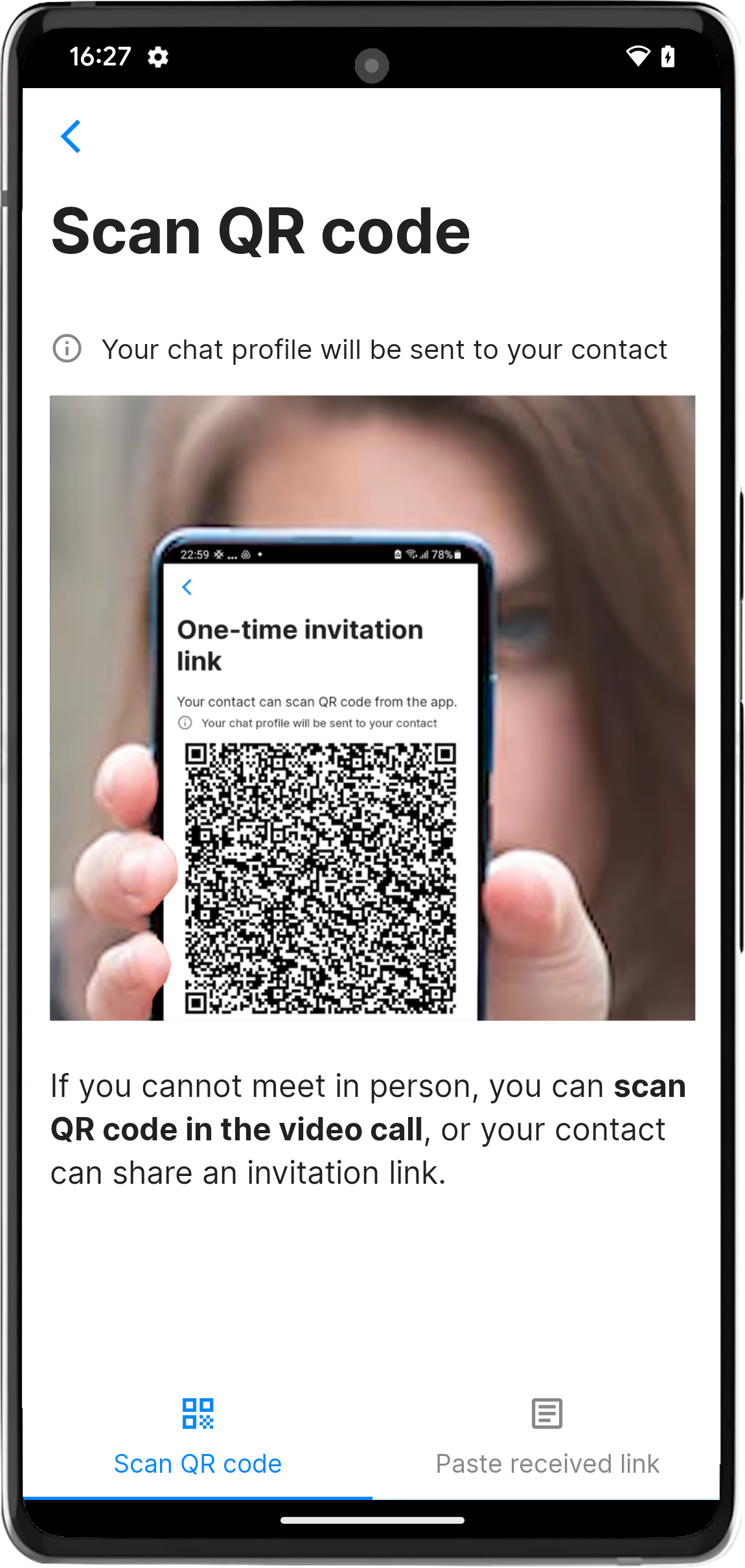

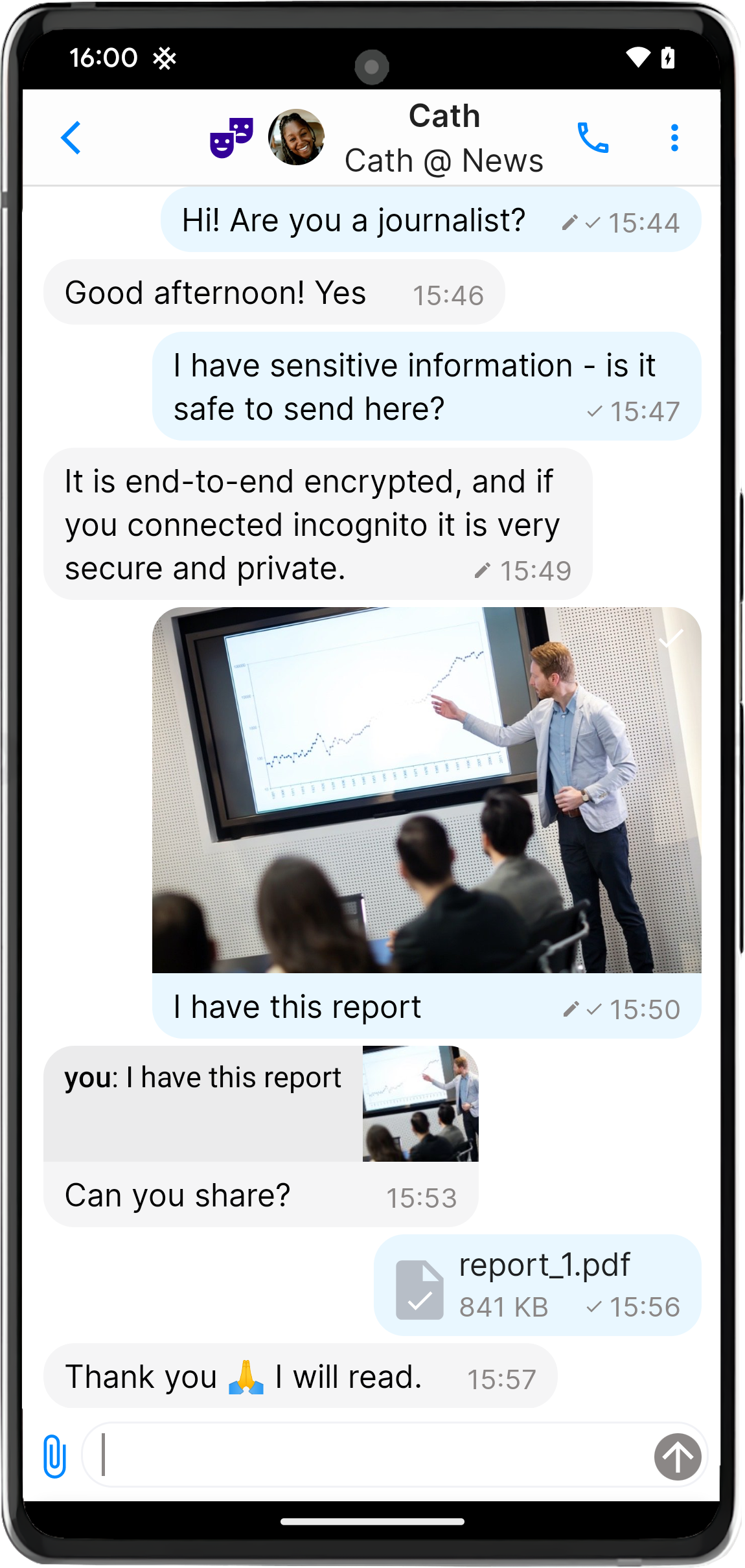
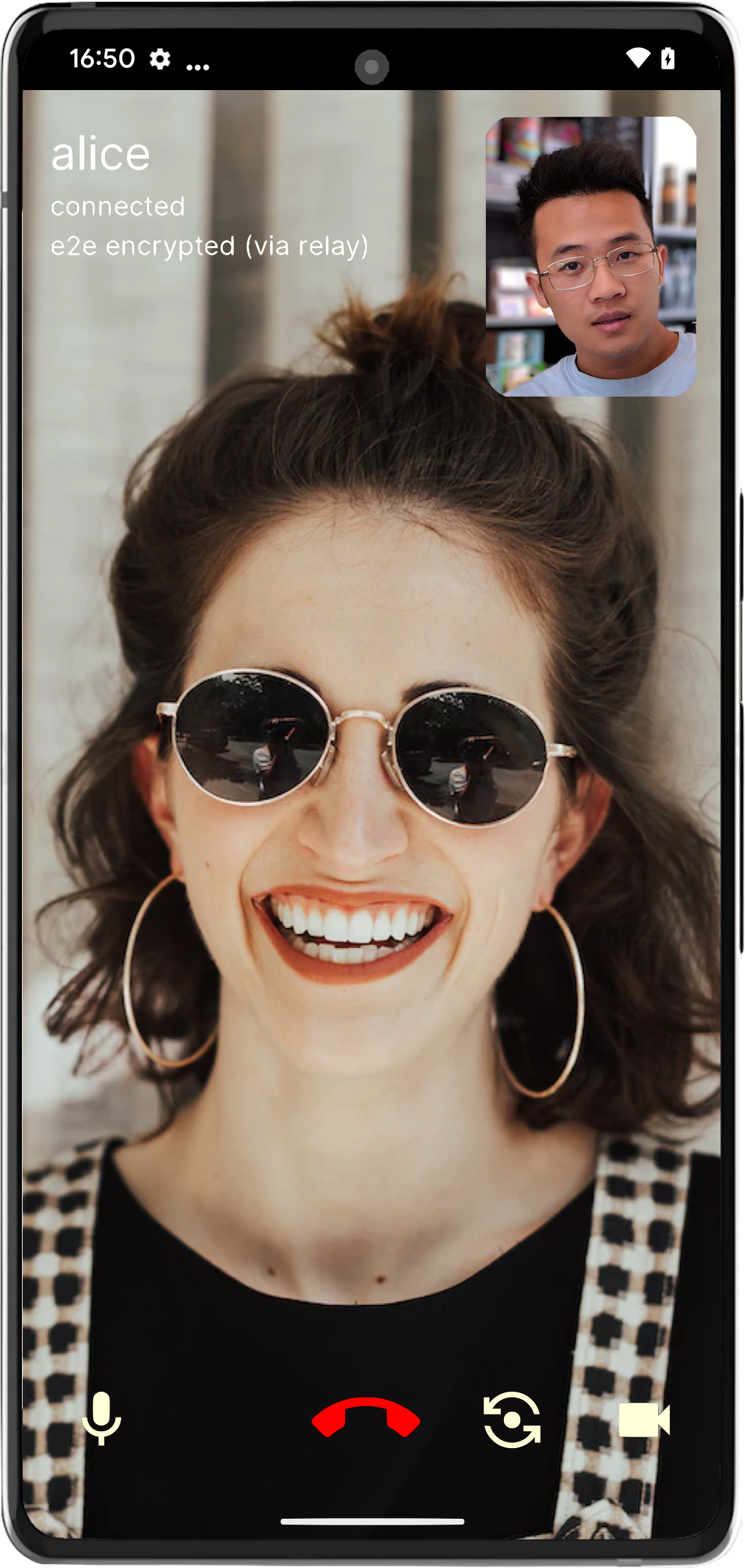
After you connect, you can verify connection security code.
User guide (NEW)
Read about the app features and settings in the new User guide.
Contribute
We would love to have you join the development! You can help us with:
- develop a chat bot for SimpleX Chat!
- writing a tutorial or recipes about hosting servers, chat bots, etc.
- developing features - please connect to us via chat so we can help you get started.
Help translating SimpleX Chat
Thanks to our users and Weblate, SimpleX Chat apps, website and documents are translated to many other languages.
Join our translators to help SimpleX grow!
| locale | language | contributor | Android and iOS | website | Github docs |
|---|---|---|---|---|---|
| 🇬🇧 en | English | ✓ | ✓ | ✓ | |
| ar | العربية | jermanuts |  - |
 |
|
| 🇧🇬 bg | Български |   |
|||
| 🇨🇿 cs | Čeština | zen0bit |   |
 |
✓ |
| 🇩🇪 de | Deutsch | mlanp |   |
 |
|
| 🇪🇸 es | Español | Mateyhv |   |
 |
|
| 🇫🇮 fi | Suomi |   |
 |
||
| 🇫🇷 fr | Français | ishi_sama |   |
 |
✓ |
| 🇮🇱 he | עִברִית |  - |
|||
| 🇭🇺 hu | Magyar |  - |
|||
| 🇮🇹 it | Italiano | unbranched |   |
 |
|
| 🇯🇵 ja | 日本語 |   |
 |
||
| 🇳🇱 nl | Nederlands | mika-nl |   |
 |
|
| 🇵🇱 pl | Polski | BxOxSxS |   |
||
| 🇧🇷 pt-BR | Português |  - |
 |
||
| 🇷🇺 ru | Русский |   |
|||
| 🇹🇭 th | ภาษาไทย | titapa-punpun |   |
||
| 🇹🇷 tr | Türkçe |   |
|||
| 🇺🇦 uk | Українська |   |
 |
||
| 🇨🇳 zh-CHS | 简体中文 | sith-on-mars Float-hu |
  |
 |
Languages in progress: Arabic, Japanese, Korean, Portuguese and others. We will be adding more languages as some of the already added are completed – please suggest new languages, review the translation guide and get in touch with us!
Please support us with your donations
Huge thank you to everybody who donated to SimpleX Chat!
We are prioritizing users privacy and security - it would be impossible without your support.
Our pledge to our users is that SimpleX protocols are and will remain open, and in public domain, - so anybody can build the future implementations of the clients and the servers. We are building SimpleX platform based on the same principles as email and web, but much more private and secure.
Your donations help us raise more funds - any amount, even the price of the cup of coffee, would make a big difference for us.
It is possible to donate via:
- GitHub (commission-free) or OpenCollective (~10% commission).
- BTC: bc1q2gy6f02nn6vvcxs0pnu29tpnpyz0qf66505d4u
- XMR: 8A3ZWAXrrQddvnT1fPrtbK86ZAoM4nai3Gjg1LEow3JWcryJtovMnHYZnxTJpCLmAbfWbnPMeTzPmMBjAhyd4xoM89hYq1c
- BCH: bitcoincash:qq6c8vfvxqrk6rhdysgvkhqc24sggkfsx5nqvdlqcg
- ETH/USDT (Ethereum, Arbitrum One): 0xD7047Fe3Eecb2f2FF78d839dD927Be27Bc12c86a (donate.simplexchat.eth)
- ZEC: t1fwjQW5gpFhDqXNhxqDWyF9j9WeKvVS5Jg
- ZEC shielded: u16rnvkflumf5uw9frngc2lymvmzgdr2mmc9unyu0l44unwfmdcpfm0axujd2w34ct3ye709azxsqge45705lpvvqu264ltzvfay55ygyq
- DOGE: D99pV4n9TrPxBPCkQGx4w4SMSa6QjRBxPf
- SOL: 7JCf5m3TiHmYKZVr6jCu1KeZVtb9Y1jRMQDU69p5ARnu
- please ask if you want to donate any other coins.
Thank you,
Evgeny
SimpleX Chat founder
Contents
- Why privacy matters
- SimpleX approach to privacy and security
- Frequently asked questions
- News and updates
- Quick installation of a terminal app
- SimpleX Platform design
- Privacy and security: technical details and limitations
- For developers
- Develop a chat bot
- Agents
- Roadmap
- Disclaimers, Security contact, License
Why privacy matters
Everyone should care about privacy and security of their communications - innocuous conversations can put you in danger even if there is nothing to hide.
One of the most shocking stories is the experience of Mohamedou Ould Salahi that he wrote about in his memoir and that is shown in The Mauritanian movie. He was put into Guantanamo camp, without trial, and was tortured there for 15 years after a phone call to his relative in Afghanistan, under suspicion of being involved in 9/11 attacks, even though he lived in Germany for the 10 years prior to the attacks.
It is not enough to use an end-to-end encrypted messenger, we all should use the messengers that protect the privacy of our personal networks - who we are connected with.
SimpleX approach to privacy and security
Complete privacy of your identity, profile, contacts and metadata
Unlike any other existing messaging platform, SimpleX has no identifiers assigned to the users - not even random numbers. This protects the privacy of who are you communicating with, hiding it from SimpleX platform servers and from any observers. Read more.
The best protection against spam and abuse
As you have no identifier on SimpleX platform, you cannot be contacted unless you share a one-time invitation link or an optional temporary user address. Read more.
Complete ownership, control and security of your data
SimpleX stores all user data on client devices, the messages are only held temporarily on SimpleX relay servers until they are received. Read more.
Users own SimpleX network
You can use SimpleX with your own servers and still communicate with people using the servers that are pre-configured in the apps or any other SimpleX servers. Read more.
Frequently asked questions
-
How SimpleX can deliver messages without any user identifiers? See v2 release announcement explaining how SimpleX works.
-
Why should I not just use Signal? Signal is a centralized platform that uses phone numbers to identify its users and their contacts. It means that while the content of your messages on Signal is protected with robust end-to-end encryption, there is a large amount of meta-data visible to Signal - who you talk with and when.
-
How is it different from Matrix, Session, Ricochet, Cwtch, etc., that also don't require user identities? Although these platforms do not require a real identity, they do rely on anonymous user identities to deliver messages – it can be, for example, an identity key or a random number. Using a persistent user identity, even anonymous, creates a risk that user's connection graph becomes known to the observers and/or service providers, and it can lead to de-anonymizing some users. If the same user profile is used to connect to two different people via any messenger other than SimpleX, these two people can confirm if they are connected to the same person - they would use the same user identifier in the messages. With SimpleX there is no meta-data in common between your conversations with different contacts - the quality that no other messaging platform has.
News and updates
Recent and important updates:
Aug 20, 2026. Equity Crowdfunding Launched - You Can Get a Stake in SimpleX Chat
Jul 22, 2026. SimpleX Public Names — a Name Nobody Can Take From You
Jan 14, 2025. SimpleX network: large groups and privacy-preserving content moderation
Mar 14, 2024. SimpleX Chat v5.6 beta: adding quantum resistance to Signal double ratchet algorithm.
Apr 22, 2023. SimpleX Chat: vision and funding, v5.0 released with videos and files up to 1gb.
⚡ Quick installation of a terminal app
curl -o- https://raw.githubusercontent.com/simplex-chat/simplex-chat/stable/install.sh | bash
Once the chat client is installed, simply run simplex-chat from your terminal.

Read more about installing and using the terminal app.
SimpleX Platform design
SimpleX is a client-server network with a unique network topology that uses redundant, disposable message relay nodes to asynchronously pass messages via unidirectional (simplex) message queues, providing recipient and sender anonymity.
Unlike P2P networks, all messages are passed through one or several server nodes, that do not even need to have persistence. In fact, the current SMP server implementation uses in-memory message storage, persisting only the queue records. SimpleX provides better metadata protection than P2P designs, as no global participant identifiers are used to deliver messages, and avoids the problems of P2P networks.
Unlike federated networks, the server nodes do not have records of the users, do not communicate with each other and do not store messages after they are delivered to the recipients. There is no way to discover the full list of servers participating in SimpleX network. This design avoids the problem of metadata visibility that all federated networks have and better protects from the network-wide attacks.
Only the client devices have information about users, their contacts and groups.
See SimpleX whitepaper for more information on platform objectives and technical design.
See SimpleX Chat Protocol for the format of messages sent between chat clients over SimpleX Messaging Protocol.
Privacy and security: technical details and limitations
SimpleX Chat is a work in progress – we are releasing improvements as they are ready. You have to decide if the current state is good enough for your usage scenario.
We compiled a glossary of terms used to describe communication systems to help understand some terms below and to help compare advantages and disadvantages of various communication systems.
What is already implemented:
- Instead of user profile identifiers used by all other platforms, even the most private ones, SimpleX uses pairwise per-queue identifiers (2 addresses for each unidirectional message queue, with an optional 3rd address for push notifications on iOS, 2 queues in each connection between the users). It makes observing the network graph on the application level more difficult, as for
nusers there can be up ton * (n-1)message queues. - End-to-end encryption in each message queue using NaCl cryptobox. This is added to allow redundancy in the future (passing each message via several servers), to avoid having the same ciphertext in different queues (that would only be visible to the attacker if TLS is compromised). The encryption keys used for this encryption are not rotated, instead we are planning to rotate the queues. Curve25519 keys are used for key negotiation.
- Double ratchet end-to-end encryption in each conversation between two users (or group members). This is the same algorithm that is used in Signal and many other messaging apps; it provides OTR messaging with forward secrecy (each message is encrypted by its own ephemeral key) and break-in recovery (the keys are frequently re-negotiated as part of the message exchange). Two pairs of Curve448 keys are used for the initial key agreement, initiating party passes these keys via the connection link, accepting side - in the header of the confirmation message.
- Post-quantum resistant key exchange in double ratchet protocol on every ratchet step. Read more in this post and also see this publication by Apple explaining the need for post-quantum key rotation.
- Additional layer of encryption using NaCL cryptobox for the messages delivered from the server to the recipient. This layer avoids having any ciphertext in common between sent and received traffic of the server inside TLS (and there are no identifiers in common as well).
- Several levels of content padding to frustrate message size attacks.
- All message metadata, including the time when the message was received by the server (rounded to a second) is sent to the recipients inside an encrypted envelope, so even if TLS is compromised it cannot be observed.
- Only TLS 1.2/1.3 are allowed for client-server connections, limited to cryptographic algorithms: CHACHA20POLY1305_SHA256, Ed25519/Ed448, Curve25519/Curve448.
- To protect against replay attacks SimpleX servers require tlsunique channel binding as session ID in each client command signed with per-queue ephemeral key.
- To protect your IP address from unknown messaging relays, and for per-message transport anonymity (compared with Tor/VPN per-connection anonymity), from v6.0 all SimpleX Chat clients use private message routing by default. Read more in this post.
- To protect your IP address from unknown file relays, when SOCKS proxy is not enabled SimpleX Chat clients ask for a confirmation before downloading the files from unknown servers.
- To protect your IP address from known servers all SimpleX Chat clients support accessing messaging servers via Tor - see v3.1 release announcement for more details.
- Local database encryption with passphrase - your contacts, groups and all sent and received messages are stored encrypted. If you used SimpleX Chat before v4.0 you need to enable the encryption via the app settings.
- Transport isolation - different TCP connections and Tor circuits are used for traffic of different user profiles, optionally - for different contacts and group member connections.
- Manual messaging queue rotations to move conversation to another SMP relay.
- Sending end-to-end encrypted files using XFTP protocol.
- Local files encryption.
- Reproducible server builds.
We plan to add:
- Automatic message queue rotation and redundancy. Currently the queues created between two users are used until the queue is manually changed by the user or contact is deleted. We are planning to add automatic queue rotation to make these identifiers temporary and rotate based on some schedule TBC (e.g., every X messages, or every X hours/days).
- Message "mixing" - adding latency to message delivery, to protect against traffic correlation by message time.
- Reproducible clients builds – this is a complex problem, but we are aiming to have it in 2025 at least partially.
- Recipients' XFTP relays to reduce traffic and conceal IP addresses from the relays chosen, and potentially controlled, by another party.
For developers
You can:
- create chat bots and services.
- run simplex-chat terminal CLI to execute individual chat commands, e.g. to send messages as part of shell script execution.
- use SimpleX Chat library to integrate chat functionality into your mobile apps.
- create chat bots and services in Haskell - see simple and more advanced chat bot example.
If you are considering developing with SimpleX platform please get in touch for any advice and support.
Please also join #simplex-devs group to ask any questions and share your success stories.
Develop a chat bot
You can create a chat bot or any chat-based service in any language running SimpleX Chat terminal CLI as a local WebSocket server.
See our new bot API reference. Most of it is automatically generated from core library types, so it stays up to date.
Also see TypeScript SimpleX Chat client and JavaScript chat bot example.
Agents
- For AI assistants: simplex.chat/llms.txt, an index of the documentation in Markdown, and SimpleX for AI agents and developers.
- Every page of simplex.chat is also available as Markdown: replace
.htmlwith.md(simplex.chat/docs/simplex.md), or add.mdto the path (simplex.chat/why.md). - Libraries: Node.js (npm) and Python (PyPI).
- Bot API guide and API reference: commands, events and types.
- Example bots: support bot and calculator in TypeScript, support bot light in Python, directory service and broadcast bot in Haskell.
- Terminal client: installation, building from source and usage.
- Servers: SMP, XFTP and chat relay.
- Protocols: SimpleX network, chat, channels and public names.
- For coding agents working in this repository: project structure and coding and building.
Roadmap
- ✅ Easy to deploy SimpleX server with in-memory message storage, without any dependencies.
- ✅ Terminal (console) client with groups and files support.
- ✅ One-click SimpleX server deployment on Linode.
- ✅ End-to-end encryption using double-ratchet protocol with additional encryption layer.
- ✅ Mobile apps v1 for Android and iOS.
- ✅ Private instant notifications for Android using background service.
- ✅ Haskell chat bot templates.
- ✅ v2.0 - supporting images and files in mobile apps.
- ✅ Manual chat history deletion.
- ✅ End-to-end encrypted WebRTC audio and video calls via the mobile apps.
- ✅ Privacy preserving instant notifications for iOS using Apple Push Notification service.
- ✅ Chat database export and import.
- ✅ Chat groups in mobile apps.
- ✅ Connecting to messaging servers via Tor.
- ✅ Dual server addresses to access messaging servers as v3 hidden services.
- ✅ Chat server and TypeScript client SDK to develop chat interfaces, integrations and chat bots (ready for announcement).
- ✅ Incognito mode to share a new random name with each contact.
- ✅ Chat database encryption.
- ✅ Automatic chat history deletion.
- ✅ Links to join groups and improve groups stability.
- ✅ Voice messages (with recipient opt-out per contact).
- ✅ Basic authentication for SMP servers (to authorize creating new queues).
- ✅ View deleted messages, full message deletion by sender (with recipient opt-in per contact).
- ✅ Block screenshots and view in recent apps.
- ✅ Advanced server configuration.
- ✅ Disappearing messages (with recipient opt-in per-contact).
- ✅ "Live" messages.
- ✅ Contact verification via a separate out-of-band channel.
- ✅ Multiple user profiles in the same chat database.
- ✅ Optionally avoid re-using the same TCP session for multiple connections.
- ✅ Preserve message drafts.
- ✅ File server to optimize for efficient and private sending of large files.
- ✅ Improved audio & video calls.
- ✅ Support older Android OS and 32-bit CPUs.
- ✅ Hidden chat profiles.
- ✅ Sending and receiving large files via XFTP protocol.
- ✅ Video messages.
- ✅ App access passcode.
- ✅ Improved Android app UI design.
- ✅ Optional alternative access password.
- ✅ Message reactions
- ✅ Message editing history
- ✅ Reduced battery and traffic usage in large groups.
- ✅ Message delivery confirmation (with sender opt-out per contact).
- ✅ Desktop client.
- ✅ Encryption of local files stored in the app.
- ✅ Using mobile profiles from the desktop app.
- ✅ Private notes.
- ✅ Improve sending videos (including encryption of locally stored videos).
- ✅ Post-quantum resistant key exchange in double ratchet protocol.
- ✅ Message delivery relay for senders (to conceal IP address from the recipients' servers and to reduce the traffic).
- ✅ Support multiple network operators in the app.
- 🏗 Large groups, communities and public channels.
- 🏗 Short links to connect and join groups.
- 🏗 Improve stability and reduce battery usage.
- 🏗 Improve experience for the new users.
- Privacy & security slider - a simple way to set all settings at once.
- SMP queue redundancy and rotation (manual is supported).
- Include optional message into connection request sent via contact address.
- Improved navigation and search in the conversation (expand and scroll to quoted message, scroll to search results, etc.).
- Feeds/broadcasts.
- Ephemeral/disappearing/OTR conversations with the existing contacts.
- Privately share your location.
- Web widgets for custom interactivity in the chats.
- Programmable chat automations / rules (automatic replies/forward/deletion/sending, reminders, etc.).
- Privacy-preserving identity server for optional DNS-based contact/group addresses to simplify connection and discovery, but not used to deliver messages:
- keep all your contacts and groups even if you lose the domain.
- the server doesn't have information about your contacts and groups.
- High capacity multi-node SMP relays.
Disclaimers
SimpleX protocols and security model was reviewed, and had many breaking changes and improvements in v1.0.0.
The implementation security assessment of SimpleX cryptography and networking was done in October 2022 by Trail of Bits – see the announcement.
The cryptographic review of SimpleX protocols was done in July 2024 by Trail of Bits – see the announcement.
SimpleX Chat is still a relatively early stage platform (the mobile apps were released in March 2022), so you may discover some bugs and missing features. We would really appreciate if you let us know anything that needs to be fixed or improved.
The default servers configured in the app are provided on the best effort basis. We are currently not guaranteeing any SLAs, although historically our servers had over 99.9% uptime each.
We have never provided or have been requested access to our servers or any information from our servers by any third parties. If we are ever requested to provide such access or information, we will be following due legal process.
We do not log IP addresses of the users and we do not perform any traffic correlation on our servers. If transport level security is critical you must use Tor or some other similar network to access messaging servers. We will be improving the client applications to reduce the opportunities for traffic correlation.
Please read more in Privacy Policy.
Security contact
Please see our Security Policy on how to report security vulnerabilities to us. We will coordinate the fix and disclosure.
Please do NOT report security vulnerabilities via GitHub issues.
License
This software is licensed under the GNU Affero General Public License version 3 (AGPLv3). See the LICENSE file for details. The SimpleX and SimpleX Chat name, logo, associated branding materials, and application and website graphic assets (illustrations, images, visual designs, etc.) are not covered by this license and are subject to the terms outlined in the TRADEMARK and ASSETS_LICENSE files respectively.
If you want to use any graphic assets in your publications, please ask for permission. Texts can be used as direct quotes, referencing the source.