 Narasimha-scandEvgeny Poberezkin
bf905eb545
Narasimha-scandEvgeny Poberezkin
bf905eb545
* android, desktop: settings navigation reorganization

Restructure the root Settings screen into two top-level sections and
fold previously-scattered items into three new sub-screens.

Root:
- Appearance, Your privacy, Chat data
- Help & support, Migrate to another device, Advanced settings

Your privacy (renamed from Privacy & security): keeps Device,
link previews / remove tracking, auto-accept images, blur media,
contact requests from groups. Adds a "More privacy" sub-screen.

More privacy (new): show last messages, message draft, encrypt local
files, protect IP address (with original dynamic footer preserved),
notification preview mode (moved from Notifications), and delivery
receipts.

Help & support (new): merges Help and Support SimpleX Chat sections
into Help / About (with App version) / Contact / Support the project.

Advanced settings (new): Network & servers, Notifications (Android),
Audio & video calls; then Developer tools, Restart and Shutdown
(Android), App update channel (desktop). Notifications is hidden on
desktop because the screen is empty after Show preview moves to
More privacy.

Chat data is the new top-level menu label for the existing
Database passphrase & export screen.

* android, desktop: trim settings reorg diff

- Remove 5 dead strings from base/strings.xml (privacy_and_security,
  database_passphrase_and_export, settings_section_title_chat_database,
  settings_section_title_support, settings_section_title_app) — no
  Kotlin references after the reorg.
- Drop the now single-variant CurrentPage enum in
  NotificationsSettingsView; replace with a direct callback.
- Read userDisplayName locally in HelpAndSupportView instead of
  threading it through SettingsLayout/SettingsView/Preview.

* android, desktop: remove orphan locale strings

Companion to 442a368c9 which removed 5 dead keys from base/strings.xml.
The :common:adjustFormatting task enforces that every locale string has
a corresponding base entry, so these orphans broke the build. Removed
across 35 locale files (154 lines).

Keys removed:
- privacy_and_security
- database_passphrase_and_export
- settings_section_title_chat_database
- settings_section_title_support
- settings_section_title_app

* Revert "android, desktop: remove orphan locale strings"

This reverts commit 0ad5fc9308a3599d15bf50ca1980002ae0e467b2.

* android, desktop: restore base strings for removed keys

Counterpart to revert of 0ad5fc930: re-add the 5 base entries that
442a368c9 had deleted so the locale files (restored by the prior revert)
are no longer orphaned. Translation keys must not be removed once
introduced — the values can change but the keys stay.

Keys restored to base with their master English values:
- database_passphrase_and_export
- privacy_and_security
- settings_section_title_chat_database
- settings_section_title_support
- settings_section_title_app

* android, desktop: keep share-button helpers in SettingsView

ContributeItem, RateAppItem, StarOnGithubItem were moved from
SettingsView.kt to HelpAndSupportView.kt as part of the reorg.
Move them back: just drop the `private` modifier (one-word edit
per function) so HelpAndSupportView can call them in place. Saves
~60 lines of diff churn vs the move + matches the file's existing
pattern where helpers like AppVersionItem, ChatPreferencesItem,
ChatLockItem, etc. are all public top-level @Composable.

* android, desktop: inline HelpAndSupportView into SettingsView.kt

HelpAndSupportView is the only call site of SettingsView.kt's
share-button helpers; placing it as a top-level @Composable in
SettingsView.kt keeps the help/about/contact/support flow next to
the other settings entry points and removes the need for a new file.
Three imports (BuildConfigCommon, SimpleXInfo, WhatsNewView) that
the reorg was deleting from SettingsView.kt stay in place. Saves
~35 lines of diff and one new file.

* android, desktop: inline AdvancedSettingsView into SettingsView.kt

Same treatment as HelpAndSupportView in the previous commit:
AdvancedSettingsView is only reached from SettingsLayout, so the
function and its expect declaration live as top-level @Composable
in SettingsView.kt instead of a new file. NetworkAndServersView
import that the reorg was deleting from SettingsView.kt stays.
The .android.kt / .desktop.kt actuals are unchanged and keep
implementing the (now relocated) expect. Saves ~15 lines and a file.

* ios: settings navigation reorganization

Mirror the multiplatform reorg on iOS:

Root SettingsView: collapse the 5 sections into 2 unlabeled groups —
{Appearance, Your privacy, Chat data} and {Help & support, Migrate to
another device, Advanced settings}. "Privacy & security" becomes
"Your privacy"; the database row label becomes "Chat data".

PrivacySettings: keeps Device, link previews / remove tracking,
auto-accept images, blur media, contact requests from groups. Adds a
"More privacy" link.

MorePrivacy (new, inlined in PrivacySettings.swift): show last
messages, message draft, encrypt local files, protect IP address
(with original dynamic footer preserved), notification preview mode
(moved from NotificationsView), delivery receipts. Own state and
private helpers for the moved set* functions.

HelpAndSupportView (new, inlined in SettingsView.swift): merges Help
and Support sections into Help / About (with App version) / Contact /
Support the project.

AdvancedSettingsView (new, inlined in SettingsView.swift): Network &
servers, Notifications, Audio & video calls, Developer tools. iOS has
no Restart/Shutdown (Android-only) or App update channel (desktop).

NotificationsView: "Show preview" navigation removed — it now lives
in MorePrivacy. notificationsIcon() promoted to a free function so
AdvancedSettingsView can render the notifications status badge.

* android, desktop: keep platform file names as SettingsView.{android,desktop}.kt

Revert the file renames from {Advanced}SettingsView.{android,desktop}.kt.
Function rename SettingsSectionApp → AdvancedSettingsAppSection stays
inside each file; only the file path returns to its original name. No
behavior change; diff stat now shows two in-place modifications instead
of renames.

* ios: keep PrivacySettings/SettingsView state in place, use inline destinations

Restructure the iOS reorg to avoid moving state, helpers, and the alert
enum out of PrivacySettings — and to avoid moving notificationsIcon
out of SettingsView. The Help & Support, Advanced Settings, and
More Privacy "screens" become private computed properties on their
parent struct, so all @AppStorage, @State, set* helpers, and the
PrivacySettingsViewAlert enum stay UNCHANGED from master. NavigationLink
destinations reference the computed properties directly.

Net iOS diff vs master: 220+/154- (was 361+/259-) — saves ~245 lines.

* simplex settings

* android, desktop: mirror iOS settings reorganization

- inline Advanced settings section into the main settings list (Network &
  servers, Notifications, Audio & video calls, App version); remove the
  separate Advanced settings page
- reorder first section: Appearance, Your privacy, Help & support, Chat data,
  Migrate; merge About SimpleX Chat into the Help section
- move the developer/maintenance section under App version (VersionInfoView);
  load core version inside the view so it always opens (Developer tools and
  Shutdown stay reachable even if the version request fails)
- keep "Developer tools" label (not renamed to "Developer")
- replace the Restart row with Cancel/Restart/Shutdown options in the
  Shutdown dialog
- split DatabaseView: "Chat data" page (messages TTL, Database passphrase &
  export, Files & media) and a sub-page with passphrase/export/import/delete
  and the Run chat toggle; rename title to "Chat data"
- align delivery receipts alert wording with the renamed "Your privacy" settings

* android, desktop: simplify settings reorg internals

- VersionInfoView: drop the section/card wrapping, keep the original plain
  version-text layout; load core version in-view so the screen always opens
- DatabaseView: make the "Database passphrase & export" sub-page a
  self-contained DatabaseManagementView that owns its own state, mirroring the
  DatabaseView/DatabaseLayout pattern instead of threading params through a modal

* android, desktop: show App version screen as a card screen

VersionInfoView now hosts a settings section (Developer tools / updates), so
open it with cardScreen = true like the other settings screens — otherwise the
section renders without the card box around it.

* android, desktop: show "Rate the app" only on mobile

The action opens a Play Store link, which does nothing on desktop (the
market:// scheme has no handler and the web fallback never fires). Gate it to
Android, like the Contribute item.

* android, desktop: move Shutdown to settings above app version

Move the Shutdown action out of the app version screen into the main
advanced settings section, just above the app version row. It stays
Android only (desktop is closed via the window) through an
AppShutdownItem expect/actual.

* android, desktop: show app version info in its own card

Wrap the version info block on the app version screen in a section card,
matching iOS and the rest of the card-screen settings.

* fix background

---------

Co-authored-by: Evgeny Poberezkin <evgeny@poberezkin.com>





| 30/03/2023 | EN, FR, CZ, PL |

SimpleX - the first messaging platform that has no user identifiers of any kind - 100% private by design!


Why we are building SimpleX Network
Welcome to SimpleX Chat!
- 📲 Install the app.
- ↔️ Connect to the team, join user groups and follow our updates.
- 🤝 Make a private connection with a friend.
- 🔤 Help translating SimpleX Chat.
- ⚡️ Contribute and support us with donations.
Learn more about SimpleX Chat.
Install the app





- 🖲 Protects your messages and metadata - who you talk to and when.
- 🔐 Double ratchet end-to-end encryption, with additional encryption layer.
- 📱 Mobile apps for Android (Google Play, APK) and iOS.
- 🚀 TestFlight preview for iOS with the new features 1-2 weeks earlier - limited to 10,000 users!
- 🖥 Available as a terminal (console) app / CLI on Linux, MacOS, Windows.
Connect to the team
You can connect to the team via the app using "chat with the developers button" available when you have no conversations in the profile, "Send questions and ideas" in the app settings or via our SimpleX address. Please connect to:
- to ask any questions
- to suggest any improvements
- to share anything relevant
We are replying the questions manually, so it is not instant – it can take up to 24 hours.
If you are interested in helping us to integrate open-source language models, and in joining our team, please get in touch.
Join user groups
You can find the groups created by users in SimpleX Directory. It is also available as SimpleX bot that allows to add your own groups and communities to the directory. We are not responsible for the content shared in these groups.
Please note: The groups below are created for the users to be able to ask questions, make suggestions and ask questions about SimpleX Chat only.
You can join an English-speaking users group if you want to ask any questions: #SimpleX users group
There is also a group #simplex-devs for developers who build on SimpleX platform:
- chat bots and automations
- integrations with other apps
- social apps and services
- etc.
You can join these and other groups by opening these links in the app or by opening them in a desktop browser and scanning the QR code.
Follow our updates
We publish our updates and releases via:
- Reddit, Twitter, Lemmy, Mastodon and Nostr.
- SimpleX Chat team profile.
- blog and RSS feed.
- mailing list, very rarely.
Make a private connection
You need to share a link with your friend or scan a QR code from their phone, in person or during a video call, to make a connection and start messaging.
The channel through which you share the link does not have to be secure - it is enough that you can confirm who sent you the message and that your SimpleX connection is established.
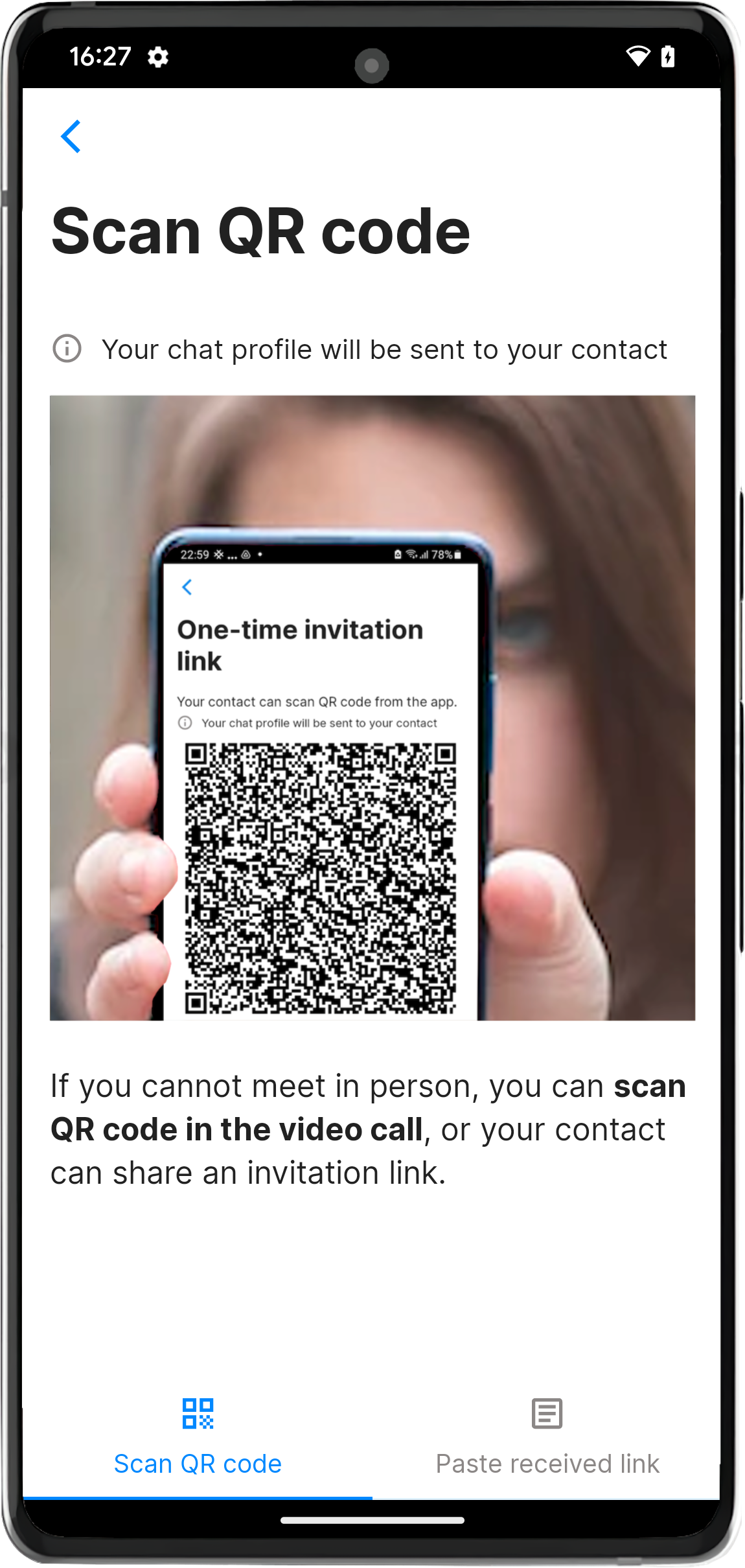

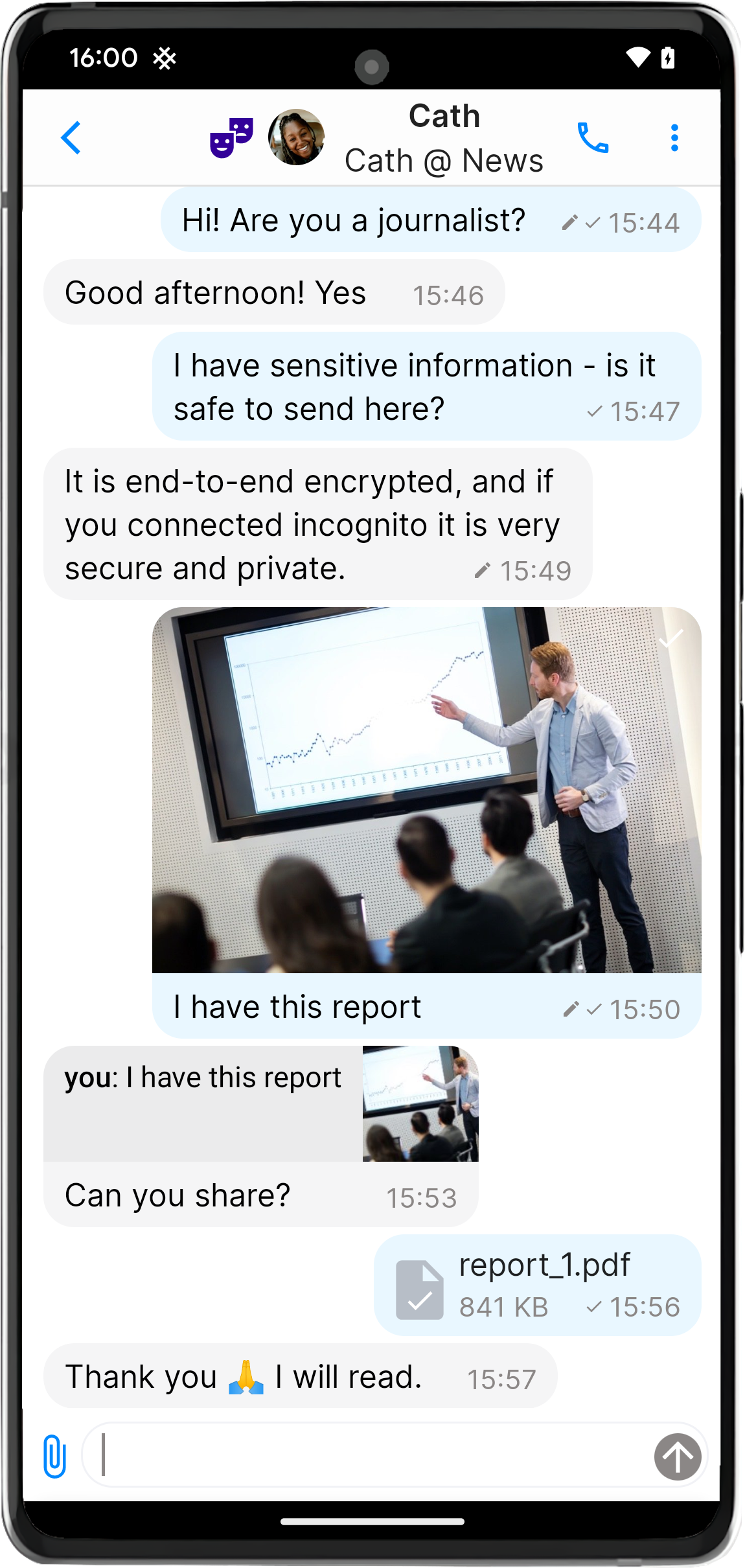
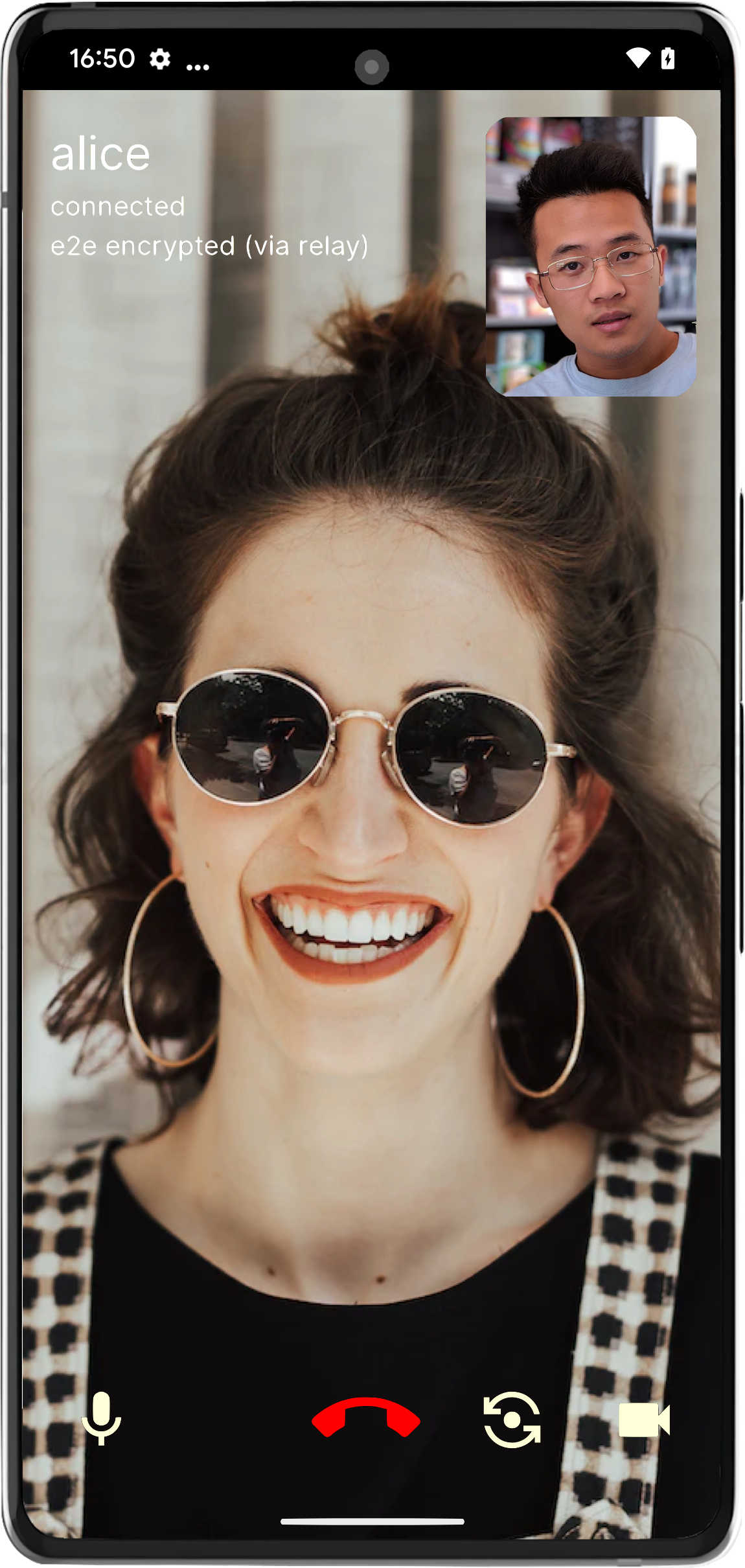
After you connect, you can verify connection security code.
User guide (NEW)
Read about the app features and settings in the new User guide.
Contribute
We would love to have you join the development! You can help us with:
- develop a chat bot for SimpleX Chat!
- writing a tutorial or recipes about hosting servers, chat bots, etc.
- developing features - please connect to us via chat so we can help you get started.
Help translating SimpleX Chat
Thanks to our users and Weblate, SimpleX Chat apps, website and documents are translated to many other languages.
Join our translators to help SimpleX grow!
| locale | language | contributor | Android and iOS | website | Github docs |
|---|---|---|---|---|---|
| 🇬🇧 en | English | ✓ | ✓ | ✓ | |
| ar | العربية | jermanuts |  - |
 |
|
| 🇧🇬 bg | Български |   |
|||
| 🇨🇿 cs | Čeština | zen0bit |   |
 |
✓ |
| 🇩🇪 de | Deutsch | mlanp |   |
 |
|
| 🇪🇸 es | Español | Mateyhv |   |
 |
|
| 🇫🇮 fi | Suomi |   |
 |
||
| 🇫🇷 fr | Français | ishi_sama |   |
 |
✓ |
| 🇮🇱 he | עִברִית |  - |
|||
| 🇭🇺 hu | Magyar |  - |
|||
| 🇮🇹 it | Italiano | unbranched |   |
 |
|
| 🇯🇵 ja | 日本語 |   |
 |
||
| 🇳🇱 nl | Nederlands | mika-nl |   |
 |
|
| 🇵🇱 pl | Polski | BxOxSxS |   |
||
| 🇧🇷 pt-BR | Português |  - |
 |
||
| 🇷🇺 ru | Русский |   |
|||
| 🇹🇭 th | ภาษาไทย | titapa-punpun |   |
||
| 🇹🇷 tr | Türkçe |   |
|||
| 🇺🇦 uk | Українська |   |
 |
||
| 🇨🇳 zh-CHS | 简体中文 | sith-on-mars Float-hu |
  |
 |
Languages in progress: Arabic, Japanese, Korean, Portuguese and others. We will be adding more languages as some of the already added are completed – please suggest new languages, review the translation guide and get in touch with us!
Please support us with your donations
Huge thank you to everybody who donated to SimpleX Chat!
We are prioritizing users privacy and security - it would be impossible without your support.
Our pledge to our users is that SimpleX protocols are and will remain open, and in public domain, - so anybody can build the future implementations of the clients and the servers. We are building SimpleX platform based on the same principles as email and web, but much more private and secure.
Your donations help us raise more funds - any amount, even the price of the cup of coffee, would make a big difference for us.
It is possible to donate via:
- GitHub (commission-free) or OpenCollective (~10% commission).
- BTC: bc1q2gy6f02nn6vvcxs0pnu29tpnpyz0qf66505d4u
- XMR: 8A3ZWAXrrQddvnT1fPrtbK86ZAoM4nai3Gjg1LEow3JWcryJtovMnHYZnxTJpCLmAbfWbnPMeTzPmMBjAhyd4xoM89hYq1c
- BCH: bitcoincash:qq6c8vfvxqrk6rhdysgvkhqc24sggkfsx5nqvdlqcg
- ETH/USDT (Ethereum, Arbitrum One): 0xD7047Fe3Eecb2f2FF78d839dD927Be27Bc12c86a (donate.simplexchat.eth)
- ZEC: t1fwjQW5gpFhDqXNhxqDWyF9j9WeKvVS5Jg
- ZEC shielded: u16rnvkflumf5uw9frngc2lymvmzgdr2mmc9unyu0l44unwfmdcpfm0axujd2w34ct3ye709azxsqge45705lpvvqu264ltzvfay55ygyq
- DOGE: D99pV4n9TrPxBPCkQGx4w4SMSa6QjRBxPf
- SOL: 7JCf5m3TiHmYKZVr6jCu1KeZVtb9Y1jRMQDU69p5ARnu
- please ask if you want to donate any other coins.
Thank you,
Evgeny
SimpleX Chat founder
Contents
- Why privacy matters
- SimpleX approach to privacy and security
- Frequently asked questions
- News and updates
- Quick installation of a terminal app
- SimpleX Platform design
- Privacy and security: technical details and limitations
- For developers
- Develop a chat bot
- Roadmap
- Disclaimers, Security contact, License
Why privacy matters
Everyone should care about privacy and security of their communications - innocuous conversations can put you in danger even if there is nothing to hide.
One of the most shocking stories is the experience of Mohamedou Ould Salahi that he wrote about in his memoir and that is shown in The Mauritanian movie. He was put into Guantanamo camp, without trial, and was tortured there for 15 years after a phone call to his relative in Afghanistan, under suspicion of being involved in 9/11 attacks, even though he lived in Germany for the 10 years prior to the attacks.
It is not enough to use an end-to-end encrypted messenger, we all should use the messengers that protect the privacy of our personal networks - who we are connected with.
SimpleX approach to privacy and security
Complete privacy of your identity, profile, contacts and metadata
Unlike any other existing messaging platform, SimpleX has no identifiers assigned to the users - not even random numbers. This protects the privacy of who are you communicating with, hiding it from SimpleX platform servers and from any observers. Read more.
The best protection against spam and abuse
As you have no identifier on SimpleX platform, you cannot be contacted unless you share a one-time invitation link or an optional temporary user address. Read more.
Complete ownership, control and security of your data
SimpleX stores all user data on client devices, the messages are only held temporarily on SimpleX relay servers until they are received. Read more.
Users own SimpleX network
You can use SimpleX with your own servers and still communicate with people using the servers that are pre-configured in the apps or any other SimpleX servers. Read more.
Frequently asked questions
-
How SimpleX can deliver messages without any user identifiers? See v2 release announcement explaining how SimpleX works.
-
Why should I not just use Signal? Signal is a centralized platform that uses phone numbers to identify its users and their contacts. It means that while the content of your messages on Signal is protected with robust end-to-end encryption, there is a large amount of meta-data visible to Signal - who you talk with and when.
-
How is it different from Matrix, Session, Ricochet, Cwtch, etc., that also don't require user identities? Although these platforms do not require a real identity, they do rely on anonymous user identities to deliver messages – it can be, for example, an identity key or a random number. Using a persistent user identity, even anonymous, creates a risk that user's connection graph becomes known to the observers and/or service providers, and it can lead to de-anonymizing some users. If the same user profile is used to connect to two different people via any messenger other than SimpleX, these two people can confirm if they are connected to the same person - they would use the same user identifier in the messages. With SimpleX there is no meta-data in common between your conversations with different contacts - the quality that no other messaging platform has.
News and updates
Recent and important updates:
Jul 29, 2025 SimpleX Chat v6.4.1: welcome your contacts, review members to protect groups, and more.
Mar 8, 2025. SimpleX Chat v6.3: new user experience and safety in public groups
Jan 14, 2025. SimpleX network: large groups and privacy-preserving content moderation
Mar 14, 2024. SimpleX Chat v5.6 beta: adding quantum resistance to Signal double ratchet algorithm.
Apr 22, 2023. SimpleX Chat: vision and funding, v5.0 released with videos and files up to 1gb.
Nov 8, 2022. Security audit by Trail of Bits, the new website and v4.2 released.
⚡ Quick installation of a terminal app
curl -o- https://raw.githubusercontent.com/simplex-chat/simplex-chat/stable/install.sh | bash
Once the chat client is installed, simply run simplex-chat from your terminal.

Read more about installing and using the terminal app.
SimpleX Platform design
SimpleX is a client-server network with a unique network topology that uses redundant, disposable message relay nodes to asynchronously pass messages via unidirectional (simplex) message queues, providing recipient and sender anonymity.
Unlike P2P networks, all messages are passed through one or several server nodes, that do not even need to have persistence. In fact, the current SMP server implementation uses in-memory message storage, persisting only the queue records. SimpleX provides better metadata protection than P2P designs, as no global participant identifiers are used to deliver messages, and avoids the problems of P2P networks.
Unlike federated networks, the server nodes do not have records of the users, do not communicate with each other and do not store messages after they are delivered to the recipients. There is no way to discover the full list of servers participating in SimpleX network. This design avoids the problem of metadata visibility that all federated networks have and better protects from the network-wide attacks.
Only the client devices have information about users, their contacts and groups.
See SimpleX whitepaper for more information on platform objectives and technical design.
See SimpleX Chat Protocol for the format of messages sent between chat clients over SimpleX Messaging Protocol.
Privacy and security: technical details and limitations
SimpleX Chat is a work in progress – we are releasing improvements as they are ready. You have to decide if the current state is good enough for your usage scenario.
We compiled a glossary of terms used to describe communication systems to help understand some terms below and to help compare advantages and disadvantages of various communication systems.
What is already implemented:
- Instead of user profile identifiers used by all other platforms, even the most private ones, SimpleX uses pairwise per-queue identifiers (2 addresses for each unidirectional message queue, with an optional 3rd address for push notifications on iOS, 2 queues in each connection between the users). It makes observing the network graph on the application level more difficult, as for
nusers there can be up ton * (n-1)message queues. - End-to-end encryption in each message queue using NaCl cryptobox. This is added to allow redundancy in the future (passing each message via several servers), to avoid having the same ciphertext in different queues (that would only be visible to the attacker if TLS is compromised). The encryption keys used for this encryption are not rotated, instead we are planning to rotate the queues. Curve25519 keys are used for key negotiation.
- Double ratchet end-to-end encryption in each conversation between two users (or group members). This is the same algorithm that is used in Signal and many other messaging apps; it provides OTR messaging with forward secrecy (each message is encrypted by its own ephemeral key) and break-in recovery (the keys are frequently re-negotiated as part of the message exchange). Two pairs of Curve448 keys are used for the initial key agreement, initiating party passes these keys via the connection link, accepting side - in the header of the confirmation message.
- Post-quantum resistant key exchange in double ratchet protocol on every ratchet step. Read more in this post and also see this publication by Apple explaining the need for post-quantum key rotation.
- Additional layer of encryption using NaCL cryptobox for the messages delivered from the server to the recipient. This layer avoids having any ciphertext in common between sent and received traffic of the server inside TLS (and there are no identifiers in common as well).
- Several levels of content padding to frustrate message size attacks.
- All message metadata, including the time when the message was received by the server (rounded to a second) is sent to the recipients inside an encrypted envelope, so even if TLS is compromised it cannot be observed.
- Only TLS 1.2/1.3 are allowed for client-server connections, limited to cryptographic algorithms: CHACHA20POLY1305_SHA256, Ed25519/Ed448, Curve25519/Curve448.
- To protect against replay attacks SimpleX servers require tlsunique channel binding as session ID in each client command signed with per-queue ephemeral key.
- To protect your IP address from unknown messaging relays, and for per-message transport anonymity (compared with Tor/VPN per-connection anonymity), from v6.0 all SimpleX Chat clients use private message routing by default. Read more in this post.
- To protect your IP address from unknown file relays, when SOCKS proxy is not enabled SimpleX Chat clients ask for a confirmation before downloading the files from unknown servers.
- To protect your IP address from known servers all SimpleX Chat clients support accessing messaging servers via Tor - see v3.1 release announcement for more details.
- Local database encryption with passphrase - your contacts, groups and all sent and received messages are stored encrypted. If you used SimpleX Chat before v4.0 you need to enable the encryption via the app settings.
- Transport isolation - different TCP connections and Tor circuits are used for traffic of different user profiles, optionally - for different contacts and group member connections.
- Manual messaging queue rotations to move conversation to another SMP relay.
- Sending end-to-end encrypted files using XFTP protocol.
- Local files encryption.
- Reproducible server builds.
We plan to add:
- Automatic message queue rotation and redundancy. Currently the queues created between two users are used until the queue is manually changed by the user or contact is deleted. We are planning to add automatic queue rotation to make these identifiers temporary and rotate based on some schedule TBC (e.g., every X messages, or every X hours/days).
- Message "mixing" - adding latency to message delivery, to protect against traffic correlation by message time.
- Reproducible clients builds – this is a complex problem, but we are aiming to have it in 2025 at least partially.
- Recipients' XFTP relays to reduce traffic and conceal IP addresses from the relays chosen, and potentially controlled, by another party.
For developers
You can:
- create chat bots and services.
- run simplex-chat terminal CLI to execute individual chat commands, e.g. to send messages as part of shell script execution.
- use SimpleX Chat library to integrate chat functionality into your mobile apps.
- create chat bots and services in Haskell - see simple and more advanced chat bot example.
If you are considering developing with SimpleX platform please get in touch for any advice and support.
Please also join #simplex-devs group to ask any questions and share your success stories.
Develop a chat bot
You can create a chat bot or any chat-based service in any language running SimpleX Chat terminal CLI as a local WebSocket server.
See our new bot API reference. Most of it is automatically generated from core library types, so it stays up to date.
Also see TypeScript SimpleX Chat client and JavaScript chat bot example.
Roadmap
- ✅ Easy to deploy SimpleX server with in-memory message storage, without any dependencies.
- ✅ Terminal (console) client with groups and files support.
- ✅ One-click SimpleX server deployment on Linode.
- ✅ End-to-end encryption using double-ratchet protocol with additional encryption layer.
- ✅ Mobile apps v1 for Android and iOS.
- ✅ Private instant notifications for Android using background service.
- ✅ Haskell chat bot templates.
- ✅ v2.0 - supporting images and files in mobile apps.
- ✅ Manual chat history deletion.
- ✅ End-to-end encrypted WebRTC audio and video calls via the mobile apps.
- ✅ Privacy preserving instant notifications for iOS using Apple Push Notification service.
- ✅ Chat database export and import.
- ✅ Chat groups in mobile apps.
- ✅ Connecting to messaging servers via Tor.
- ✅ Dual server addresses to access messaging servers as v3 hidden services.
- ✅ Chat server and TypeScript client SDK to develop chat interfaces, integrations and chat bots (ready for announcement).
- ✅ Incognito mode to share a new random name with each contact.
- ✅ Chat database encryption.
- ✅ Automatic chat history deletion.
- ✅ Links to join groups and improve groups stability.
- ✅ Voice messages (with recipient opt-out per contact).
- ✅ Basic authentication for SMP servers (to authorize creating new queues).
- ✅ View deleted messages, full message deletion by sender (with recipient opt-in per contact).
- ✅ Block screenshots and view in recent apps.
- ✅ Advanced server configuration.
- ✅ Disappearing messages (with recipient opt-in per-contact).
- ✅ "Live" messages.
- ✅ Contact verification via a separate out-of-band channel.
- ✅ Multiple user profiles in the same chat database.
- ✅ Optionally avoid re-using the same TCP session for multiple connections.
- ✅ Preserve message drafts.
- ✅ File server to optimize for efficient and private sending of large files.
- ✅ Improved audio & video calls.
- ✅ Support older Android OS and 32-bit CPUs.
- ✅ Hidden chat profiles.
- ✅ Sending and receiving large files via XFTP protocol.
- ✅ Video messages.
- ✅ App access passcode.
- ✅ Improved Android app UI design.
- ✅ Optional alternative access password.
- ✅ Message reactions
- ✅ Message editing history
- ✅ Reduced battery and traffic usage in large groups.
- ✅ Message delivery confirmation (with sender opt-out per contact).
- ✅ Desktop client.
- ✅ Encryption of local files stored in the app.
- ✅ Using mobile profiles from the desktop app.
- ✅ Private notes.
- ✅ Improve sending videos (including encryption of locally stored videos).
- ✅ Post-quantum resistant key exchange in double ratchet protocol.
- ✅ Message delivery relay for senders (to conceal IP address from the recipients' servers and to reduce the traffic).
- ✅ Support multiple network operators in the app.
- 🏗 Large groups, communities and public channels.
- 🏗 Short links to connect and join groups.
- 🏗 Improve stability and reduce battery usage.
- 🏗 Improve experience for the new users.
- Privacy & security slider - a simple way to set all settings at once.
- SMP queue redundancy and rotation (manual is supported).
- Include optional message into connection request sent via contact address.
- Improved navigation and search in the conversation (expand and scroll to quoted message, scroll to search results, etc.).
- Feeds/broadcasts.
- Ephemeral/disappearing/OTR conversations with the existing contacts.
- Privately share your location.
- Web widgets for custom interactivity in the chats.
- Programmable chat automations / rules (automatic replies/forward/deletion/sending, reminders, etc.).
- Privacy-preserving identity server for optional DNS-based contact/group addresses to simplify connection and discovery, but not used to deliver messages:
- keep all your contacts and groups even if you lose the domain.
- the server doesn't have information about your contacts and groups.
- High capacity multi-node SMP relays.
Disclaimers
SimpleX protocols and security model was reviewed, and had many breaking changes and improvements in v1.0.0.
The implementation security assessment of SimpleX cryptography and networking was done in October 2022 by Trail of Bits – see the announcement.
The cryptographic review of SimpleX protocols was done in July 2024 by Trail of Bits – see the announcement.
SimpleX Chat is still a relatively early stage platform (the mobile apps were released in March 2022), so you may discover some bugs and missing features. We would really appreciate if you let us know anything that needs to be fixed or improved.
The default servers configured in the app are provided on the best effort basis. We are currently not guaranteeing any SLAs, although historically our servers had over 99.9% uptime each.
We have never provided or have been requested access to our servers or any information from our servers by any third parties. If we are ever requested to provide such access or information, we will be following due legal process.
We do not log IP addresses of the users and we do not perform any traffic correlation on our servers. If transport level security is critical you must use Tor or some other similar network to access messaging servers. We will be improving the client applications to reduce the opportunities for traffic correlation.
Please read more in Privacy Policy.
Security contact
Please see our Security Policy on how to report security vulnerabilities to us. We will coordinate the fix and disclosure.
Please do NOT report security vulnerabilities via GitHub issues.
License
This software is licensed under the GNU Affero General Public License version 3 (AGPLv3). See the LICENSE file for details. The SimpleX and SimpleX Chat name, logo, associated branding materials, and application and website graphic assets (illustrations, images, visual designs, etc.) are not covered by this license and are subject to the terms outlined in the TRADEMARK and ASSETS_LICENSE files respectively.
If you want to use any graphic assets in your publications, please ask for permission. Texts can be used as direct quotes, referencing the source.